

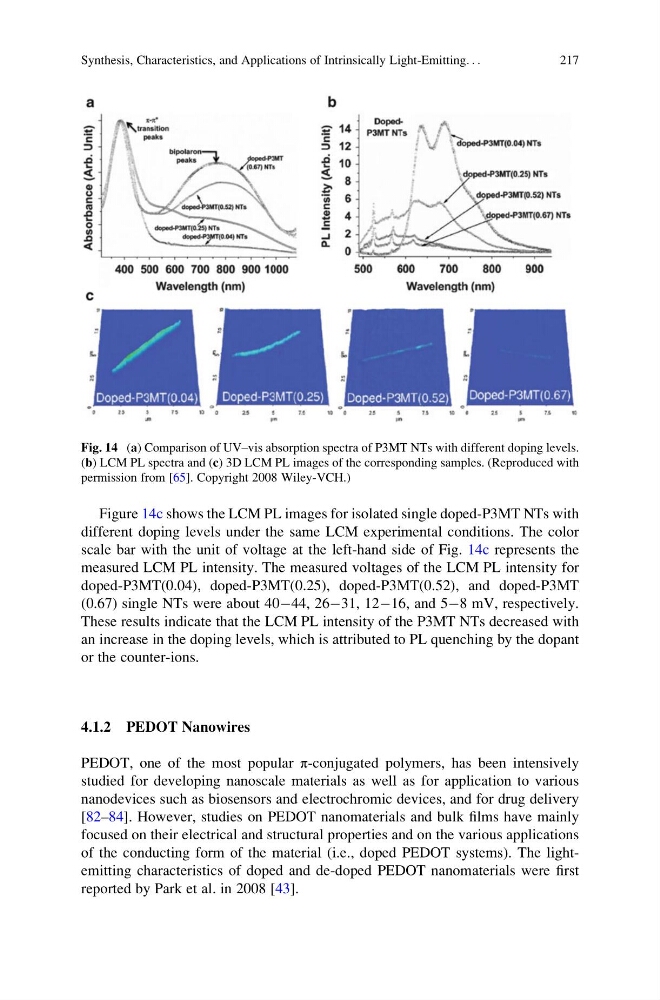
Figure 14c shows the LCM PL images for isolated single doped-P3MT NTs with
different doping levels under the same LCM experimental conditions. The color
scale bar with the unit of voltage at the left-hand side of Fig. 14c represents the
measured LCM PL intensity. The measured voltages of the LCM PL intensity for
doped-P3MT(0.04), doped-P3MT(0.25), doped-P3MT(0.52), and doped-P3MT
(0.67) single NTs were about 40À44, 26À31, 12À16, and 5À8 mV, respectively.
These results indicate that the LCM PL intensity of the P3MT NTs decreased with
an increase in the doping levels, which is attributed to PL quenching by the dopant
or the counter-ions.
4.1.2 PEDOT Nanowires
PEDOT, one of the most popular π-conjugated polymers, has been intensively
studied for developing nanoscale materials as well as for application to various
nanodevices such as biosensors and electrochromic devices, and for drug delivery
[82–84]. However, studies on PEDOT nanomaterials and bulk films have mainly
focused on their electrical and structural properties and on the various applications
of the conducting form of the material (i.e., doped PEDOT systems). The lightemitting characteristics of doped and de-doped PEDOT nanomaterials were first
reported by Park et al. in 2008 [43].
Fig. 14 (a) Comparison of UV–vis absorption spectra of P3MT NTs with different doping levels.
(b) LCM PL spectra and (c) 3D LCM PL images of the corresponding samples. (Reproduced with
permission from [65]. Copyright 2008 Wiley-VCH.)
Synthesis, Characteristics, and Applications of Intrinsically Light-Emitting. . .
217
different doping levels under the same LCM experimental conditions. The color
scale bar with the unit of voltage at the left-hand side of Fig. 14c represents the
measured LCM PL intensity. The measured voltages of the LCM PL intensity for
doped-P3MT(0.04), doped-P3MT(0.25), doped-P3MT(0.52), and doped-P3MT
(0.67) single NTs were about 40À44, 26À31, 12À16, and 5À8 mV, respectively.
These results indicate that the LCM PL intensity of the P3MT NTs decreased with
an increase in the doping levels, which is attributed to PL quenching by the dopant
or the counter-ions.
4.1.2 PEDOT Nanowires
PEDOT, one of the most popular π-conjugated polymers, has been intensively
studied for developing nanoscale materials as well as for application to various
nanodevices such as biosensors and electrochromic devices, and for drug delivery
[82–84]. However, studies on PEDOT nanomaterials and bulk films have mainly
focused on their electrical and structural properties and on the various applications
of the conducting form of the material (i.e., doped PEDOT systems). The lightemitting characteristics of doped and de-doped PEDOT nanomaterials were first
reported by Park et al. in 2008 [43].
Fig. 14 (a) Comparison of UV–vis absorption spectra of P3MT NTs with different doping levels.
(b) LCM PL spectra and (c) 3D LCM PL images of the corresponding samples. (Reproduced with
permission from [65]. Copyright 2008 Wiley-VCH.)
Synthesis, Characteristics, and Applications of Intrinsically Light-Emitting. . .
217