

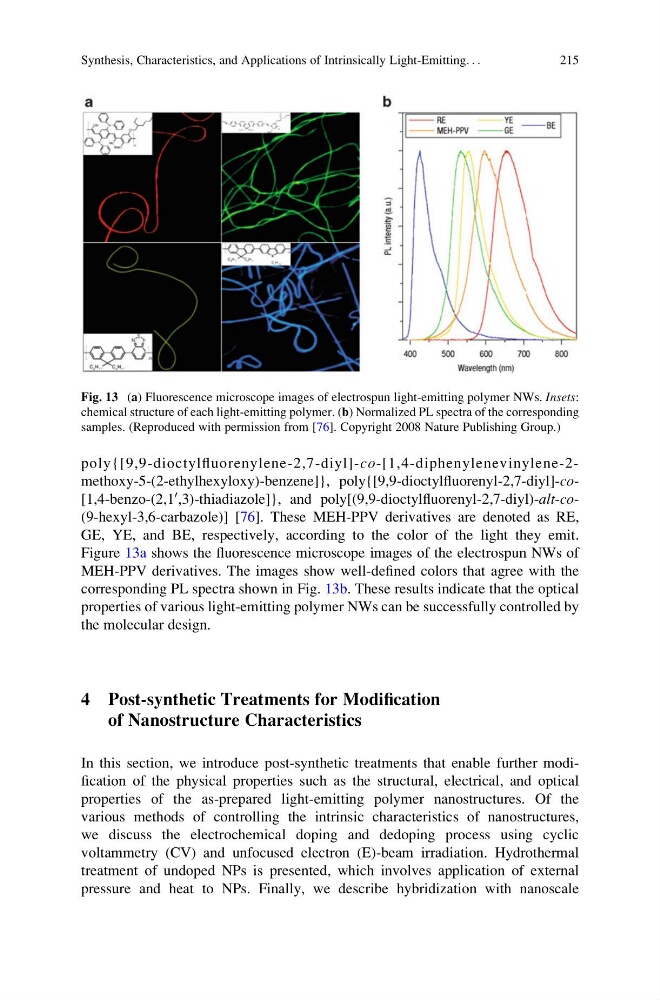
poly{[9,9-dioctylfluorenylene-2,7-diyl]-co-[1,4-diphenylenevinylene-2methoxy-5-(2-ethylhexyloxy)-benzene]}, poly{[9,9-dioctylfluorenyl-2,7-diyl]-co[1,4-benzo-(2,1
0 ,3)-thiadiazole]}, and poly[(9,9-dioctylfluorenyl-2,7-diyl)-alt-co(9-hexyl-3,6-carbazole)] [76]. These MEH-PPV derivatives are denoted as RE,
GE, YE, and BE, respectively, according to the color of the light they emit.
Figure 13a shows the fluorescence microscope images of the electrospun NWs of
MEH-PPV derivatives. The images show well-defined colors that agree with the
corresponding PL spectra shown in Fig. 13b. These results indicate that the optical
properties of various light-emitting polymer NWs can be successfully controlled by
the molecular design.
4 Post-synthetic Treatments for Modification
of Nanostructure Characteristics
In this section, we introduce post-synthetic treatments that enable further modification of the physical properties such as the structural, electrical, and optical
properties of the as-prepared light-emitting polymer nanostructures. Of the
various methods of controlling the intrinsic characteristics of nanostructures,
we discuss the electrochemical doping and dedoping process using cyclic
voltammetry (CV) and unfocused electron (E)-beam irradiation. Hydrothermal
treatment of undoped NPs is presented, which involves application of external
pressure and heat to NPs. Finally, we describe hybridization with nanoscale
Fig. 13 (a) Fluorescence microscope images of electrospun light-emitting polymer NWs. Insets:
chemical structure of each light-emitting polymer. (b) Normalized PL spectra of the corresponding
samples. (Reproduced with permission from [76]. Copyright 2008 Nature Publishing Group.)
Synthesis, Characteristics, and Applications of Intrinsically Light-Emitting. . .
215
0 ,3)-thiadiazole]}, and poly[(9,9-dioctylfluorenyl-2,7-diyl)-alt-co(9-hexyl-3,6-carbazole)] [76]. These MEH-PPV derivatives are denoted as RE,
GE, YE, and BE, respectively, according to the color of the light they emit.
Figure 13a shows the fluorescence microscope images of the electrospun NWs of
MEH-PPV derivatives. The images show well-defined colors that agree with the
corresponding PL spectra shown in Fig. 13b. These results indicate that the optical
properties of various light-emitting polymer NWs can be successfully controlled by
the molecular design.
4 Post-synthetic Treatments for Modification
of Nanostructure Characteristics
In this section, we introduce post-synthetic treatments that enable further modification of the physical properties such as the structural, electrical, and optical
properties of the as-prepared light-emitting polymer nanostructures. Of the
various methods of controlling the intrinsic characteristics of nanostructures,
we discuss the electrochemical doping and dedoping process using cyclic
voltammetry (CV) and unfocused electron (E)-beam irradiation. Hydrothermal
treatment of undoped NPs is presented, which involves application of external
pressure and heat to NPs. Finally, we describe hybridization with nanoscale
Fig. 13 (a) Fluorescence microscope images of electrospun light-emitting polymer NWs. Insets:
chemical structure of each light-emitting polymer. (b) Normalized PL spectra of the corresponding
samples. (Reproduced with permission from [76]. Copyright 2008 Nature Publishing Group.)
Synthesis, Characteristics, and Applications of Intrinsically Light-Emitting. . .
215