

method, ultrathin fibers can be obtained from solutions and melts by the uniaxial
elongation of viscoelastic jets owing to the electrostatic repulsive interaction
between surface charges. Conventional electrospinning systems consist of three
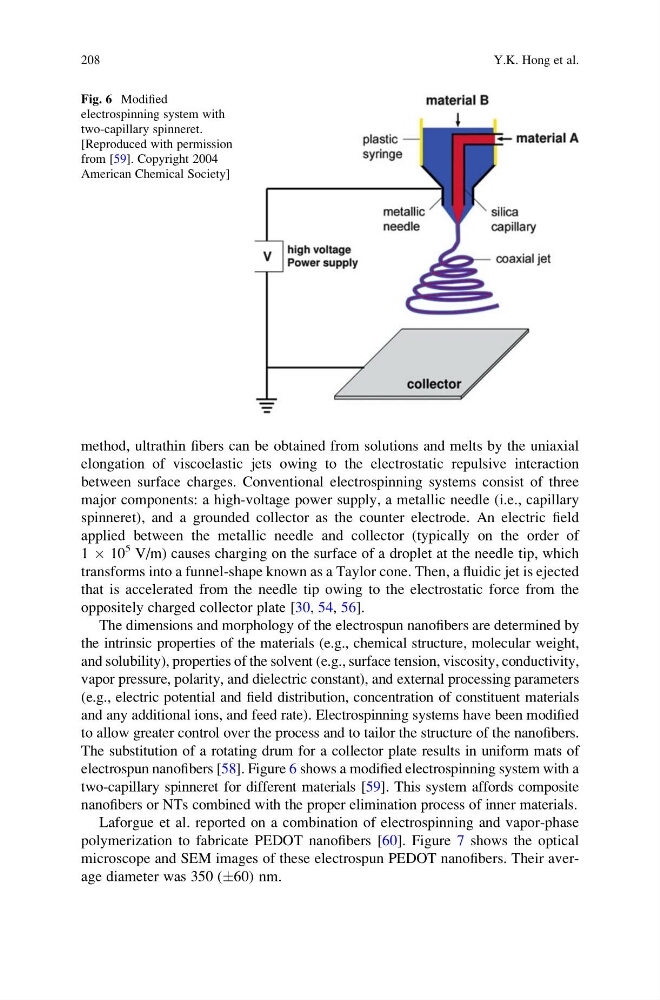
major components: a high-voltage power supply, a metallic needle (i.e., capillary
spinneret), and a grounded collector as the counter electrode. An electric field
applied between the metallic needle and collector (typically on the order of
1 Â 10
5 V/m) causes charging on the surface of a droplet at the needle tip, which
transforms into a funnel-shape known as a Taylor cone. Then, a fluidic jet is ejected
that is accelerated from the needle tip owing to the electrostatic force from the
oppositely charged collector plate [30, 54, 56].
The dimensions and morphology of the electrospun nanofibers are determined by
the intrinsic properties of the materials (e.g., chemical structure, molecular weight,
and solubility), properties of the solvent (e.g., surface tension, viscosity, conductivity,
vapor pressure, polarity, and dielectric constant), and external processing parameters
(e.g., electric potential and field distribution, concentration of constituent materials
and any additional ions, and feed rate). Electrospinning systems have been modified
to allow greater control over the process and to tailor the structure of the nanofibers.
The substitution of a rotating drum for a collector plate results in uniform mats of
electrospun nanofibers [58]. Figure 6 shows a modified electrospinning system with a
two-capillary spinneret for different materials [59]. This system affords composite
nanofibers or NTs combined with the proper elimination process of inner materials.
Laforgue et al. reported on a combination of electrospinning and vapor-phase
polymerization to fabricate PEDOT nanofibers [60]. Figure 7 shows the optical
microscope and SEM images of these electrospun PEDOT nanofibers. Their average diameter was 350 (Æ60) nm.
Fig. 6 Modified
electrospinning system with
two-capillary spinneret.
[Reproduced with permission
from [59]. Copyright 2004
American Chemical Society]
208
Y.K. Hong et al.
elongation of viscoelastic jets owing to the electrostatic repulsive interaction
between surface charges. Conventional electrospinning systems consist of three
major components: a high-voltage power supply, a metallic needle (i.e., capillary
spinneret), and a grounded collector as the counter electrode. An electric field
applied between the metallic needle and collector (typically on the order of
1 Â 10
5 V/m) causes charging on the surface of a droplet at the needle tip, which
transforms into a funnel-shape known as a Taylor cone. Then, a fluidic jet is ejected
that is accelerated from the needle tip owing to the electrostatic force from the
oppositely charged collector plate [30, 54, 56].
The dimensions and morphology of the electrospun nanofibers are determined by
the intrinsic properties of the materials (e.g., chemical structure, molecular weight,
and solubility), properties of the solvent (e.g., surface tension, viscosity, conductivity,
vapor pressure, polarity, and dielectric constant), and external processing parameters
(e.g., electric potential and field distribution, concentration of constituent materials
and any additional ions, and feed rate). Electrospinning systems have been modified
to allow greater control over the process and to tailor the structure of the nanofibers.
The substitution of a rotating drum for a collector plate results in uniform mats of
electrospun nanofibers [58]. Figure 6 shows a modified electrospinning system with a
two-capillary spinneret for different materials [59]. This system affords composite
nanofibers or NTs combined with the proper elimination process of inner materials.
Laforgue et al. reported on a combination of electrospinning and vapor-phase
polymerization to fabricate PEDOT nanofibers [60]. Figure 7 shows the optical
microscope and SEM images of these electrospun PEDOT nanofibers. Their average diameter was 350 (Æ60) nm.
Fig. 6 Modified
electrospinning system with
two-capillary spinneret.
[Reproduced with permission
from [59]. Copyright 2004
American Chemical Society]
208
Y.K. Hong et al.