

Lin et al. further extended the theoretical considerations from binary systems to
ternary systems involving polypeptide chain and a randomly coiled polymer
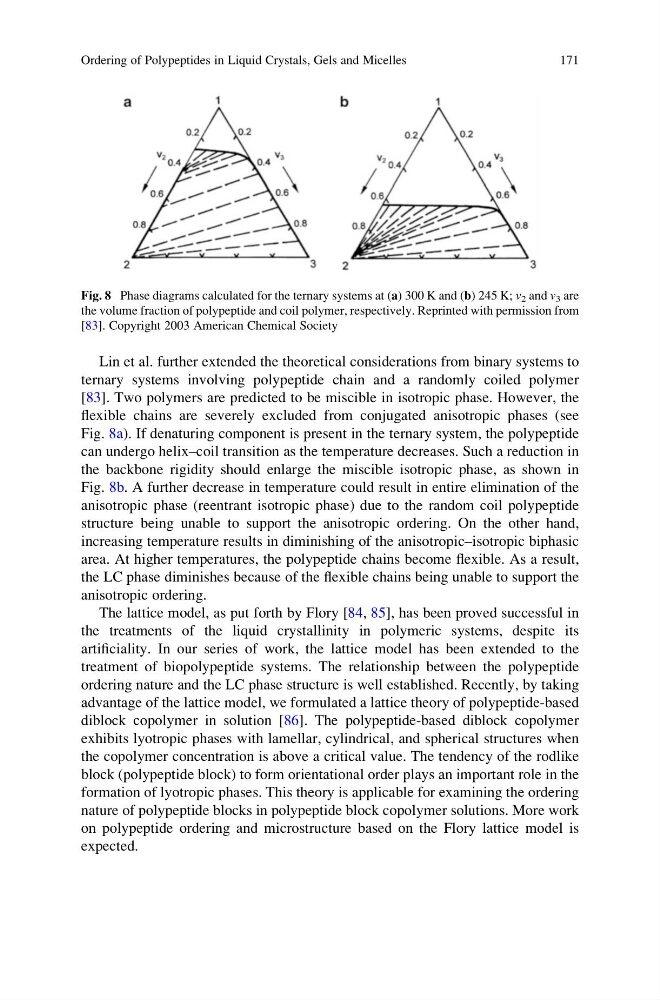
[83]. Two polymers are predicted to be miscible in isotropic phase. However, the
flexible chains are severely excluded from conjugated anisotropic phases (see
Fig. 8a). If denaturing component is present in the ternary system, the polypeptide
can undergo helix–coil transition as the temperature decreases. Such a reduction in
the backbone rigidity should enlarge the miscible isotropic phase, as shown in
Fig. 8b. A further decrease in temperature could result in entire elimination of the
anisotropic phase (reentrant isotropic phase) due to the random coil polypeptide
structure being unable to support the anisotropic ordering. On the other hand,
increasing temperature results in diminishing of the anisotropic–isotropic biphasic
area. At higher temperatures, the polypeptide chains become flexible. As a result,
the LC phase diminishes because of the flexible chains being unable to support the
anisotropic ordering.
The lattice model, as put forth by Flory [84, 85], has been proved successful in
the treatments of the liquid crystallinity in polymeric systems, despite its
artificiality. In our series of work, the lattice model has been extended to the
treatment of biopolypeptide systems. The relationship between the polypeptide
ordering nature and the LC phase structure is well established. Recently, by taking
advantage of the lattice model, we formulated a lattice theory of polypeptide-based
diblock copolymer in solution [86]. The polypeptide-based diblock copolymer
exhibits lyotropic phases with lamellar, cylindrical, and spherical structures when
the copolymer concentration is above a critical value. The tendency of the rodlike
block (polypeptide block) to form orientational order plays an important role in the
formation of lyotropic phases. This theory is applicable for examining the ordering
nature of polypeptide blocks in polypeptide block copolymer solutions. More work
on polypeptide ordering and microstructure based on the Flory lattice model is
expected.
Fig. 8 Phase diagrams calculated for the ternary systems at (a) 300 K and (b) 245 K; v 2 and v 3 are
the volume fraction of polypeptide and coil polymer, respectively. Reprinted with permission from
[83]. Copyright 2003 American Chemical Society
Ordering of Polypeptides in Liquid Crystals, Gels and Micelles
171
ternary systems involving polypeptide chain and a randomly coiled polymer
[83]. Two polymers are predicted to be miscible in isotropic phase. However, the
flexible chains are severely excluded from conjugated anisotropic phases (see
Fig. 8a). If denaturing component is present in the ternary system, the polypeptide
can undergo helix–coil transition as the temperature decreases. Such a reduction in
the backbone rigidity should enlarge the miscible isotropic phase, as shown in
Fig. 8b. A further decrease in temperature could result in entire elimination of the
anisotropic phase (reentrant isotropic phase) due to the random coil polypeptide
structure being unable to support the anisotropic ordering. On the other hand,
increasing temperature results in diminishing of the anisotropic–isotropic biphasic
area. At higher temperatures, the polypeptide chains become flexible. As a result,
the LC phase diminishes because of the flexible chains being unable to support the
anisotropic ordering.
The lattice model, as put forth by Flory [84, 85], has been proved successful in
the treatments of the liquid crystallinity in polymeric systems, despite its
artificiality. In our series of work, the lattice model has been extended to the
treatment of biopolypeptide systems. The relationship between the polypeptide
ordering nature and the LC phase structure is well established. Recently, by taking
advantage of the lattice model, we formulated a lattice theory of polypeptide-based
diblock copolymer in solution [86]. The polypeptide-based diblock copolymer
exhibits lyotropic phases with lamellar, cylindrical, and spherical structures when
the copolymer concentration is above a critical value. The tendency of the rodlike
block (polypeptide block) to form orientational order plays an important role in the
formation of lyotropic phases. This theory is applicable for examining the ordering
nature of polypeptide blocks in polypeptide block copolymer solutions. More work
on polypeptide ordering and microstructure based on the Flory lattice model is
expected.
Fig. 8 Phase diagrams calculated for the ternary systems at (a) 300 K and (b) 245 K; v 2 and v 3 are
the volume fraction of polypeptide and coil polymer, respectively. Reprinted with permission from
[83]. Copyright 2003 American Chemical Society
Ordering of Polypeptides in Liquid Crystals, Gels and Micelles
171