

systems must invariably be accompanied by selective reorganization favoring more
extended chain conformations. The intramolecular conformational change can,
therefore, be coupled with the isotropic–anisotropic transition and be accelerated
by the intermolecular order. Such an effect is termed “conformational ordering”
and pertains to semi-rigid chains in general.
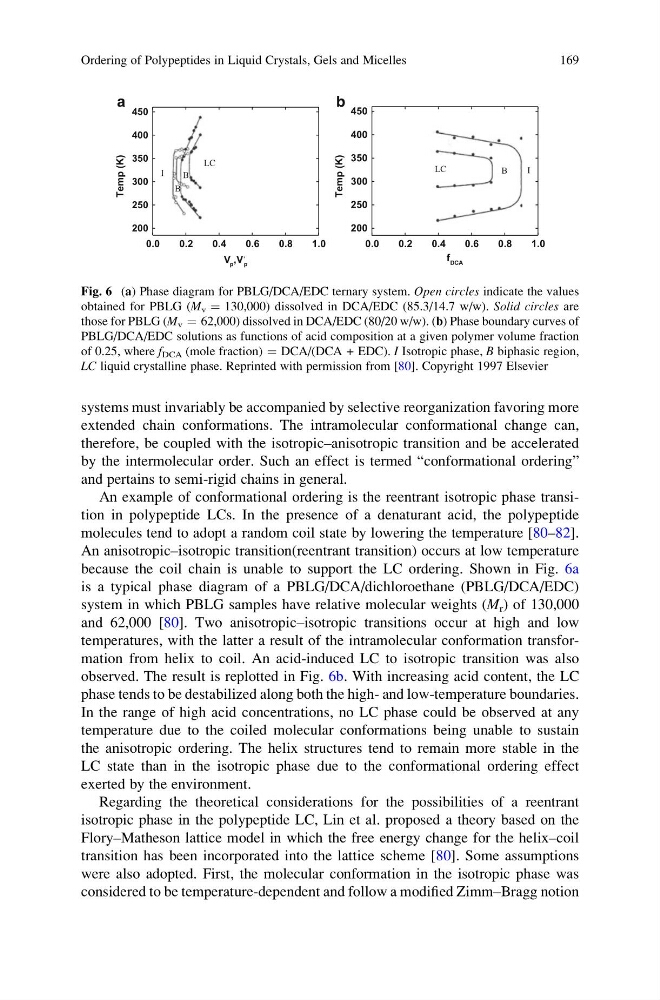
An example of conformational ordering is the reentrant isotropic phase transition in polypeptide LCs. In the presence of a denaturant acid, the polypeptide
molecules tend to adopt a random coil state by lowering the temperature [80–82].
An anisotropic–isotropic transition(reentrant transition) occurs at low temperature
because the coil chain is unable to support the LC ordering. Shown in Fig. 6a
is a typical phase diagram of a PBLG/DCA/dichloroethane (PBLG/DCA/EDC)
system in which PBLG samples have relative molecular weights (M r ) of 130,000
and 62,000 [80]. Two anisotropic–isotropic transitions occur at high and low
temperatures, with the latter a result of the intramolecular conformation transformation from helix to coil. An acid-induced LC to isotropic transition was also
observed. The result is replotted in Fig. 6b. With increasing acid content, the LC
phase tends to be destabilized along both the high- and low-temperature boundaries.
In the range of high acid concentrations, no LC phase could be observed at any
temperature due to the coiled molecular conformations being unable to sustain
the anisotropic ordering. The helix structures tend to remain more stable in the
LC state than in the isotropic phase due to the conformational ordering effect
exerted by the environment.
Regarding the theoretical considerations for the possibilities of a reentrant
isotropic phase in the polypeptide LC, Lin et al. proposed a theory based on the
Flory–Matheson lattice model in which the free energy change for the helix–coil
transition has been incorporated into the lattice scheme [80]. Some assumptions
were also adopted. First, the molecular conformation in the isotropic phase was
considered to be temperature-dependent and follow a modified Zimm–Bragg notion
I
LC
B
B
0.0
0.2
0.4
0.6
0.8
1.0
200
250
300
350
400
450
Temp (K)
V p ,V
,
p
LC
B
I
0.0
0.2
0.4
0.6
0.8
1.0
200
250
300
350
400
450
Temp (K)
f DCA
a
b
Fig. 6 (a) Phase diagram for PBLG/DCA/EDC ternary system. Open circles indicate the values
obtained for PBLG (M v ¼ 130,000) dissolved in DCA/EDC (85.3/14.7 w/w). Solid circles are
those for PBLG (M v ¼ 62,000) dissolved in DCA/EDC (80/20 w/w). (b) Phase boundary curves of
PBLG/DCA/EDC solutions as functions of acid composition at a given polymer volume fraction
of 0.25, where f DCA (mole fraction) ¼ DCA/(DCA + EDC). I Isotropic phase, B biphasic region,
LC liquid crystalline phase. Reprinted with permission from [80]. Copyright 1997 Elsevier
Ordering of Polypeptides in Liquid Crystals, Gels and Micelles
169
extended chain conformations. The intramolecular conformational change can,
therefore, be coupled with the isotropic–anisotropic transition and be accelerated
by the intermolecular order. Such an effect is termed “conformational ordering”
and pertains to semi-rigid chains in general.
An example of conformational ordering is the reentrant isotropic phase transition in polypeptide LCs. In the presence of a denaturant acid, the polypeptide
molecules tend to adopt a random coil state by lowering the temperature [80–82].
An anisotropic–isotropic transition(reentrant transition) occurs at low temperature
because the coil chain is unable to support the LC ordering. Shown in Fig. 6a
is a typical phase diagram of a PBLG/DCA/dichloroethane (PBLG/DCA/EDC)
system in which PBLG samples have relative molecular weights (M r ) of 130,000
and 62,000 [80]. Two anisotropic–isotropic transitions occur at high and low
temperatures, with the latter a result of the intramolecular conformation transformation from helix to coil. An acid-induced LC to isotropic transition was also
observed. The result is replotted in Fig. 6b. With increasing acid content, the LC
phase tends to be destabilized along both the high- and low-temperature boundaries.
In the range of high acid concentrations, no LC phase could be observed at any
temperature due to the coiled molecular conformations being unable to sustain
the anisotropic ordering. The helix structures tend to remain more stable in the
LC state than in the isotropic phase due to the conformational ordering effect
exerted by the environment.
Regarding the theoretical considerations for the possibilities of a reentrant
isotropic phase in the polypeptide LC, Lin et al. proposed a theory based on the
Flory–Matheson lattice model in which the free energy change for the helix–coil
transition has been incorporated into the lattice scheme [80]. Some assumptions
were also adopted. First, the molecular conformation in the isotropic phase was
considered to be temperature-dependent and follow a modified Zimm–Bragg notion
I
LC
B
B
0.0
0.2
0.4
0.6
0.8
1.0
200
250
300
350
400
450
Temp (K)
V p ,V
,
p
LC
B
I
0.0
0.2
0.4
0.6
0.8
1.0
200
250
300
350
400
450
Temp (K)
f DCA
a
b
Fig. 6 (a) Phase diagram for PBLG/DCA/EDC ternary system. Open circles indicate the values
obtained for PBLG (M v ¼ 130,000) dissolved in DCA/EDC (85.3/14.7 w/w). Solid circles are
those for PBLG (M v ¼ 62,000) dissolved in DCA/EDC (80/20 w/w). (b) Phase boundary curves of
PBLG/DCA/EDC solutions as functions of acid composition at a given polymer volume fraction
of 0.25, where f DCA (mole fraction) ¼ DCA/(DCA + EDC). I Isotropic phase, B biphasic region,
LC liquid crystalline phase. Reprinted with permission from [80]. Copyright 1997 Elsevier
Ordering of Polypeptides in Liquid Crystals, Gels and Micelles
169