

For example, for the system of PBLG/m-cresol LCs, in the temperature range of
30–60
C, right-handed cholesteric LCs are observed and the periodicity S increases
with increasing temperature [74]. At 60
C, the cholesteric character disappears and
nematic LCs are formed. Above this temperature, left-handed cholesteric structures
appear and the periodicity S decreases with increasing temperature. Regarding the
dependence on the nature of the solvent, results from the PBLG LCs formed in
dioxane-dichloroethane mixed solvent showed that the chirality of the LC
transformed from right-handed to left-handed with increasing volume fraction of
dichloroethane [75]. For such phenomenon, the dielectric constant of the solvents is
believed to be one of the important influencing factors. Usually, a solvent with
lower dielectric constant supports a right-handed cholesteric structure.
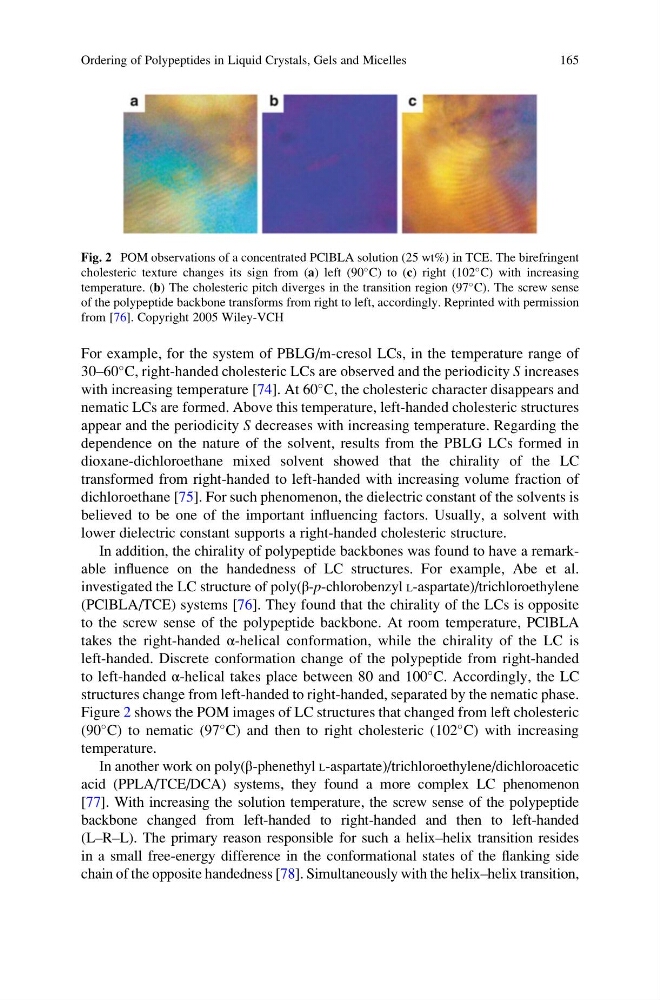
In addition, the chirality of polypeptide backbones was found to have a remarkable influence on the handedness of LC structures. For example, Abe et al.
investigated the LC structure of poly(β-p-chlorobenzyl L-aspartate)/trichloroethylene
(PClBLA/TCE) systems [76]. They found that the chirality of the LCs is opposite
to the screw sense of the polypeptide backbone. At room temperature, PClBLA
takes the right-handed α-helical conformation, while the chirality of the LC is
left-handed. Discrete conformation change of the polypeptide from right-handed
to left-handed α-helical takes place between 80 and 100
C. Accordingly, the LC
structures change from left-handed to right-handed, separated by the nematic phase.
Figure 2 shows the POM images of LC structures that changed from left cholesteric
(90
C) to nematic (97
C) and then to right cholesteric (102
C) with increasing
temperature.
In another work on poly(β-phenethyl L-aspartate)/trichloroethylene/dichloroacetic
acid (PPLA/TCE/DCA) systems, they found a more complex LC phenomenon
[77]. With increasing the solution temperature, the screw sense of the polypeptide
backbone changed from left-handed to right-handed and then to left-handed
(L–R–L). The primary reason responsible for such a helix–helix transition resides
in a small free-energy difference in the conformational states of the flanking side
chain of the opposite handedness [78]. Simultaneously with the helix–helix transition,
Fig. 2 POM observations of a concentrated PClBLA solution (25 wt%) in TCE. The birefringent
cholesteric texture changes its sign from (a) left (90
C) to (c) right (102
C) with increasing
temperature. (b) The cholesteric pitch diverges in the transition region (97
C). The screw sense
of the polypeptide backbone transforms from right to left, accordingly. Reprinted with permission
from [76]. Copyright 2005 Wiley-VCH
Ordering of Polypeptides in Liquid Crystals, Gels and Micelles
165
30–60
C, right-handed cholesteric LCs are observed and the periodicity S increases
with increasing temperature [74]. At 60
C, the cholesteric character disappears and
nematic LCs are formed. Above this temperature, left-handed cholesteric structures
appear and the periodicity S decreases with increasing temperature. Regarding the
dependence on the nature of the solvent, results from the PBLG LCs formed in
dioxane-dichloroethane mixed solvent showed that the chirality of the LC
transformed from right-handed to left-handed with increasing volume fraction of
dichloroethane [75]. For such phenomenon, the dielectric constant of the solvents is
believed to be one of the important influencing factors. Usually, a solvent with
lower dielectric constant supports a right-handed cholesteric structure.
In addition, the chirality of polypeptide backbones was found to have a remarkable influence on the handedness of LC structures. For example, Abe et al.
investigated the LC structure of poly(β-p-chlorobenzyl L-aspartate)/trichloroethylene
(PClBLA/TCE) systems [76]. They found that the chirality of the LCs is opposite
to the screw sense of the polypeptide backbone. At room temperature, PClBLA
takes the right-handed α-helical conformation, while the chirality of the LC is
left-handed. Discrete conformation change of the polypeptide from right-handed
to left-handed α-helical takes place between 80 and 100
C. Accordingly, the LC
structures change from left-handed to right-handed, separated by the nematic phase.
Figure 2 shows the POM images of LC structures that changed from left cholesteric
(90
C) to nematic (97
C) and then to right cholesteric (102
C) with increasing
temperature.
In another work on poly(β-phenethyl L-aspartate)/trichloroethylene/dichloroacetic
acid (PPLA/TCE/DCA) systems, they found a more complex LC phenomenon
[77]. With increasing the solution temperature, the screw sense of the polypeptide
backbone changed from left-handed to right-handed and then to left-handed
(L–R–L). The primary reason responsible for such a helix–helix transition resides
in a small free-energy difference in the conformational states of the flanking side
chain of the opposite handedness [78]. Simultaneously with the helix–helix transition,
Fig. 2 POM observations of a concentrated PClBLA solution (25 wt%) in TCE. The birefringent
cholesteric texture changes its sign from (a) left (90
C) to (c) right (102
C) with increasing
temperature. (b) The cholesteric pitch diverges in the transition region (97
C). The screw sense
of the polypeptide backbone transforms from right to left, accordingly. Reprinted with permission
from [76]. Copyright 2005 Wiley-VCH
Ordering of Polypeptides in Liquid Crystals, Gels and Micelles
165