

2.1 Typical LC Structures
LCs of polypeptide homopolymers were first described in the 1950s by Elliott and
Ambrose, who observed a birefringent solution phase of poly(γ-benzyl L-glutamate)/
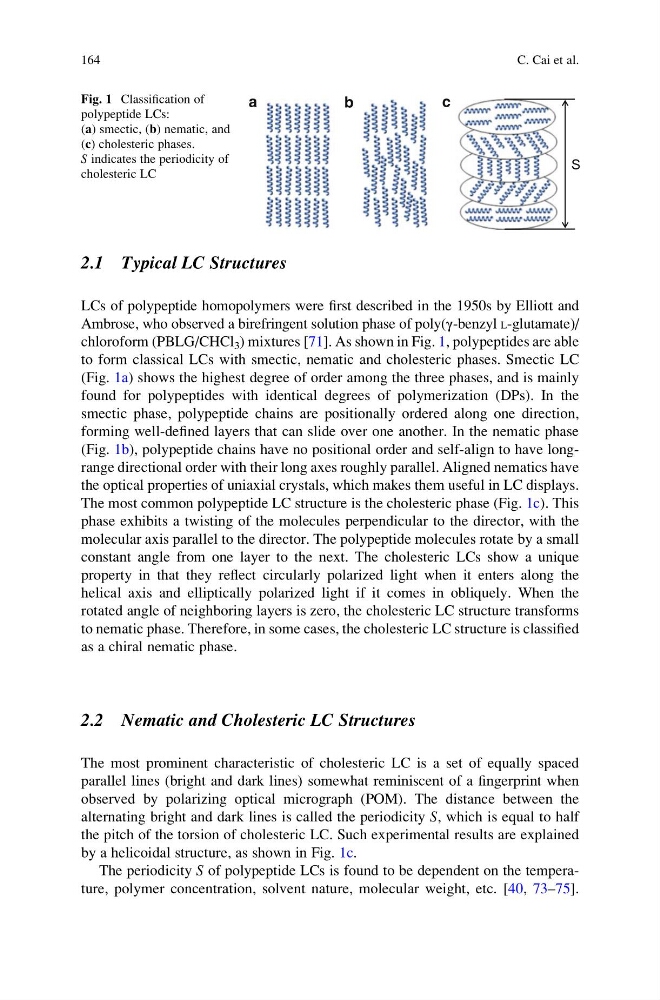
chloroform (PBLG/CHCl 3 ) mixtures [71]. As shown in Fig. 1, polypeptides are able
to form classical LCs with smectic, nematic and cholesteric phases. Smectic LC
(Fig. 1a) shows the highest degree of order among the three phases, and is mainly
found for polypeptides with identical degrees of polymerization (DPs). In the
smectic phase, polypeptide chains are positionally ordered along one direction,
forming well-defined layers that can slide over one another. In the nematic phase
(Fig. 1b), polypeptide chains have no positional order and self-align to have longrange directional order with their long axes roughly parallel. Aligned nematics have
the optical properties of uniaxial crystals, which makes them useful in LC displays.
The most common polypeptide LC structure is the cholesteric phase (Fig. 1c). This
phase exhibits a twisting of the molecules perpendicular to the director, with the
molecular axis parallel to the director. The polypeptide molecules rotate by a small
constant angle from one layer to the next. The cholesteric LCs show a unique
property in that they reflect circularly polarized light when it enters along the
helical axis and elliptically polarized light if it comes in obliquely. When the
rotated angle of neighboring layers is zero, the cholesteric LC structure transforms
to nematic phase. Therefore, in some cases, the cholesteric LC structure is classified
as a chiral nematic phase.
2.2 Nematic and Cholesteric LC Structures
The most prominent characteristic of cholesteric LC is a set of equally spaced
parallel lines (bright and dark lines) somewhat reminiscent of a fingerprint when
observed by polarizing optical micrograph (POM). The distance between the
alternating bright and dark lines is called the periodicity S, which is equal to half
the pitch of the torsion of cholesteric LC. Such experimental results are explained
by a helicoidal structure, as shown in Fig. 1c.
The periodicity S of polypeptide LCs is found to be dependent on the temperature, polymer concentration, solvent nature, molecular weight, etc. [40, 73–75].
S
a
b
c
Fig. 1 Classification of
polypeptide LCs:
(a) smectic, (b) nematic, and
(c) cholesteric phases.
S indicates the periodicity of
cholesteric LC
164
C. Cai et al.
LCs of polypeptide homopolymers were first described in the 1950s by Elliott and
Ambrose, who observed a birefringent solution phase of poly(γ-benzyl L-glutamate)/
chloroform (PBLG/CHCl 3 ) mixtures [71]. As shown in Fig. 1, polypeptides are able
to form classical LCs with smectic, nematic and cholesteric phases. Smectic LC
(Fig. 1a) shows the highest degree of order among the three phases, and is mainly
found for polypeptides with identical degrees of polymerization (DPs). In the
smectic phase, polypeptide chains are positionally ordered along one direction,
forming well-defined layers that can slide over one another. In the nematic phase
(Fig. 1b), polypeptide chains have no positional order and self-align to have longrange directional order with their long axes roughly parallel. Aligned nematics have
the optical properties of uniaxial crystals, which makes them useful in LC displays.
The most common polypeptide LC structure is the cholesteric phase (Fig. 1c). This
phase exhibits a twisting of the molecules perpendicular to the director, with the
molecular axis parallel to the director. The polypeptide molecules rotate by a small
constant angle from one layer to the next. The cholesteric LCs show a unique
property in that they reflect circularly polarized light when it enters along the
helical axis and elliptically polarized light if it comes in obliquely. When the
rotated angle of neighboring layers is zero, the cholesteric LC structure transforms
to nematic phase. Therefore, in some cases, the cholesteric LC structure is classified
as a chiral nematic phase.
2.2 Nematic and Cholesteric LC Structures
The most prominent characteristic of cholesteric LC is a set of equally spaced
parallel lines (bright and dark lines) somewhat reminiscent of a fingerprint when
observed by polarizing optical micrograph (POM). The distance between the
alternating bright and dark lines is called the periodicity S, which is equal to half
the pitch of the torsion of cholesteric LC. Such experimental results are explained
by a helicoidal structure, as shown in Fig. 1c.
The periodicity S of polypeptide LCs is found to be dependent on the temperature, polymer concentration, solvent nature, molecular weight, etc. [40, 73–75].
S
a
b
c
Fig. 1 Classification of
polypeptide LCs:
(a) smectic, (b) nematic, and
(c) cholesteric phases.
S indicates the periodicity of
cholesteric LC
164
C. Cai et al.