

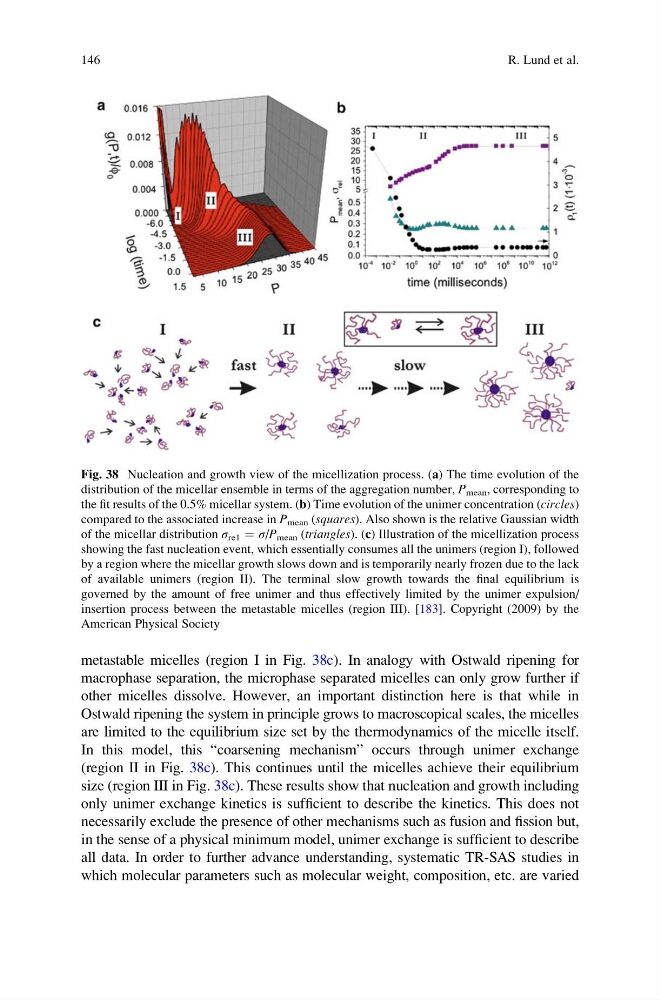
metastable micelles (region I in Fig. 38c). In analogy with Ostwald ripening for
macrophase separation, the microphase separated micelles can only grow further if
other micelles dissolve. However, an important distinction here is that while in
Ostwald ripening the system in principle grows to macroscopical scales, the micelles
are limited to the equilibrium size set by the thermodynamics of the micelle itself.
In this model, this “coarsening mechanism” occurs through unimer exchange
(region II in Fig. 38c). This continues until the micelles achieve their equilibrium
size (region III in Fig. 38c). These results show that nucleation and growth including
only unimer exchange kinetics is sufficient to describe the kinetics. This does not
necessarily exclude the presence of other mechanisms such as fusion and fission but,
in the sense of a physical minimum model, unimer exchange is sufficient to describe
all data. In order to further advance understanding, systematic TR-SAS studies in
which molecular parameters such as molecular weight, composition, etc. are varied
Fig. 38 Nucleation and growth view of the micellization process. (a) The time evolution of the
distribution of the micellar ensemble in terms of the aggregation number, P mean , corresponding to
the fit results of the 0.5% micellar system. (b) Time evolution of the unimer concentration (circles)
compared to the associated increase in P mean (squares). Also shown is the relative Gaussian width
of the micellar distribution σ re1 ¼ σ/P mean (triangles). (c) Illustration of the micellization process
showing the fast nucleation event, which essentially consumes all the unimers (region I), followed
by a region where the micellar growth slows down and is temporarily nearly frozen due to the lack
of available unimers (region II). The terminal slow growth towards the final equilibrium is
governed by the amount of free unimer and thus effectively limited by the unimer expulsion/
insertion process between the metastable micelles (region III). [183]. Copyright (2009) by the
American Physical Society
146
R. Lund et al.
macrophase separation, the microphase separated micelles can only grow further if
other micelles dissolve. However, an important distinction here is that while in
Ostwald ripening the system in principle grows to macroscopical scales, the micelles
are limited to the equilibrium size set by the thermodynamics of the micelle itself.
In this model, this “coarsening mechanism” occurs through unimer exchange
(region II in Fig. 38c). This continues until the micelles achieve their equilibrium
size (region III in Fig. 38c). These results show that nucleation and growth including
only unimer exchange kinetics is sufficient to describe the kinetics. This does not
necessarily exclude the presence of other mechanisms such as fusion and fission but,
in the sense of a physical minimum model, unimer exchange is sufficient to describe
all data. In order to further advance understanding, systematic TR-SAS studies in
which molecular parameters such as molecular weight, composition, etc. are varied
Fig. 38 Nucleation and growth view of the micellization process. (a) The time evolution of the
distribution of the micellar ensemble in terms of the aggregation number, P mean , corresponding to
the fit results of the 0.5% micellar system. (b) Time evolution of the unimer concentration (circles)
compared to the associated increase in P mean (squares). Also shown is the relative Gaussian width
of the micellar distribution σ re1 ¼ σ/P mean (triangles). (c) Illustration of the micellization process
showing the fast nucleation event, which essentially consumes all the unimers (region I), followed
by a region where the micellar growth slows down and is temporarily nearly frozen due to the lack
of available unimers (region II). The terminal slow growth towards the final equilibrium is
governed by the amount of free unimer and thus effectively limited by the unimer expulsion/
insertion process between the metastable micelles (region III). [183]. Copyright (2009) by the
American Physical Society
146
R. Lund et al.