

of the concentration dependence is desirable in order to scrutinize in more detail the
slowing down of chain exchange observed in ordered diblock copolymer micelles.
Moreover, the diffusion process through the corona should be investigated. Thus,
variation of the corona chain length needs still to be explored although this might
only be a minor factor and perhaps mostly relevant for star-like micelles. Motivation
for such a study can be found in recent computer simulation results [162], where a
quicker exchange rate was found by increasing the corona block length, which is in
conflict with the slower rate predicted by theory. The double exponential dependence
of γ and N could effectively be used to tailor micellar properties for applications such
as the production of frozen nanoparticles, for tuning rheological properties of transient networks built from telechelic polymers, or the control of release from micellar
cores for biomedical purposes.
5 Non-equilibrium Kinetics in Block Copolymer Micelles
5.1 Formation and Micellization Kinetics
Non-equilibrium kinetic processes typically involve monitoring a change in micellar structure or morphology over time, or following the formation of micelles from a
molecular solution (unimers), i.e., micellization kinetics. Thus, in contrast to
equilibrium processes a perturbation is required. Typically this is achieved by
abruptly altering the thermodynamic conditions, which can be achieved either via
extensive parameters like temperature and pressure, or by changing intensive
parameters such as salt concentration or pH.
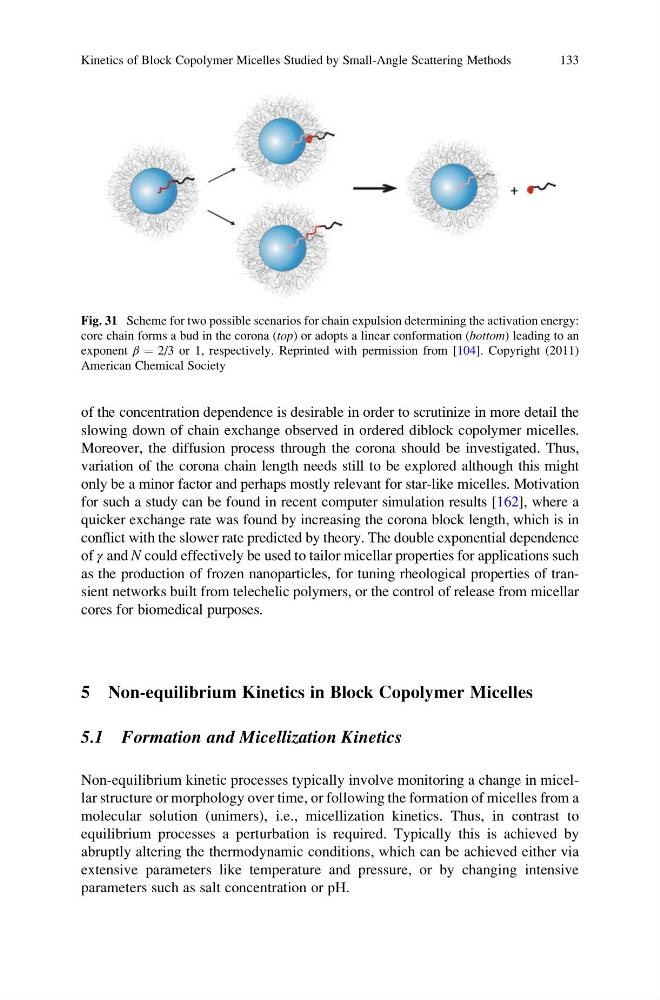
Fig. 31 Scheme for two possible scenarios for chain expulsion determining the activation energy:
core chain forms a bud in the corona (top) or adopts a linear conformation (bottom) leading to an
exponent β ¼ 2/3 or 1, respectively. Reprinted with permission from [104]. Copyright (2011)
American Chemical Society
Kinetics of Block Copolymer Micelles Studied by Small-Angle Scattering Methods
133
slowing down of chain exchange observed in ordered diblock copolymer micelles.
Moreover, the diffusion process through the corona should be investigated. Thus,
variation of the corona chain length needs still to be explored although this might
only be a minor factor and perhaps mostly relevant for star-like micelles. Motivation
for such a study can be found in recent computer simulation results [162], where a
quicker exchange rate was found by increasing the corona block length, which is in
conflict with the slower rate predicted by theory. The double exponential dependence
of γ and N could effectively be used to tailor micellar properties for applications such
as the production of frozen nanoparticles, for tuning rheological properties of transient networks built from telechelic polymers, or the control of release from micellar
cores for biomedical purposes.
5 Non-equilibrium Kinetics in Block Copolymer Micelles
5.1 Formation and Micellization Kinetics
Non-equilibrium kinetic processes typically involve monitoring a change in micellar structure or morphology over time, or following the formation of micelles from a
molecular solution (unimers), i.e., micellization kinetics. Thus, in contrast to
equilibrium processes a perturbation is required. Typically this is achieved by
abruptly altering the thermodynamic conditions, which can be achieved either via
extensive parameters like temperature and pressure, or by changing intensive
parameters such as salt concentration or pH.
Fig. 31 Scheme for two possible scenarios for chain expulsion determining the activation energy:
core chain forms a bud in the corona (top) or adopts a linear conformation (bottom) leading to an
exponent β ¼ 2/3 or 1, respectively. Reprinted with permission from [104]. Copyright (2011)
American Chemical Society
Kinetics of Block Copolymer Micelles Studied by Small-Angle Scattering Methods
133