

4.7 Summary
In general, the experimental results obtained by the TR-SANS technique strongly
indicate that the component exchange kinetics of all the micellar systems investigated
occurs solely via the Aniansson and Wall mechanism, i.e., the insertion/expulsion of
only single chains at a given time even for elevated concentrations. The involved
activation energy for chain expulsion scales with the core block degree of polymerization and the interfacial tension: E A $ αγN
β
B , thus determining the relaxation rate
double exponentially. The observed strong dependence on the core block degree of
polymerization finally allowed explanation of the logarithmic time decay by the finite
polydispersity of the insoluble block, even for chains with a narrow chain length
distribution. Thus, from theoretical and experimental points of view one can conclude
that the equilibrium kinetics in block copolymer micelles in dilute solution is
essentially understood. Solely the value of the exponent β and of the numerical
prefactor α remain unclear. For β ¼ 2/3, the activation energy is determined by the
interfacial tension arising from surface contacts between the fully collapsed insoluble
block and the solvent in the corona of the micelle. For β ¼ 1, the expelled insoluble
block is still swollen with solvent and E a is determined by monomer–solvent contacts
via the Flory–Huggins interaction parameter, χN. A visualization of the two discussed
possibilities for chain expulsion is shown in Fig. 31.
Deviations of the parameter α from the theoretical value may be due to small
variations in local structural properties of the “activated complex” during the expulsion process. Here, factors like screening of solvent/core polymer contacts by the
corona block and ill-defined core–corona interfaces might come into play. However,
discrepancies could also arise from small uncertainties in the determination of
polymer characteristics. However, these discrepancies are obviously system-specific
and depend on selective solvent, type of block polymer, temperature, and degree of
polymerization and are thus of minor relevance for the general understanding of
equilibrium kinetics. From the experimental point of view, a more systematic study
10
-2
10
-1
10
0
10
1
10
2
10
3
10
4
0.0
0.1
0.2
0.3
0.4
0.5
0.6
0.7
0.8
0.9
1.0
R(t)
time [s]
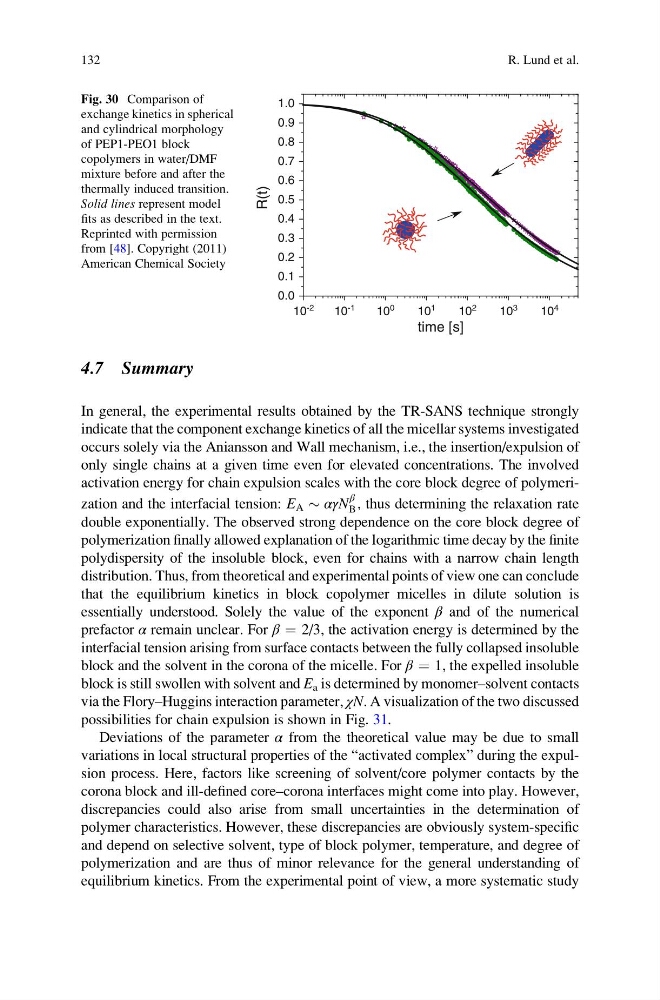
Fig. 30 Comparison of
exchange kinetics in spherical
and cylindrical morphology
of PEP1-PEO1 block
copolymers in water/DMF
mixture before and after the
thermally induced transition.
Solid lines represent model
fits as described in the text.
Reprinted with permission
from [48]. Copyright (2011)
American Chemical Society
132
R. Lund et al.
In general, the experimental results obtained by the TR-SANS technique strongly
indicate that the component exchange kinetics of all the micellar systems investigated
occurs solely via the Aniansson and Wall mechanism, i.e., the insertion/expulsion of
only single chains at a given time even for elevated concentrations. The involved
activation energy for chain expulsion scales with the core block degree of polymerization and the interfacial tension: E A $ αγN
β
B , thus determining the relaxation rate
double exponentially. The observed strong dependence on the core block degree of
polymerization finally allowed explanation of the logarithmic time decay by the finite
polydispersity of the insoluble block, even for chains with a narrow chain length
distribution. Thus, from theoretical and experimental points of view one can conclude
that the equilibrium kinetics in block copolymer micelles in dilute solution is
essentially understood. Solely the value of the exponent β and of the numerical
prefactor α remain unclear. For β ¼ 2/3, the activation energy is determined by the
interfacial tension arising from surface contacts between the fully collapsed insoluble
block and the solvent in the corona of the micelle. For β ¼ 1, the expelled insoluble
block is still swollen with solvent and E a is determined by monomer–solvent contacts
via the Flory–Huggins interaction parameter, χN. A visualization of the two discussed
possibilities for chain expulsion is shown in Fig. 31.
Deviations of the parameter α from the theoretical value may be due to small
variations in local structural properties of the “activated complex” during the expulsion process. Here, factors like screening of solvent/core polymer contacts by the
corona block and ill-defined core–corona interfaces might come into play. However,
discrepancies could also arise from small uncertainties in the determination of
polymer characteristics. However, these discrepancies are obviously system-specific
and depend on selective solvent, type of block polymer, temperature, and degree of
polymerization and are thus of minor relevance for the general understanding of
equilibrium kinetics. From the experimental point of view, a more systematic study
10
-2
10
-1
10
0
10
1
10
2
10
3
10
4
0.0
0.1
0.2
0.3
0.4
0.5
0.6
0.7
0.8
0.9
1.0
R(t)
time [s]
Fig. 30 Comparison of
exchange kinetics in spherical
and cylindrical morphology
of PEP1-PEO1 block
copolymers in water/DMF
mixture before and after the
thermally induced transition.
Solid lines represent model
fits as described in the text.
Reprinted with permission
from [48]. Copyright (2011)
American Chemical Society
132
R. Lund et al.