

pseudo-logarithmic relaxation in polymeric micelles. This applies also for polymers
with small polydispersities (M w /M n smaller than 1.1), usually obtained by living
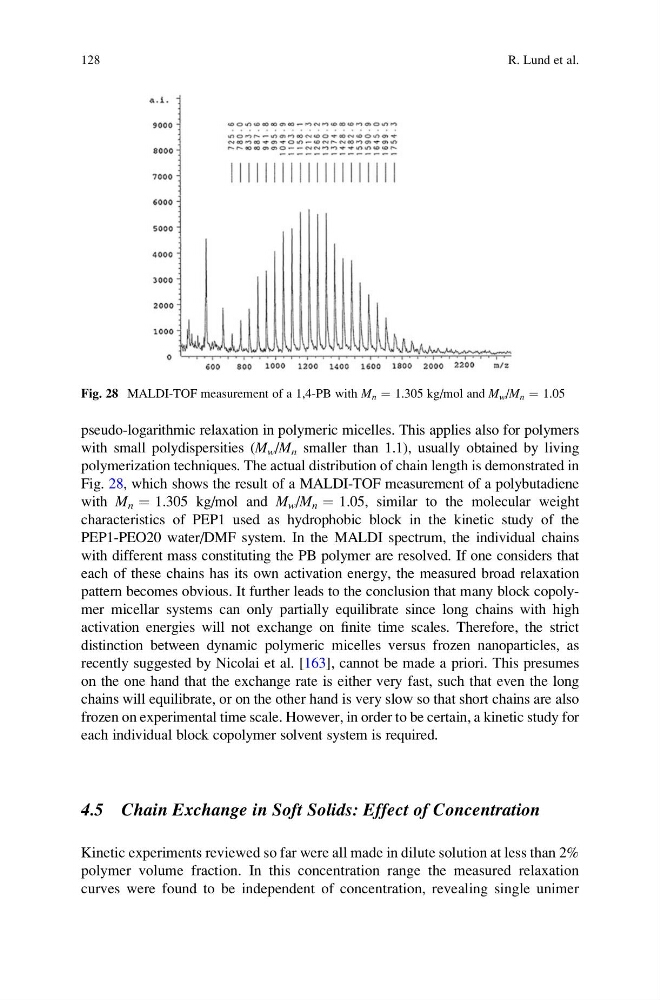
polymerization techniques. The actual distribution of chain length is demonstrated in
Fig. 28, which shows the result of a MALDI-TOF measurement of a polybutadiene
with M n ¼ 1.305 kg/mol and M w /M n ¼ 1.05, similar to the molecular weight
characteristics of PEP1 used as hydrophobic block in the kinetic study of the
PEP1-PEO20 water/DMF system. In the MALDI spectrum, the individual chains
with different mass constituting the PB polymer are resolved. If one considers that
each of these chains has its own activation energy, the measured broad relaxation
pattern becomes obvious. It further leads to the conclusion that many block copolymer micellar systems can only partially equilibrate since long chains with high
activation energies will not exchange on finite time scales. Therefore, the strict
distinction between dynamic polymeric micelles versus frozen nanoparticles, as
recently suggested by Nicolai et al. [163], cannot be made a priori. This presumes
on the one hand that the exchange rate is either very fast, such that even the long
chains will equilibrate, or on the other hand is very slow so that short chains are also
frozen on experimental time scale. However, in order to be certain, a kinetic study for
each individual block copolymer solvent system is required.
4.5 Chain Exchange in Soft Solids: Effect of Concentration
Kinetic experiments reviewed so far were all made in dilute solution at less than 2%
polymer volume fraction. In this concentration range the measured relaxation
curves were found to be independent of concentration, revealing single unimer
Fig. 28 MALDI-TOF measurement of a 1,4-PB with M n ¼ 1.305 kg/mol and M w /M n ¼ 1.05
128
R. Lund et al.
with small polydispersities (M w /M n smaller than 1.1), usually obtained by living
polymerization techniques. The actual distribution of chain length is demonstrated in
Fig. 28, which shows the result of a MALDI-TOF measurement of a polybutadiene
with M n ¼ 1.305 kg/mol and M w /M n ¼ 1.05, similar to the molecular weight
characteristics of PEP1 used as hydrophobic block in the kinetic study of the
PEP1-PEO20 water/DMF system. In the MALDI spectrum, the individual chains
with different mass constituting the PB polymer are resolved. If one considers that
each of these chains has its own activation energy, the measured broad relaxation
pattern becomes obvious. It further leads to the conclusion that many block copolymer micellar systems can only partially equilibrate since long chains with high
activation energies will not exchange on finite time scales. Therefore, the strict
distinction between dynamic polymeric micelles versus frozen nanoparticles, as
recently suggested by Nicolai et al. [163], cannot be made a priori. This presumes
on the one hand that the exchange rate is either very fast, such that even the long
chains will equilibrate, or on the other hand is very slow so that short chains are also
frozen on experimental time scale. However, in order to be certain, a kinetic study for
each individual block copolymer solvent system is required.
4.5 Chain Exchange in Soft Solids: Effect of Concentration
Kinetic experiments reviewed so far were all made in dilute solution at less than 2%
polymer volume fraction. In this concentration range the measured relaxation
curves were found to be independent of concentration, revealing single unimer
Fig. 28 MALDI-TOF measurement of a 1,4-PB with M n ¼ 1.305 kg/mol and M w /M n ¼ 1.05
128
R. Lund et al.