

gave the same results, most likely due to the chosen small Q-range, where form factor
differences of the two differently labeled polymers do not play a role. The inset of
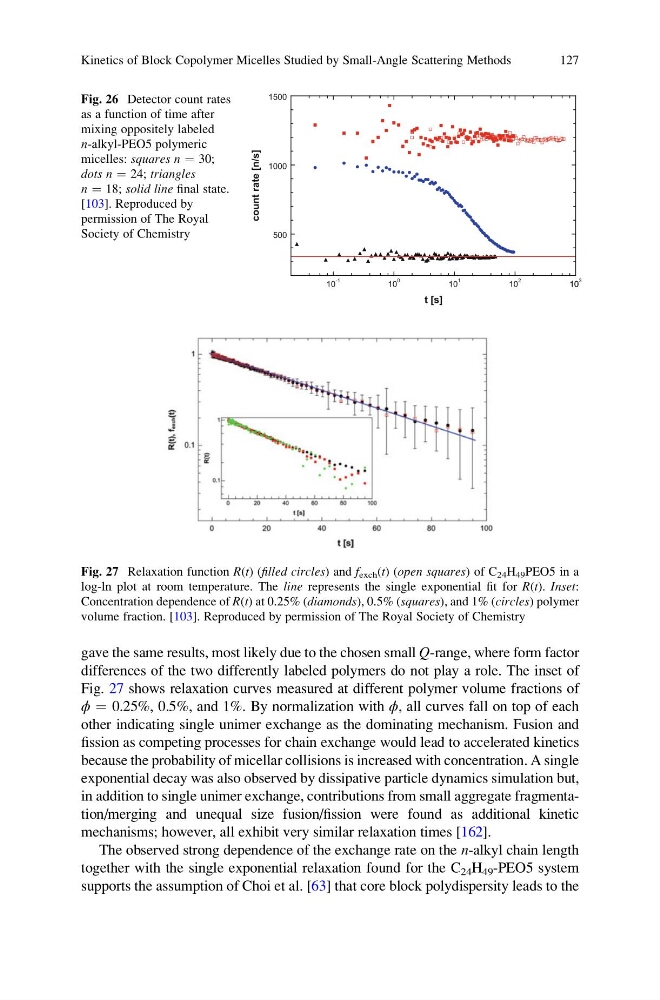
Fig. 27 shows relaxation curves measured at different polymer volume fractions of
ϕ ¼ 0.25%, 0.5%, and 1%. By normalization with ϕ, all curves fall on top of each
other indicating single unimer exchange as the dominating mechanism. Fusion and
fission as competing processes for chain exchange would lead to accelerated kinetics
because the probability of micellar collisions is increased with concentration. A single
exponential decay was also observed by dissipative particle dynamics simulation but,
in addition to single unimer exchange, contributions from small aggregate fragmentation/merging and unequal size fusion/fission were found as additional kinetic
mechanisms; however, all exhibit very similar relaxation times [162].
The observed strong dependence of the exchange rate on the n-alkyl chain length
together with the single exponential relaxation found for the C 24 H 49 -PEO5 system
supports the assumption of Choi et al. [63] that core block polydispersity leads to the
Fig. 26 Detector count rates
as a function of time after
mixing oppositely labeled
n-alkyl-PEO5 polymeric
micelles: squares n ¼ 30;
dots n ¼ 24; triangles
n ¼ 18; solid line final state.
[103]. Reproduced by
permission of The Royal
Society of Chemistry
Fig. 27 Relaxation function R(t) (filled circles) and f exch (t) (open squares) of C 24 H 49 PEO5 in a
log-ln plot at room temperature. The line represents the single exponential fit for R(t). Inset:
Concentration dependence of R(t) at 0.25% (diamonds), 0.5% (squares), and 1% (circles) polymer
volume fraction. [103]. Reproduced by permission of The Royal Society of Chemistry
Kinetics of Block Copolymer Micelles Studied by Small-Angle Scattering Methods
127
differences of the two differently labeled polymers do not play a role. The inset of
Fig. 27 shows relaxation curves measured at different polymer volume fractions of
ϕ ¼ 0.25%, 0.5%, and 1%. By normalization with ϕ, all curves fall on top of each
other indicating single unimer exchange as the dominating mechanism. Fusion and
fission as competing processes for chain exchange would lead to accelerated kinetics
because the probability of micellar collisions is increased with concentration. A single
exponential decay was also observed by dissipative particle dynamics simulation but,
in addition to single unimer exchange, contributions from small aggregate fragmentation/merging and unequal size fusion/fission were found as additional kinetic
mechanisms; however, all exhibit very similar relaxation times [162].
The observed strong dependence of the exchange rate on the n-alkyl chain length
together with the single exponential relaxation found for the C 24 H 49 -PEO5 system
supports the assumption of Choi et al. [63] that core block polydispersity leads to the
Fig. 26 Detector count rates
as a function of time after
mixing oppositely labeled
n-alkyl-PEO5 polymeric
micelles: squares n ¼ 30;
dots n ¼ 24; triangles
n ¼ 18; solid line final state.
[103]. Reproduced by
permission of The Royal
Society of Chemistry
Fig. 27 Relaxation function R(t) (filled circles) and f exch (t) (open squares) of C 24 H 49 PEO5 in a
log-ln plot at room temperature. The line represents the single exponential fit for R(t). Inset:
Concentration dependence of R(t) at 0.25% (diamonds), 0.5% (squares), and 1% (circles) polymer
volume fraction. [103]. Reproduced by permission of The Royal Society of Chemistry
Kinetics of Block Copolymer Micelles Studied by Small-Angle Scattering Methods
127