

where α again is a free prefactor and χ the Flory–Huggins interaction parameter, χN
denotes enthalpically unfavorable contacts between solvent and hydrophobic block
segments. We note that the scaling is equivalent to that presented for E a in Eq. 37
with β ¼ 1.
Setting the time scale for the escape rate constant, Choi and colleagues used the
longest Rouse time to replace the pre-exponential factor in Eq. 37
7 :
τ 0 ¼ τ R ¼ ξN
2
B l
2
B =ð6π
2 k B TÞ
(120)
with ξ being the monomeric friction for PS. The use of Rouse relaxation was
justified by the fact that the short PS blocks are only weakly entangled. Motivated
by the observed dramatic dependence on N PS the authors anticipated that the
distribution of core chain length must play an important role in the exchange
dynamics. Hence, they modified the kinetics by using a Schulz–Zimm distribution
for the core chain length:
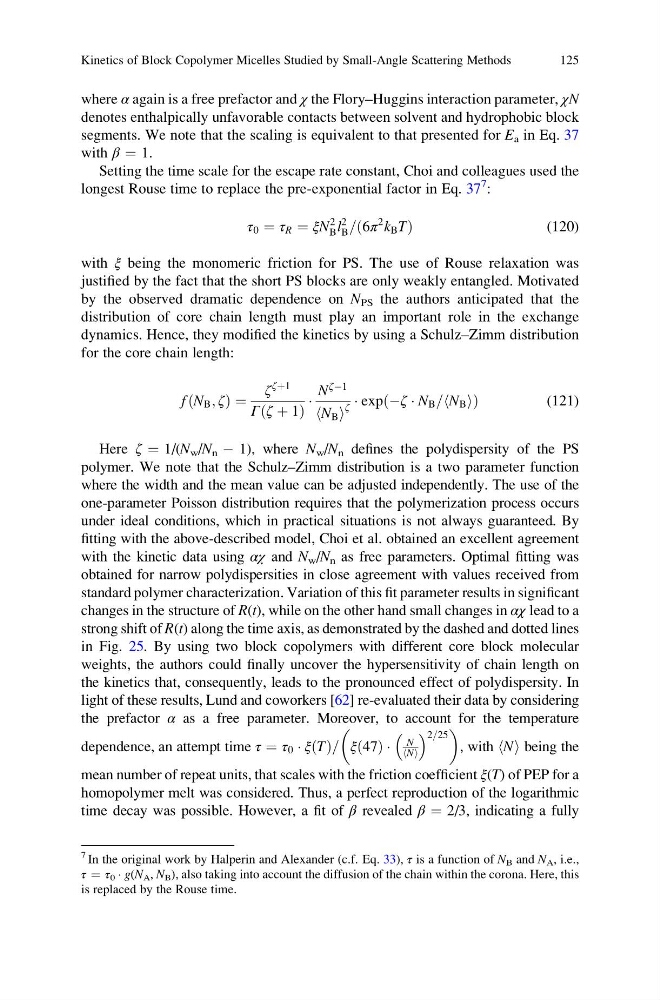
f ðN B ; ζÞ ¼
ζ
ζþ1
Γðζ þ 1Þ
Á
N
ζÀ1
N B
h i
ζ
Á exp Àζ Á N B = N B
h i
ð
Þ
(121)
Here ζ ¼ 1/(N w /N n À 1), where N w /N n defines the polydispersity of the PS
polymer. We note that the Schulz–Zimm distribution is a two parameter function
where the width and the mean value can be adjusted independently. The use of the
one-parameter Poisson distribution requires that the polymerization process occurs
under ideal conditions, which in practical situations is not always guaranteed. By
fitting with the above-described model, Choi et al. obtained an excellent agreement
with the kinetic data using αχ and N w /N n as free parameters. Optimal fitting was
obtained for narrow polydispersities in close agreement with values received from
standard polymer characterization. Variation of this fit parameter results in significant
changes in the structure of R(t), while on the other hand small changes in αχ lead to a
strong shift of R(t) along the time axis, as demonstrated by the dashed and dotted lines
in Fig. 25. By using two block copolymers with different core block molecular
weights, the authors could finally uncover the hypersensitivity of chain length on
the kinetics that, consequently, leads to the pronounced effect of polydispersity. In
light of these results, Lund and coworkers [62] re-evaluated their data by considering
the prefactor α as a free parameter. Moreover, to account for the temperature
dependence, an attempt time τ ¼ τ 0 Á ξðTÞ= ξð47Þ Á
N
hNi
2=25
, with hNi being the
mean number of repeat units, that scales with the friction coefficient ξ(T) of PEP for a
homopolymer melt was considered. Thus, a perfect reproduction of the logarithmic
time decay was possible. However, a fit of β revealed β ¼ 2/3, indicating a fully
7 In the original work by Halperin and Alexander (c.f. Eq. 33), τ is a function of N B and N A , i.e.,
τ ¼ τ 0 Á g(N A , N B ), also taking into account the diffusion of the chain within the corona. Here, this
is replaced by the Rouse time.
Kinetics of Block Copolymer Micelles Studied by Small-Angle Scattering Methods
125
denotes enthalpically unfavorable contacts between solvent and hydrophobic block
segments. We note that the scaling is equivalent to that presented for E a in Eq. 37
with β ¼ 1.
Setting the time scale for the escape rate constant, Choi and colleagues used the
longest Rouse time to replace the pre-exponential factor in Eq. 37
7 :
τ 0 ¼ τ R ¼ ξN
2
B l
2
B =ð6π
2 k B TÞ
(120)
with ξ being the monomeric friction for PS. The use of Rouse relaxation was
justified by the fact that the short PS blocks are only weakly entangled. Motivated
by the observed dramatic dependence on N PS the authors anticipated that the
distribution of core chain length must play an important role in the exchange
dynamics. Hence, they modified the kinetics by using a Schulz–Zimm distribution
for the core chain length:
f ðN B ; ζÞ ¼
ζ
ζþ1
Γðζ þ 1Þ
Á
N
ζÀ1
N B
h i
ζ
Á exp Àζ Á N B = N B
h i
ð
Þ
(121)
Here ζ ¼ 1/(N w /N n À 1), where N w /N n defines the polydispersity of the PS
polymer. We note that the Schulz–Zimm distribution is a two parameter function
where the width and the mean value can be adjusted independently. The use of the
one-parameter Poisson distribution requires that the polymerization process occurs
under ideal conditions, which in practical situations is not always guaranteed. By
fitting with the above-described model, Choi et al. obtained an excellent agreement
with the kinetic data using αχ and N w /N n as free parameters. Optimal fitting was
obtained for narrow polydispersities in close agreement with values received from
standard polymer characterization. Variation of this fit parameter results in significant
changes in the structure of R(t), while on the other hand small changes in αχ lead to a
strong shift of R(t) along the time axis, as demonstrated by the dashed and dotted lines
in Fig. 25. By using two block copolymers with different core block molecular
weights, the authors could finally uncover the hypersensitivity of chain length on
the kinetics that, consequently, leads to the pronounced effect of polydispersity. In
light of these results, Lund and coworkers [62] re-evaluated their data by considering
the prefactor α as a free parameter. Moreover, to account for the temperature
dependence, an attempt time τ ¼ τ 0 Á ξðTÞ= ξð47Þ Á
N
hNi
2=25
, with hNi being the
mean number of repeat units, that scales with the friction coefficient ξ(T) of PEP for a
homopolymer melt was considered. Thus, a perfect reproduction of the logarithmic
time decay was possible. However, a fit of β revealed β ¼ 2/3, indicating a fully
7 In the original work by Halperin and Alexander (c.f. Eq. 33), τ is a function of N B and N A , i.e.,
τ ¼ τ 0 Á g(N A , N B ), also taking into account the diffusion of the chain within the corona. Here, this
is replaced by the Rouse time.
Kinetics of Block Copolymer Micelles Studied by Small-Angle Scattering Methods
125