

4.3 Block Copolymer Micelles in Organic Solvents
In this section, we will focus on the kinetics of micelles built from diblock copolymers
in organic solvents. Typical systems are polystyrene–polybutadiene (PS-PB),
polystyrene–polyisoprene (PS-PI), or polystyrene–poly(ethylene-alt-propylene)
(PS-PEP) block copolymers in hydrocarbon solvents like alkanes. Alkanes are poor
solvents for PS and good solvents for the polydienes and PEP, respectively, such that
in all cases PS forms the micellar core. A common feature of these systems is the fact
that the thermodynamic interactions are significantly weaker than in water-based
micelles, reflected by small χ parameters or correspondingly by low interfacial
tensions. Accordingly, such systems are only weakly segregated, which may lead to
micellar cores considerably swollen by the solvent. This has been observed, e.g., by
SANS on PS-PI micelles in n-decane [74] and PS-PB micelles [30] in a series of
n-alkanes (C n H 2n+2 , where n ¼ 7,10,12,14, or 16) by using contrast variation and
detailed model fitting. For the PS-PI micelles in n-decane, the core was swollen with
15–25% solvent, depending on molecular weight. For micelles formed by a symmetric PS-PB block copolymer, the solvent fraction was even higher (35–55%) but
decreased with increasing number of carbon atoms of the n-alkane solvent. The
opposite trend was observed for the aggregation number, which increases with
n although the interfacial tension stays constant or even slightly decreases from
5.7 mN/m for n-heptane to 4.8 mN/m for n-hexadecane. This unexpected behavior
can be understood by applying a modified mean-field model that properly takes into
account solvent entropy effects [30]. The chain exchange kinetics of the PS-PB
system was studied in the different n-alkanes by TR-SANS [150, 155]. The study
revealed that the exchange dynamics depend strongly on the choice of solvent. For
instance, in n-decane exchange is very fast and outside the time window accessible by
TR-SANS. This was still the case after lowering the temperature to 10
C. If the
carbon length of the solvent is increased, the exchange dynamics decrease and is
slowest for n-hexadecane where the time scale is optimal for TR-SANS
measurements. It should be noted that the activation barrier, E a , for unimer release
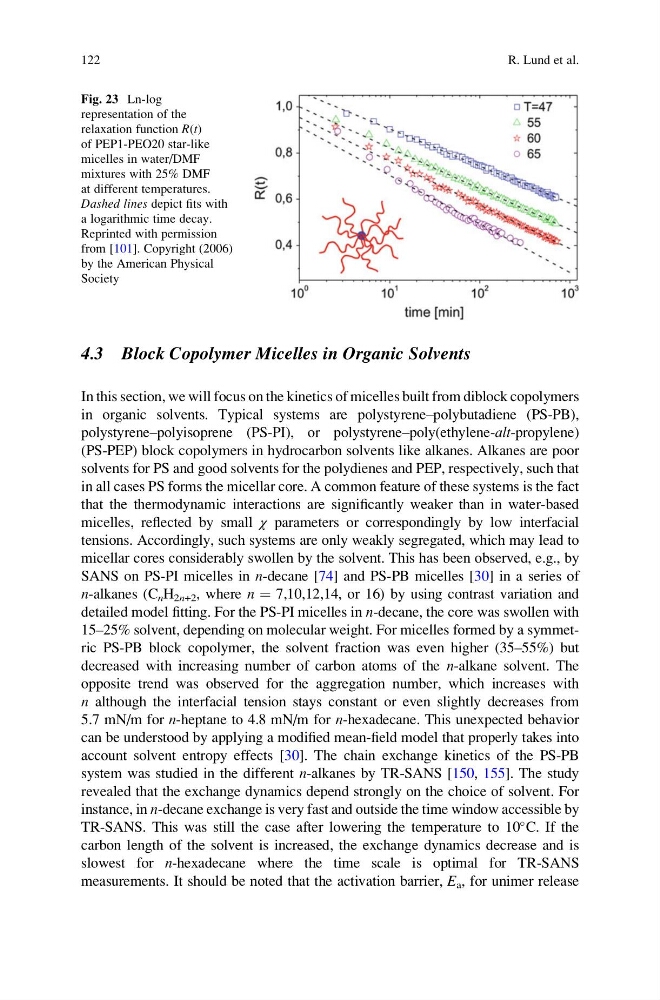
Fig. 23 Ln-log
representation of the
relaxation function R(t)
of PEP1-PEO20 star-like
micelles in water/DMF
mixtures with 25% DMF
at different temperatures.
Dashed lines depict fits with
a logarithmic time decay.
Reprinted with permission
from [101]. Copyright (2006)
by the American Physical
Society
122
R. Lund et al.
In this section, we will focus on the kinetics of micelles built from diblock copolymers
in organic solvents. Typical systems are polystyrene–polybutadiene (PS-PB),
polystyrene–polyisoprene (PS-PI), or polystyrene–poly(ethylene-alt-propylene)
(PS-PEP) block copolymers in hydrocarbon solvents like alkanes. Alkanes are poor
solvents for PS and good solvents for the polydienes and PEP, respectively, such that
in all cases PS forms the micellar core. A common feature of these systems is the fact
that the thermodynamic interactions are significantly weaker than in water-based
micelles, reflected by small χ parameters or correspondingly by low interfacial
tensions. Accordingly, such systems are only weakly segregated, which may lead to
micellar cores considerably swollen by the solvent. This has been observed, e.g., by
SANS on PS-PI micelles in n-decane [74] and PS-PB micelles [30] in a series of
n-alkanes (C n H 2n+2 , where n ¼ 7,10,12,14, or 16) by using contrast variation and
detailed model fitting. For the PS-PI micelles in n-decane, the core was swollen with
15–25% solvent, depending on molecular weight. For micelles formed by a symmetric PS-PB block copolymer, the solvent fraction was even higher (35–55%) but
decreased with increasing number of carbon atoms of the n-alkane solvent. The
opposite trend was observed for the aggregation number, which increases with
n although the interfacial tension stays constant or even slightly decreases from
5.7 mN/m for n-heptane to 4.8 mN/m for n-hexadecane. This unexpected behavior
can be understood by applying a modified mean-field model that properly takes into
account solvent entropy effects [30]. The chain exchange kinetics of the PS-PB
system was studied in the different n-alkanes by TR-SANS [150, 155]. The study
revealed that the exchange dynamics depend strongly on the choice of solvent. For
instance, in n-decane exchange is very fast and outside the time window accessible by
TR-SANS. This was still the case after lowering the temperature to 10
C. If the
carbon length of the solvent is increased, the exchange dynamics decrease and is
slowest for n-hexadecane where the time scale is optimal for TR-SANS
measurements. It should be noted that the activation barrier, E a , for unimer release
Fig. 23 Ln-log
representation of the
relaxation function R(t)
of PEP1-PEO20 star-like
micelles in water/DMF
mixtures with 25% DMF
at different temperatures.
Dashed lines depict fits with
a logarithmic time decay.
Reprinted with permission
from [101]. Copyright (2006)
by the American Physical
Society
122
R. Lund et al.