

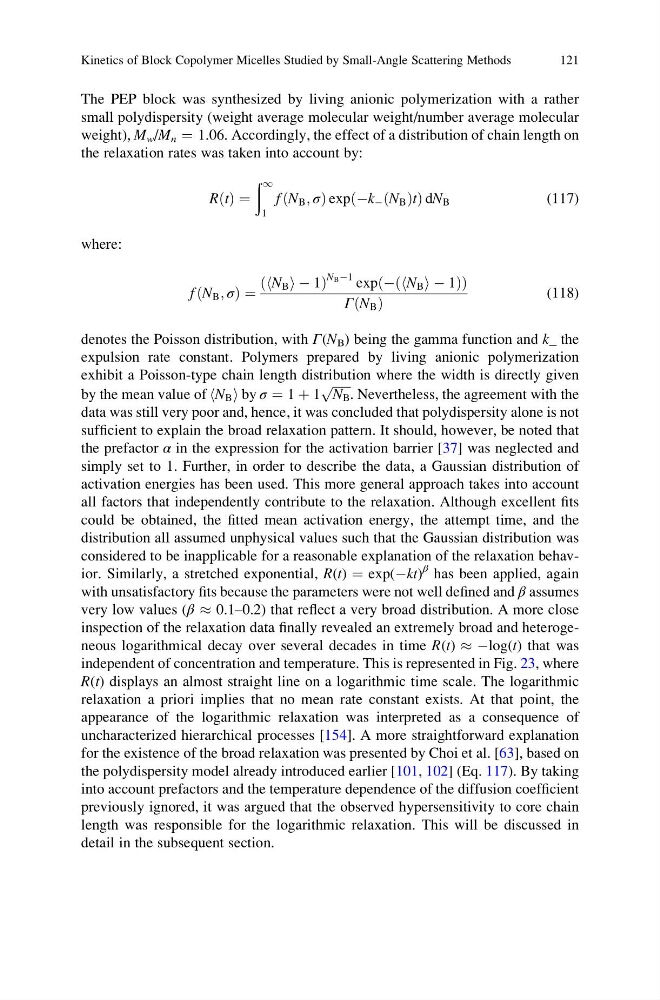
The PEP block was synthesized by living anionic polymerization with a rather
small polydispersity (weight average molecular weight/number average molecular
weight), M w /M n ¼ 1.06. Accordingly, the effect of a distribution of chain length on
the relaxation rates was taken into account by:
RðtÞ ¼
ð 1
1
f ðN B ; σÞ exp Àk À ðN B Þt
ð
ÞdN B
(117)
where:
f ðN B ; σÞ ¼
N B
h i À 1
ð
Þ
N B À1 exp À N B
h i À 1
ð
Þ
ð
Þ
ΓðN B Þ
(118)
denotes the Poisson distribution, with Γ(N B ) being the gamma function and k_ the
expulsion rate constant. Polymers prepared by living anionic polymerization
exhibit a Poisson-type chain length distribution where the width is directly given
by the mean value of N B
h iby σ ¼ 1 þ 1
ffiffiffiffiffiffi
N B
p
. Nevertheless, the agreement with the
data was still very poor and, hence, it was concluded that polydispersity alone is not
sufficient to explain the broad relaxation pattern. It should, however, be noted that
the prefactor α in the expression for the activation barrier [37] was neglected and
simply set to 1. Further, in order to describe the data, a Gaussian distribution of
activation energies has been used. This more general approach takes into account
all factors that independently contribute to the relaxation. Although excellent fits
could be obtained, the fitted mean activation energy, the attempt time, and the
distribution all assumed unphysical values such that the Gaussian distribution was
considered to be inapplicable for a reasonable explanation of the relaxation behavior. Similarly, a stretched exponential, R(t) ¼ exp(Àkt)
β has been applied, again
with unsatisfactory fits because the parameters were not well defined and β assumes
very low values (β % 0.1–0.2) that reflect a very broad distribution. A more close
inspection of the relaxation data finally revealed an extremely broad and heterogeneous logarithmical decay over several decades in time R(t) % Àlog(t) that was
independent of concentration and temperature. This is represented in Fig. 23, where
R(t) displays an almost straight line on a logarithmic time scale. The logarithmic
relaxation a priori implies that no mean rate constant exists. At that point, the
appearance of the logarithmic relaxation was interpreted as a consequence of
uncharacterized hierarchical processes [154]. A more straightforward explanation
for the existence of the broad relaxation was presented by Choi et al. [63], based on
the polydispersity model already introduced earlier [101, 102] (Eq. 117). By taking
into account prefactors and the temperature dependence of the diffusion coefficient
previously ignored, it was argued that the observed hypersensitivity to core chain
length was responsible for the logarithmic relaxation. This will be discussed in
detail in the subsequent section.
Kinetics of Block Copolymer Micelles Studied by Small-Angle Scattering Methods
121
small polydispersity (weight average molecular weight/number average molecular
weight), M w /M n ¼ 1.06. Accordingly, the effect of a distribution of chain length on
the relaxation rates was taken into account by:
RðtÞ ¼
ð 1
1
f ðN B ; σÞ exp Àk À ðN B Þt
ð
ÞdN B
(117)
where:
f ðN B ; σÞ ¼
N B
h i À 1
ð
Þ
N B À1 exp À N B
h i À 1
ð
Þ
ð
Þ
ΓðN B Þ
(118)
denotes the Poisson distribution, with Γ(N B ) being the gamma function and k_ the
expulsion rate constant. Polymers prepared by living anionic polymerization
exhibit a Poisson-type chain length distribution where the width is directly given
by the mean value of N B
h iby σ ¼ 1 þ 1
ffiffiffiffiffiffi
N B
p
. Nevertheless, the agreement with the
data was still very poor and, hence, it was concluded that polydispersity alone is not
sufficient to explain the broad relaxation pattern. It should, however, be noted that
the prefactor α in the expression for the activation barrier [37] was neglected and
simply set to 1. Further, in order to describe the data, a Gaussian distribution of
activation energies has been used. This more general approach takes into account
all factors that independently contribute to the relaxation. Although excellent fits
could be obtained, the fitted mean activation energy, the attempt time, and the
distribution all assumed unphysical values such that the Gaussian distribution was
considered to be inapplicable for a reasonable explanation of the relaxation behavior. Similarly, a stretched exponential, R(t) ¼ exp(Àkt)
β has been applied, again
with unsatisfactory fits because the parameters were not well defined and β assumes
very low values (β % 0.1–0.2) that reflect a very broad distribution. A more close
inspection of the relaxation data finally revealed an extremely broad and heterogeneous logarithmical decay over several decades in time R(t) % Àlog(t) that was
independent of concentration and temperature. This is represented in Fig. 23, where
R(t) displays an almost straight line on a logarithmic time scale. The logarithmic
relaxation a priori implies that no mean rate constant exists. At that point, the
appearance of the logarithmic relaxation was interpreted as a consequence of
uncharacterized hierarchical processes [154]. A more straightforward explanation
for the existence of the broad relaxation was presented by Choi et al. [63], based on
the polydispersity model already introduced earlier [101, 102] (Eq. 117). By taking
into account prefactors and the temperature dependence of the diffusion coefficient
previously ignored, it was argued that the observed hypersensitivity to core chain
length was responsible for the logarithmic relaxation. This will be discussed in
detail in the subsequent section.
Kinetics of Block Copolymer Micelles Studied by Small-Angle Scattering Methods
121