

reduction with DIBAL-H at low temperatures and subsequent trapping with acetic
anhydride leads to the synthetically useful α-acetoxy ether 262 (Scheme 68, Eq. 4)
[126, 127]. Of the available methods, the relative stability of the α-acetoxy ether
intermediate and the variety of available methods for lactone formation make the
reductive acetylation strategy preferable.
6.1 Lactol Reduction
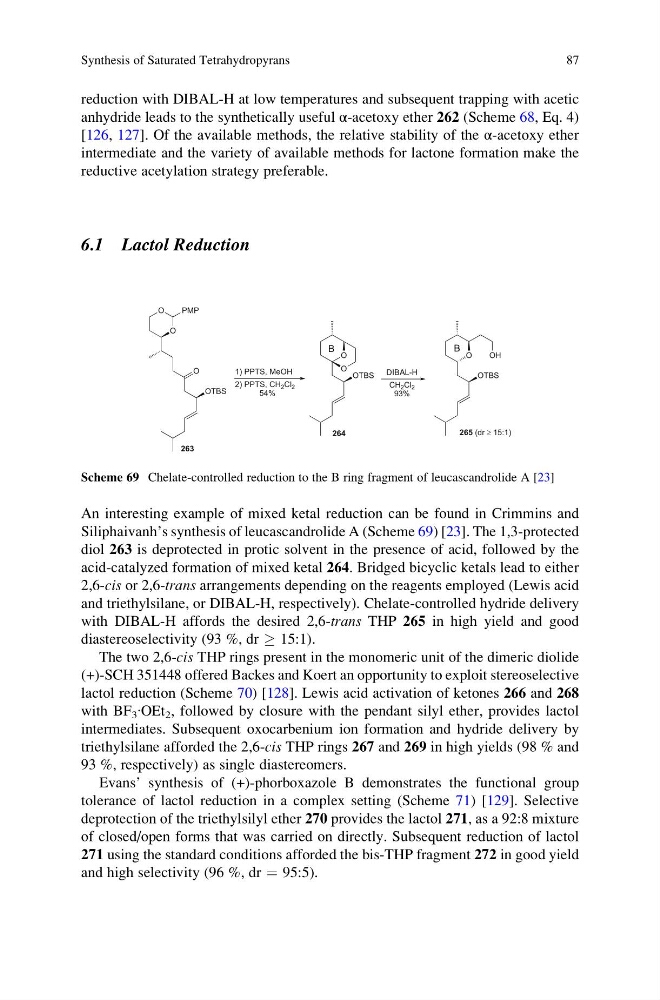
An interesting example of mixed ketal reduction can be found in Crimmins and
Siliphaivanh’s synthesis of leucascandrolide A (Scheme 69) [23]. The 1,3-protected
diol 263 is deprotected in protic solvent in the presence of acid, followed by the
acid-catalyzed formation of mixed ketal 264. Bridged bicyclic ketals lead to either
2,6-cis or 2,6-trans arrangements depending on the reagents employed (Lewis acid
and triethylsilane, or DIBAL-H, respectively). Chelate-controlled hydride delivery
with DIBAL-H affords the desired 2,6-trans THP 265 in high yield and good
diastereoselectivity (93 %, dr ! 15:1).
The two 2,6-cis THP rings present in the monomeric unit of the dimeric diolide
(+)-SCH 351448 offered Backes and Koert an opportunity to exploit stereoselective
lactol reduction (Scheme 70) [128]. Lewis acid activation of ketones 266 and 268
with BF 3 ∙OEt 2 , followed by closure with the pendant silyl ether, provides lactol
intermediates. Subsequent oxocarbenium ion formation and hydride delivery by
triethylsilane afforded the 2,6-cis THP rings 267 and 269 in high yields (98 % and
93 %, respectively) as single diastereomers.
Evans’ synthesis of (+)-phorboxazole B demonstrates the functional group
tolerance of lactol reduction in a complex setting (Scheme 71) [129]. Selective
deprotection of the triethylsilyl ether 270 provides the lactol 271, as a 92:8 mixture
of closed/open forms that was carried on directly. Subsequent reduction of lactol
271 using the standard conditions afforded the bis-THP fragment 272 in good yield
and high selectivity (96 %, dr ¼ 95:5).
O
OH
B
OTBS
O
OTBS
O
OTBS
O
O
O
PMP
1) PPTS, MeOH
2) PPTS, CH 2 Cl 2
54%
B
DIBAL-H
CH 2 Cl 2
93%
263
264
265 (dr ³ 15:1)
Scheme 69 Chelate-controlled reduction to the B ring fragment of leucascandrolide A [23]
Synthesis of Saturated Tetrahydropyrans
87
anhydride leads to the synthetically useful α-acetoxy ether 262 (Scheme 68, Eq. 4)
[126, 127]. Of the available methods, the relative stability of the α-acetoxy ether
intermediate and the variety of available methods for lactone formation make the
reductive acetylation strategy preferable.
6.1 Lactol Reduction
An interesting example of mixed ketal reduction can be found in Crimmins and
Siliphaivanh’s synthesis of leucascandrolide A (Scheme 69) [23]. The 1,3-protected
diol 263 is deprotected in protic solvent in the presence of acid, followed by the
acid-catalyzed formation of mixed ketal 264. Bridged bicyclic ketals lead to either
2,6-cis or 2,6-trans arrangements depending on the reagents employed (Lewis acid
and triethylsilane, or DIBAL-H, respectively). Chelate-controlled hydride delivery
with DIBAL-H affords the desired 2,6-trans THP 265 in high yield and good
diastereoselectivity (93 %, dr ! 15:1).
The two 2,6-cis THP rings present in the monomeric unit of the dimeric diolide
(+)-SCH 351448 offered Backes and Koert an opportunity to exploit stereoselective
lactol reduction (Scheme 70) [128]. Lewis acid activation of ketones 266 and 268
with BF 3 ∙OEt 2 , followed by closure with the pendant silyl ether, provides lactol
intermediates. Subsequent oxocarbenium ion formation and hydride delivery by
triethylsilane afforded the 2,6-cis THP rings 267 and 269 in high yields (98 % and
93 %, respectively) as single diastereomers.
Evans’ synthesis of (+)-phorboxazole B demonstrates the functional group
tolerance of lactol reduction in a complex setting (Scheme 71) [129]. Selective
deprotection of the triethylsilyl ether 270 provides the lactol 271, as a 92:8 mixture
of closed/open forms that was carried on directly. Subsequent reduction of lactol
271 using the standard conditions afforded the bis-THP fragment 272 in good yield
and high selectivity (96 %, dr ¼ 95:5).
O
OH
B
OTBS
O
OTBS
O
OTBS
O
O
O
PMP
1) PPTS, MeOH
2) PPTS, CH 2 Cl 2
54%
B
DIBAL-H
CH 2 Cl 2
93%
263
264
265 (dr ³ 15:1)
Scheme 69 Chelate-controlled reduction to the B ring fragment of leucascandrolide A [23]
Synthesis of Saturated Tetrahydropyrans
87