

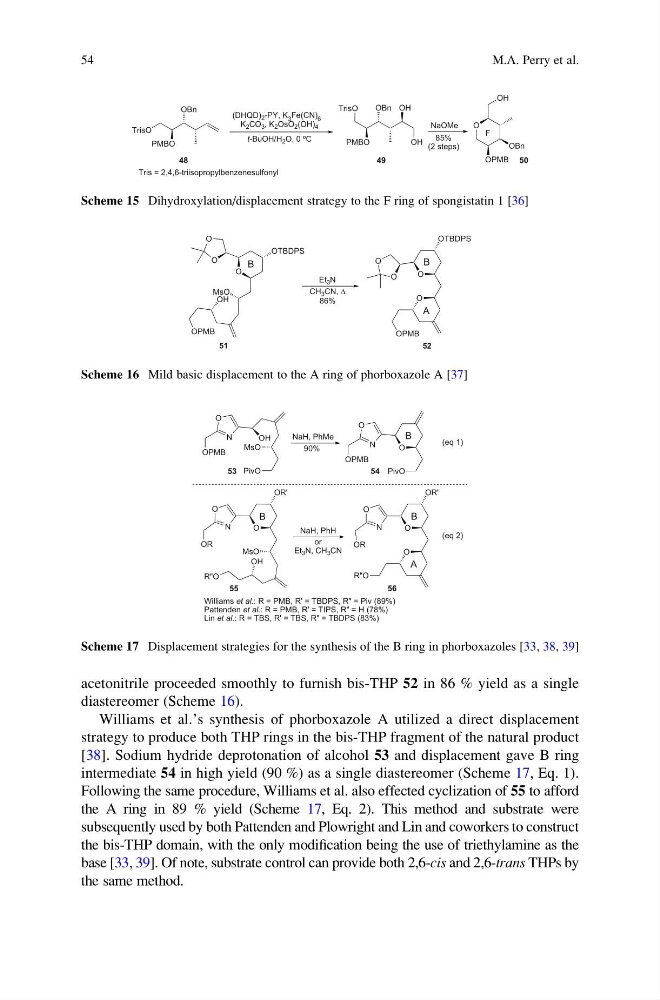
acetonitrile proceeded smoothly to furnish bis-THP 52 in 86 % yield as a single
diastereomer (Scheme 16).
Williams et al.’s synthesis of phorboxazole A utilized a direct displacement
strategy to produce both THP rings in the bis-THP fragment of the natural product
[38]. Sodium hydride deprotonation of alcohol 53 and displacement gave B ring
intermediate 54 in high yield (90 %) as a single diastereomer (Scheme 17, Eq. 1).
Following the same procedure, Williams et al. also effected cyclization of 55 to afford
the A ring in 89 % yield (Scheme 17, Eq. 2). This method and substrate were
subsequently used by both Pattenden and Plowright and Lin and coworkers to construct
the bis-THP domain, with the only modification being the use of triethylamine as the
base [33, 39]. Of note, substrate control can provide both 2,6-cis and 2,6-trans THPs by
the same method.
OH
O
N
O
B
O
N
NaH, PhMe
90%
OPMB
OPMB
PivO
PivO
MsO
O
R"O
B
O
N
OR'
MsO
OH
O
R"O
B
O
N
OR'
O
A
NaH, PhH
or
Et 3 N, CH 3 CN
OR
OR
Williams et al.: R = PMB, R' = TBDPS, R" = Piv (89%)
Pattenden et al.: R = PMB, R' = TIPS, R" = H (78%)
Lin et al.: R = TBS, R' = TBS, R" = TBDPS (83%)
53
54
55
56
(eq 1)
(eq 2)
Scheme 17 Displacement strategies for the synthesis of the B ring in phorboxazoles [33, 38, 39]
TrisO
OBn
PMBO
TrisO
OBn
PMBO
O
OPMB
OBn
OH
NaOMe
(DHQD) 2 -PY, K 3 Fe(CN) 6
K 2 CO 3 , K 2 OsO 2 (OH) 4
85%
(2 steps)
t-BuOH/H 2 O, 0 ºC
OH
OH
F
48
49
50
Tris = 2,4,6-triisopropylbenzenesulfonyl
Scheme 15 Dihydroxylation/displacement strategy to the F ring of spongistatin 1 [36]
O
B
O
O
OTBDPS
MsO
OH
O
B
O
O
OTBDPS
O
A
CH 3 CN, D
86%
OPMB
OPMB
51
52
Et 3 N
Scheme 16 Mild basic displacement to the A ring of phorboxazole A [37]
54
M.A. Perry et al.
diastereomer (Scheme 16).
Williams et al.’s synthesis of phorboxazole A utilized a direct displacement
strategy to produce both THP rings in the bis-THP fragment of the natural product
[38]. Sodium hydride deprotonation of alcohol 53 and displacement gave B ring
intermediate 54 in high yield (90 %) as a single diastereomer (Scheme 17, Eq. 1).
Following the same procedure, Williams et al. also effected cyclization of 55 to afford
the A ring in 89 % yield (Scheme 17, Eq. 2). This method and substrate were
subsequently used by both Pattenden and Plowright and Lin and coworkers to construct
the bis-THP domain, with the only modification being the use of triethylamine as the
base [33, 39]. Of note, substrate control can provide both 2,6-cis and 2,6-trans THPs by
the same method.
OH
O
N
O
B
O
N
NaH, PhMe
90%
OPMB
OPMB
PivO
PivO
MsO
O
R"O
B
O
N
OR'
MsO
OH
O
R"O
B
O
N
OR'
O
A
NaH, PhH
or
Et 3 N, CH 3 CN
OR
OR
Williams et al.: R = PMB, R' = TBDPS, R" = Piv (89%)
Pattenden et al.: R = PMB, R' = TIPS, R" = H (78%)
Lin et al.: R = TBS, R' = TBS, R" = TBDPS (83%)
53
54
55
56
(eq 1)
(eq 2)
Scheme 17 Displacement strategies for the synthesis of the B ring in phorboxazoles [33, 38, 39]
TrisO
OBn
PMBO
TrisO
OBn
PMBO
O
OPMB
OBn
OH
NaOMe
(DHQD) 2 -PY, K 3 Fe(CN) 6
K 2 CO 3 , K 2 OsO 2 (OH) 4
85%
(2 steps)
t-BuOH/H 2 O, 0 ºC
OH
OH
F
48
49
50
Tris = 2,4,6-triisopropylbenzenesulfonyl
Scheme 15 Dihydroxylation/displacement strategy to the F ring of spongistatin 1 [36]
O
B
O
O
OTBDPS
MsO
OH
O
B
O
O
OTBDPS
O
A
CH 3 CN, D
86%
OPMB
OPMB
51
52
Et 3 N
Scheme 16 Mild basic displacement to the A ring of phorboxazole A [37]
54
M.A. Perry et al.