

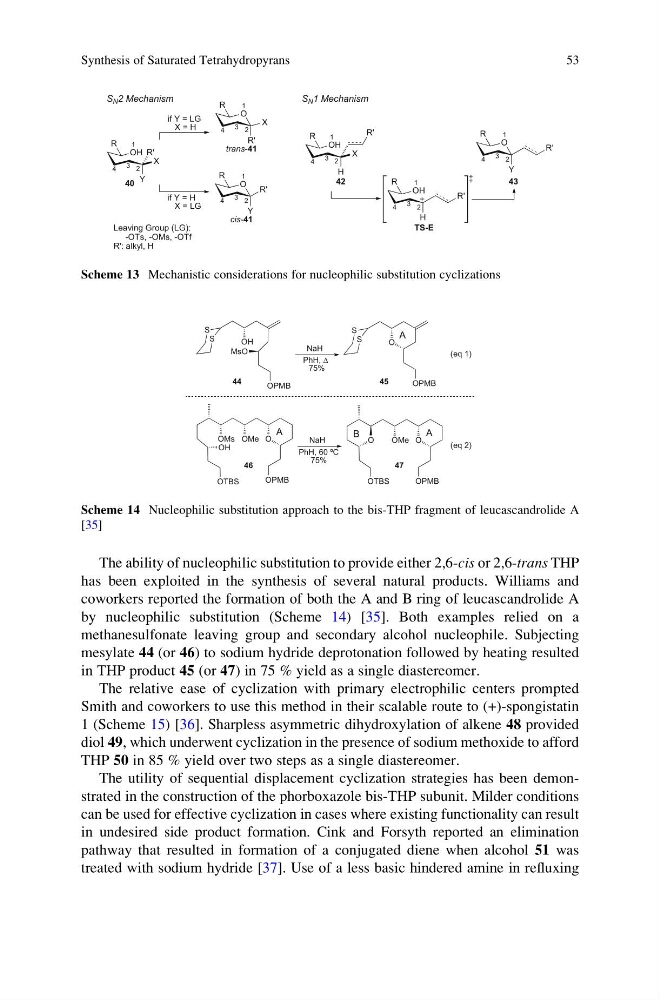
The ability of nucleophilic substitution to provide either 2,6-cis or 2,6-trans THP
has been exploited in the synthesis of several natural products. Williams and
coworkers reported the formation of both the A and B ring of leucascandrolide A
by nucleophilic substitution (Scheme 14) [35]. Both examples relied on a
methanesulfonate leaving group and secondary alcohol nucleophile. Subjecting
mesylate 44 (or 46) to sodium hydride deprotonation followed by heating resulted
in THP product 45 (or 47) in 75 % yield as a single diastereomer.
The relative ease of cyclization with primary electrophilic centers prompted
Smith and coworkers to use this method in their scalable route to (+)-spongistatin
1 (Scheme 15) [36]. Sharpless asymmetric dihydroxylation of alkene 48 provided
diol 49, which underwent cyclization in the presence of sodium methoxide to afford
THP 50 in 85 % yield over two steps as a single diastereomer.
The utility of sequential displacement cyclization strategies has been demonstrated in the construction of the phorboxazole bis-THP subunit. Milder conditions
can be used for effective cyclization in cases where existing functionality can result
in undesired side product formation. Cink and Forsyth reported an elimination
pathway that resulted in formation of a conjugated diene when alcohol 51 was
treated with sodium hydride [37]. Use of a less basic hindered amine in refluxing
O
A
OH
OPMB
S
S
S
S
MsO
PhH, D
75%
OMs OMe O
OPMB
OTBS
A
OH
O
OMe O
OPMB
OTBS
A
PhH, 60 ºC
75%
B
OPMB
44
45
46
47
(eq 1)
(eq 2)
NaH
NaH
Scheme 14 Nucleophilic substitution approach to the bis-THP fragment of leucascandrolide A
[35]
1
2
3
4
trans-41
cis-41
OH
R
R'
1
2
3
4
O
R
1
2
3
4
O
R
R'
R'
Y
X
if Y = LG
X = H
if Y = H
X = LG
Y
X
S N 2 Mechanism
1
2
3
4
OH
R
1
2
3
4
OH
R
H
X
H
S N 1 Mechanism
1
2
3
4
O
R
Y
Leaving Group (LG):
-OTs, -OMs, -OTf
R': alkyl, H
R'
R'
R'
40
42
43
‡
TS-E
Scheme 13 Mechanistic considerations for nucleophilic substitution cyclizations
Synthesis of Saturated Tetrahydropyrans
53
has been exploited in the synthesis of several natural products. Williams and
coworkers reported the formation of both the A and B ring of leucascandrolide A
by nucleophilic substitution (Scheme 14) [35]. Both examples relied on a
methanesulfonate leaving group and secondary alcohol nucleophile. Subjecting
mesylate 44 (or 46) to sodium hydride deprotonation followed by heating resulted
in THP product 45 (or 47) in 75 % yield as a single diastereomer.
The relative ease of cyclization with primary electrophilic centers prompted
Smith and coworkers to use this method in their scalable route to (+)-spongistatin
1 (Scheme 15) [36]. Sharpless asymmetric dihydroxylation of alkene 48 provided
diol 49, which underwent cyclization in the presence of sodium methoxide to afford
THP 50 in 85 % yield over two steps as a single diastereomer.
The utility of sequential displacement cyclization strategies has been demonstrated in the construction of the phorboxazole bis-THP subunit. Milder conditions
can be used for effective cyclization in cases where existing functionality can result
in undesired side product formation. Cink and Forsyth reported an elimination
pathway that resulted in formation of a conjugated diene when alcohol 51 was
treated with sodium hydride [37]. Use of a less basic hindered amine in refluxing
O
A
OH
OPMB
S
S
S
S
MsO
PhH, D
75%
OMs OMe O
OPMB
OTBS
A
OH
O
OMe O
OPMB
OTBS
A
PhH, 60 ºC
75%
B
OPMB
44
45
46
47
(eq 1)
(eq 2)
NaH
NaH
Scheme 14 Nucleophilic substitution approach to the bis-THP fragment of leucascandrolide A
[35]
1
2
3
4
trans-41
cis-41
OH
R
R'
1
2
3
4
O
R
1
2
3
4
O
R
R'
R'
Y
X
if Y = LG
X = H
if Y = H
X = LG
Y
X
S N 2 Mechanism
1
2
3
4
OH
R
1
2
3
4
OH
R
H
X
H
S N 1 Mechanism
1
2
3
4
O
R
Y
Leaving Group (LG):
-OTs, -OMs, -OTf
R': alkyl, H
R'
R'
R'
40
42
43
‡
TS-E
Scheme 13 Mechanistic considerations for nucleophilic substitution cyclizations
Synthesis of Saturated Tetrahydropyrans
53