

8 Nucleophilic Substitutions
Another approach to substituted tetrahydrofurans has involved the intramolecular
addition of oxygen nucleophiles to electrophilic carbon atoms [75]. Outlined here
are recent efforts in this area.
Langer and coworkers have synthesized a number of substituted tetrahydrofurans from alkylidene tetrahydrofurans which in turn were generated from an
alkylation/cyclization sequence of β-ketoesters [76]. For example, alkylation of
the dianion of β-ketoester 264 with 1-bromo-2-chloroethane resulted in the synthesis of 2-alkylidene tetrahydrofuran 265 (Scheme 69).
In an analogous fashion to the results with 1-bromo-2-chloroethane, the treatment of the dianion from ethyl acetoacetate with 1,4-dibromo-2-butene resulted in
the generation of 2-alkylidenetetrahydrofuran 268 as a 1:1 mixture of olefin isomers
in 75 % yield (Scheme 70). Hydrogenation of 268 gave 2,5-cis-tetrahydrofuran 269.
Langer et al. have also carried out alkylation and cyclization reactions from
bis-silyl enol ether 270 using 1-chloro-2,2-dimethoxyethane 271 as the electrophile
to give 2-alkylidiene tetrahydrofuran 272 (Scheme 71) [77].
OH
R 2 R 3
R 1
TfOH (1 mol %)
Acetone•H 2 O (4:1)
90 °C;
NXS or Selectfluor
-5 °C
O
R 1
X
R 2
R 3
via:
R 2
R 3
R 1
HO
287 (R
2 > R
3
)
60-98%
R 1 = H, Aryl
R 2 = aryl, alkynyl
R 3 = aryl, alkyl
286
288
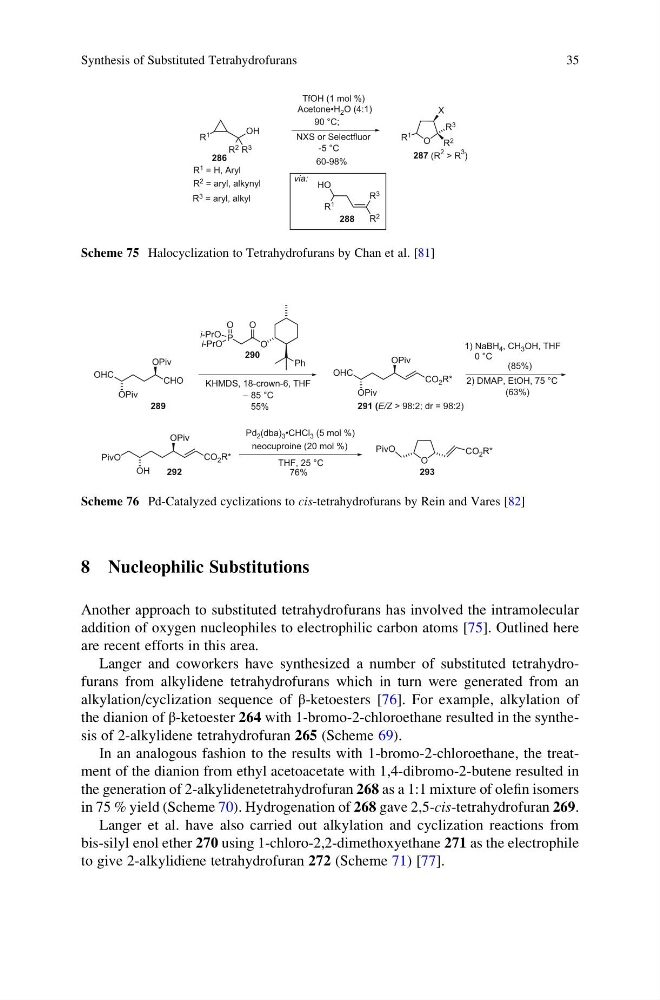
Scheme 75 Halocyclization to Tetrahydrofurans by Chan et al. [81]
OHC
CHO
OPiv
OPiv
P
O
O
i-PrO
i-PrO
O
Ph
KHMDS, 18-crown-6, THF
– 85 °C
55%
OHC
OPiv
OPiv
CO 2 R*
291 (E/Z > 98:2; dr = 98:2)
1) NaBH 4 , CH 3 OH, THF
0 °C
(85%)
2) DMAP, EtOH, 75 °C
(63%)
OH
OPiv
CO 2 R*
PivO
Pd 2 (dba) 3 •CHCl 3 (5 mol %)
neocuproine (20 mol %)
THF, 25 °C
O
CO 2 R*
PivO
76%
289
290
292
293
Scheme 76 Pd-Catalyzed cyclizations to cis-tetrahydrofurans by Rein and Vares [82]
Synthesis of Substituted Tetrahydrofurans
35
Another approach to substituted tetrahydrofurans has involved the intramolecular
addition of oxygen nucleophiles to electrophilic carbon atoms [75]. Outlined here
are recent efforts in this area.
Langer and coworkers have synthesized a number of substituted tetrahydrofurans from alkylidene tetrahydrofurans which in turn were generated from an
alkylation/cyclization sequence of β-ketoesters [76]. For example, alkylation of
the dianion of β-ketoester 264 with 1-bromo-2-chloroethane resulted in the synthesis of 2-alkylidene tetrahydrofuran 265 (Scheme 69).
In an analogous fashion to the results with 1-bromo-2-chloroethane, the treatment of the dianion from ethyl acetoacetate with 1,4-dibromo-2-butene resulted in
the generation of 2-alkylidenetetrahydrofuran 268 as a 1:1 mixture of olefin isomers
in 75 % yield (Scheme 70). Hydrogenation of 268 gave 2,5-cis-tetrahydrofuran 269.
Langer et al. have also carried out alkylation and cyclization reactions from
bis-silyl enol ether 270 using 1-chloro-2,2-dimethoxyethane 271 as the electrophile
to give 2-alkylidiene tetrahydrofuran 272 (Scheme 71) [77].
OH
R 2 R 3
R 1
TfOH (1 mol %)
Acetone•H 2 O (4:1)
90 °C;
NXS or Selectfluor
-5 °C
O
R 1
X
R 2
R 3
via:
R 2
R 3
R 1
HO
287 (R
2 > R
3
)
60-98%
R 1 = H, Aryl
R 2 = aryl, alkynyl
R 3 = aryl, alkyl
286
288
Scheme 75 Halocyclization to Tetrahydrofurans by Chan et al. [81]
OHC
CHO
OPiv
OPiv
P
O
O
i-PrO
i-PrO
O
Ph
KHMDS, 18-crown-6, THF
– 85 °C
55%
OHC
OPiv
OPiv
CO 2 R*
291 (E/Z > 98:2; dr = 98:2)
1) NaBH 4 , CH 3 OH, THF
0 °C
(85%)
2) DMAP, EtOH, 75 °C
(63%)
OH
OPiv
CO 2 R*
PivO
Pd 2 (dba) 3 •CHCl 3 (5 mol %)
neocuproine (20 mol %)
THF, 25 °C
O
CO 2 R*
PivO
76%
289
290
292
293
Scheme 76 Pd-Catalyzed cyclizations to cis-tetrahydrofurans by Rein and Vares [82]
Synthesis of Substituted Tetrahydrofurans
35