

In addition to the reactions outlined above, regioselective ROM/CM was used to
generate tricyclic tetrahydrofuran 241 (Scheme 65).
Oikawa and coworkers have employed unsymmetrical 7-oxanorbornenes in
regioselective ROM/CM reactions and have used the products from these reactions
to generate glutamate analogs 250 and 251 [72]. As illustrated in Scheme 66, by
combining amine 242 with furfural 245, benzylisonitrile 244, and β-iodoacryclic
acid 243, they were able to generate oxanorbornene 246 in 68 % yield from a
tandem Ugi/Diels-Alder cascade. The iodide in 246 was amenable to substitution
with oxygen and nitrogen nucleophiles to give tricyclic metathesis precursor 247.
The authors subsequently used the Hoveyda–Grubbs second-generation catalyst
248 to carry out an ROM/CM reaction with vinyl acetate to give tetrahydrofuran
249 which was taken on to glutamate analogs.
Benjamin and Martin have employed optically active oxanorbornenes in
regioselective ROM/CM reactions (Scheme 67) [73].
From an interest in the phelligridin G scaffold Cooper and Wright have reported
a tandem ROM/RCM approach to oxaspirocycles (Scheme 68) [74].
The ROM/RCM reaction of readily available oxabicycle 262 using the Grubbs
second-generation catalyst 229 resulted in the generation of spirocycle 263 in 50 %
yield.
HO
OAc
OBn
NHBoc
Pd(PPh 3 ) 4 (cat.), PPh 3
THF, 55 °C
87%
O
OBn
BocHN
O
C 14 H 29
OH
H 2 N
HO
OAc
OBn
NHBoc
Pd(PPh 3 ) 4 (cat.), PPh 3
THF, 55 °C
89%
O
OBn
BocHN
278 (dr = 2:1)
280 (dr = 9:1)
Pachastrissamine
277
279
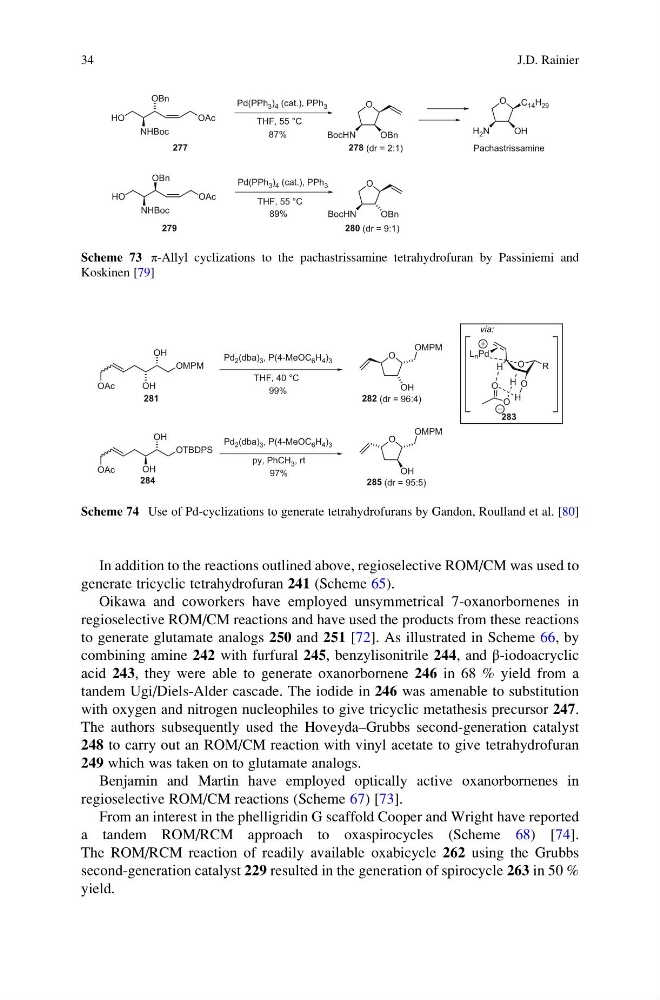
Scheme 73 π-Allyl cyclizations to the pachastrissamine tetrahydrofuran by Passiniemi and
Koskinen [79]
O
OMPM
OH
OH
OAc
Pd 2 (dba) 3 , P(4-MeOC 6 H 4 ) 3
THF, 40 °C
OMPM
OH
99%
282 (dr = 96:4)
O
OTBDPS
OH
OH
OAc
Pd 2 (dba) 3 , P(4-MeOC 6 H 4 ) 3
py, PhCH 3 , rt
OMPM
OH
97%
285 (dr = 95:5)
via:
O
R
H
O
H
L n Pd
O H
O
281
284
283
Scheme 74 Use of Pd-cyclizations to generate tetrahydrofurans by Gandon, Roulland et al. [80]
34
J.D. Rainier
generate tricyclic tetrahydrofuran 241 (Scheme 65).
Oikawa and coworkers have employed unsymmetrical 7-oxanorbornenes in
regioselective ROM/CM reactions and have used the products from these reactions
to generate glutamate analogs 250 and 251 [72]. As illustrated in Scheme 66, by
combining amine 242 with furfural 245, benzylisonitrile 244, and β-iodoacryclic
acid 243, they were able to generate oxanorbornene 246 in 68 % yield from a
tandem Ugi/Diels-Alder cascade. The iodide in 246 was amenable to substitution
with oxygen and nitrogen nucleophiles to give tricyclic metathesis precursor 247.
The authors subsequently used the Hoveyda–Grubbs second-generation catalyst
248 to carry out an ROM/CM reaction with vinyl acetate to give tetrahydrofuran
249 which was taken on to glutamate analogs.
Benjamin and Martin have employed optically active oxanorbornenes in
regioselective ROM/CM reactions (Scheme 67) [73].
From an interest in the phelligridin G scaffold Cooper and Wright have reported
a tandem ROM/RCM approach to oxaspirocycles (Scheme 68) [74].
The ROM/RCM reaction of readily available oxabicycle 262 using the Grubbs
second-generation catalyst 229 resulted in the generation of spirocycle 263 in 50 %
yield.
HO
OAc
OBn
NHBoc
Pd(PPh 3 ) 4 (cat.), PPh 3
THF, 55 °C
87%
O
OBn
BocHN
O
C 14 H 29
OH
H 2 N
HO
OAc
OBn
NHBoc
Pd(PPh 3 ) 4 (cat.), PPh 3
THF, 55 °C
89%
O
OBn
BocHN
278 (dr = 2:1)
280 (dr = 9:1)
Pachastrissamine
277
279
Scheme 73 π-Allyl cyclizations to the pachastrissamine tetrahydrofuran by Passiniemi and
Koskinen [79]
O
OMPM
OH
OH
OAc
Pd 2 (dba) 3 , P(4-MeOC 6 H 4 ) 3
THF, 40 °C
OMPM
OH
99%
282 (dr = 96:4)
O
OTBDPS
OH
OH
OAc
Pd 2 (dba) 3 , P(4-MeOC 6 H 4 ) 3
py, PhCH 3 , rt
OMPM
OH
97%
285 (dr = 95:5)
via:
O
R
H
O
H
L n Pd
O H
O
281
284
283
Scheme 74 Use of Pd-cyclizations to generate tetrahydrofurans by Gandon, Roulland et al. [80]
34
J.D. Rainier