

7.2 Ring-Opening Metathesis
A number of groups have examined the generation of substituted tetrahydrofurans
from ring-opening metathesis/cross-metathesis (ROM/CM) reactions of
7-oxabicyclo[2.2.1]heptenes. The Plumet group has had a tremendous impact on
this area. One example of their work is highlighted in Scheme 60 where they
demonstrated the use of ROM/CM reactions and ring-opening metathesis/ringclosing metathesis (ROM/RCM) reactions to generate 2,5-cis-tetrahydrofurans
having spiro-fused β-lactams at C3 [68]. The ring-opening precursors 225 were
generated from allylamine 223 using a Staudinger reaction. ROM/RCM of 225
using the first generation Grubbs catalyst 226 and ethylene enabled them to
efficiently generate the spiro-fused furan 227. The corresponding ROM/RCM was
limited to ethers as the use of an ester or thioether only afforded ROM/CM
products.
Winkler and coworkers have developed tandem ROM/RCM that leads to furancontaining polycyclic substrates [69]. As an example of their work, the ROM/RCM
cascade of readily available oxanorbornene 228 using the second generation
Grubbs ruthenium catalyst 229 gave tricyclic substrate 230 in 95 % yield
(Scheme 61). The use of this strategy to generate even more complex substrates
than 230 was somewhat problematic.
Ru
N
N
Cl
Cl
O
Mes
Mes
248
MeO
NH 2
CN
HO 2 C
I
O
CHO
50 °C
CH 3 OH
68%
O
I
N
PMB H
O
NHBn
O
Nu
O
N
PMB H
O
NHBn
O
49-100%
X
247
248 (0.5-10 mol %)
O
N
AcO
PMB
O
H H
H
OAc, PhH
X
O
HN
H
H
X
H
250
HO2C
CO 2 H
OH
OH
HO 2 C
242
243
244
245
246
(X = O, OCH 2 , N(Ns), N(Ns)CH 2 )
249
X = O
X = OCH 2
O
HN
H
H
H
HO 2 C
CO 2 H
O
OH
OH
251
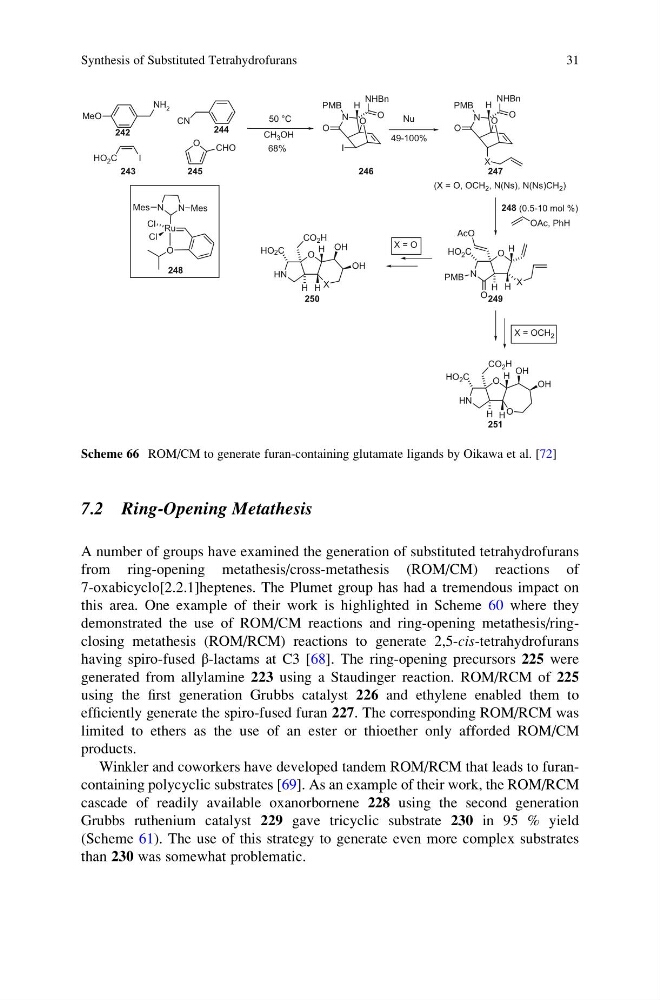
Scheme 66 ROM/CM to generate furan-containing glutamate ligands by Oikawa et al. [72]
Synthesis of Substituted Tetrahydrofurans
31
A number of groups have examined the generation of substituted tetrahydrofurans
from ring-opening metathesis/cross-metathesis (ROM/CM) reactions of
7-oxabicyclo[2.2.1]heptenes. The Plumet group has had a tremendous impact on
this area. One example of their work is highlighted in Scheme 60 where they
demonstrated the use of ROM/CM reactions and ring-opening metathesis/ringclosing metathesis (ROM/RCM) reactions to generate 2,5-cis-tetrahydrofurans
having spiro-fused β-lactams at C3 [68]. The ring-opening precursors 225 were
generated from allylamine 223 using a Staudinger reaction. ROM/RCM of 225
using the first generation Grubbs catalyst 226 and ethylene enabled them to
efficiently generate the spiro-fused furan 227. The corresponding ROM/RCM was
limited to ethers as the use of an ester or thioether only afforded ROM/CM
products.
Winkler and coworkers have developed tandem ROM/RCM that leads to furancontaining polycyclic substrates [69]. As an example of their work, the ROM/RCM
cascade of readily available oxanorbornene 228 using the second generation
Grubbs ruthenium catalyst 229 gave tricyclic substrate 230 in 95 % yield
(Scheme 61). The use of this strategy to generate even more complex substrates
than 230 was somewhat problematic.
Ru
N
N
Cl
Cl
O
Mes
Mes
248
MeO
NH 2
CN
HO 2 C
I
O
CHO
50 °C
CH 3 OH
68%
O
I
N
PMB H
O
NHBn
O
Nu
O
N
PMB H
O
NHBn
O
49-100%
X
247
248 (0.5-10 mol %)
O
N
AcO
PMB
O
H H
H
OAc, PhH
X
O
HN
H
H
X
H
250
HO2C
CO 2 H
OH
OH
HO 2 C
242
243
244
245
246
(X = O, OCH 2 , N(Ns), N(Ns)CH 2 )
249
X = O
X = OCH 2
O
HN
H
H
H
HO 2 C
CO 2 H
O
OH
OH
251
Scheme 66 ROM/CM to generate furan-containing glutamate ligands by Oikawa et al. [72]
Synthesis of Substituted Tetrahydrofurans
31