

7.1 Microbial Oxidation of Oxabicyclic Substrates
Mihovilovic and coworkers have utilized a microbial Baeyer–Villiger oxidation to
desymmetrize readily available 8-oxabicyclo[3.2.1]octene 218. Their key reaction
used E. coli in a whole-cell oxidation to give multi-gram quantities of 219 in high
optical purity (Scheme 59) [67]. To demonstrate its utility they transformed 219
into 220, 221, and 222 thus intercepting intermediates that had previously been
converted into the natural products (+)-trans-kumausyne, goniofufurone, and
(+)-showdomycin.
Ts
H
O
O
229 (6 mol %)
CHCl 3 , rt
O
Ts
R
OEt (5 equiv)
O
H
240
241
83%
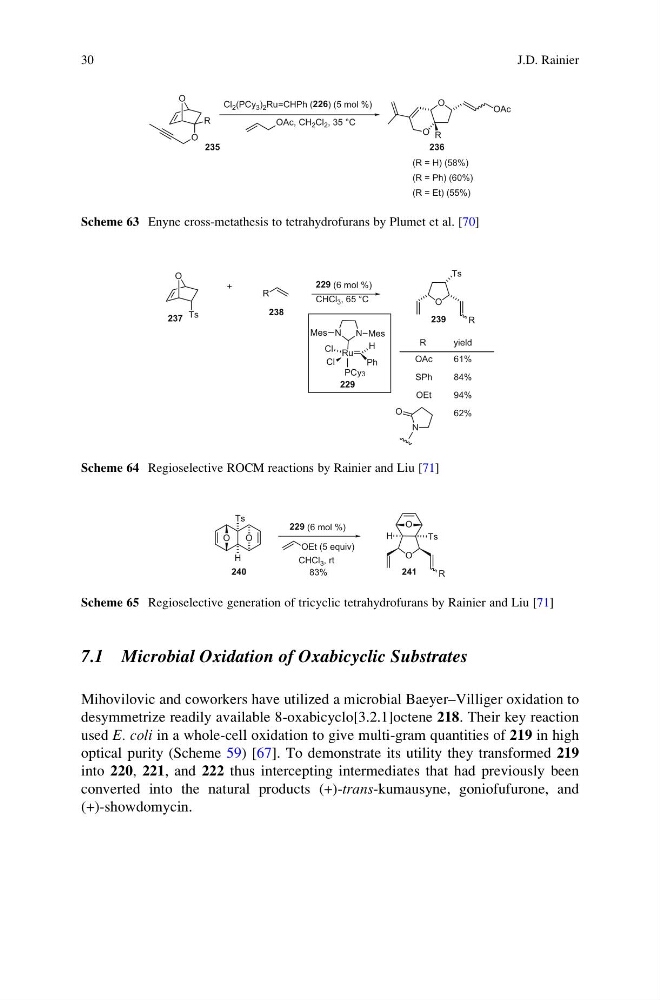
Scheme 65 Regioselective generation of tricyclic tetrahydrofurans by Rainier and Liu [71]
O
O
Cl 2 (PCy 3 ) 2 Ru=CHPh (226) (5 mol %)
O
O
(R = H) (58%)
(R = Ph) (60%)
R
R
OAc, CH 2 Cl 2 , 35 °C
OAc
(R = Et) (55%)
235
236
Scheme 63 Enyne cross-metathesis to tetrahydrofurans by Plumet et al. [70]
O
+
O
R
Ru
H
N
N
Cl
Cl
PCy3
Mes
Mes
Ph
229
Ts
229 (6 mol %)
CHCl 3 , 65 °C
Ts
R
R
OAc
SPh
OEt
yield
61%
84%
94%
62%
N
O
237
238
239
Scheme 64 Regioselective ROCM reactions by Rainier and Liu [71]
30
J.D. Rainier
Mihovilovic and coworkers have utilized a microbial Baeyer–Villiger oxidation to
desymmetrize readily available 8-oxabicyclo[3.2.1]octene 218. Their key reaction
used E. coli in a whole-cell oxidation to give multi-gram quantities of 219 in high
optical purity (Scheme 59) [67]. To demonstrate its utility they transformed 219
into 220, 221, and 222 thus intercepting intermediates that had previously been
converted into the natural products (+)-trans-kumausyne, goniofufurone, and
(+)-showdomycin.
Ts
H
O
O
229 (6 mol %)
CHCl 3 , rt
O
Ts
R
OEt (5 equiv)
O
H
240
241
83%
Scheme 65 Regioselective generation of tricyclic tetrahydrofurans by Rainier and Liu [71]
O
O
Cl 2 (PCy 3 ) 2 Ru=CHPh (226) (5 mol %)
O
O
(R = H) (58%)
(R = Ph) (60%)
R
R
OAc, CH 2 Cl 2 , 35 °C
OAc
(R = Et) (55%)
235
236
Scheme 63 Enyne cross-metathesis to tetrahydrofurans by Plumet et al. [70]
O
+
O
R
Ru
H
N
N
Cl
Cl
PCy3
Mes
Mes
Ph
229
Ts
229 (6 mol %)
CHCl 3 , 65 °C
Ts
R
R
OAc
SPh
OEt
yield
61%
84%
94%
62%
N
O
237
238
239
Scheme 64 Regioselective ROCM reactions by Rainier and Liu [71]
30
J.D. Rainier