

forming sequence including the ready availability of the starting substrates and the
high levels of diastereocontrol that are often observed.
4.1 Cobalt-Catalyzed Cyclizations
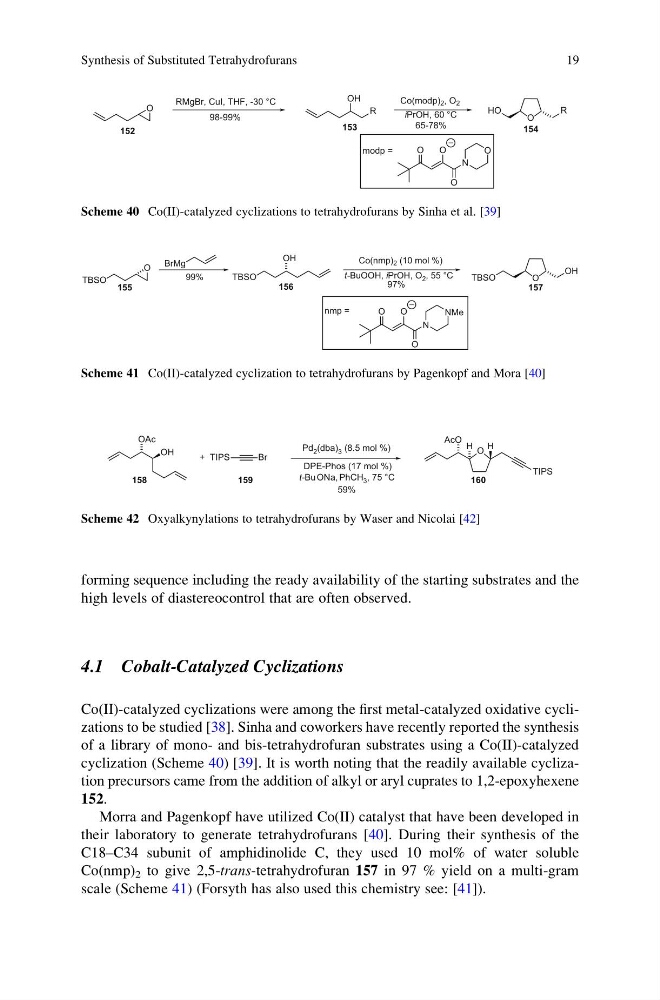
Co(II)-catalyzed cyclizations were among the first metal-catalyzed oxidative cyclizations to be studied [38]. Sinha and coworkers have recently reported the synthesis
of a library of mono- and bis-tetrahydrofuran substrates using a Co(II)-catalyzed
cyclization (Scheme 40) [39]. It is worth noting that the readily available cyclization precursors came from the addition of alkyl or aryl cuprates to 1,2-epoxyhexene
152.
Morra and Pagenkopf have utilized Co(II) catalyst that have been developed in
their laboratory to generate tetrahydrofurans [40]. During their synthesis of the
C18–C34 subunit of amphidinolide C, they used 10 mol% of water soluble
Co(nmp) 2 to give 2,5-trans-tetrahydrofuran 157 in 97 % yield on a multi-gram
scale (Scheme 41) (Forsyth has also used this chemistry see: [41]).
TBSO
O
99%
TBSO
OH
Co(nmp) 2 (10 mol %)
t-BuOOH, iPrOH, O 2 , 55 °C
97%
O
OH
nmp =
O
O
N
O
NMe
155
156
157
BrMg
TBSO
Scheme 41 Co(II)-catalyzed cyclization to tetrahydrofurans by Pagenkopf and Mora [40]
O
RMgBr, CuI, THF, -30 °C
98-99%
OH
R
Co(modp) 2 , O 2
iPrOH, 60 °C
65-78%
O
HO
R
modp =
O
O
N
O
O
152
153
154
Scheme 40 Co(II)-catalyzed cyclizations to tetrahydrofurans by Sinha et al. [39]
OAc
OH
Br
+ TIPS
Pd 2 (dba) 3 (8.5 mol %)
DPE-Phos (17 mol %)
t-Bu ONa, PhCH 3 , 75 °C
59%
O
TIPS
AcO H
H
158
159
160
Scheme 42 Oxyalkynylations to tetrahydrofurans by Waser and Nicolai [42]
Synthesis of Substituted Tetrahydrofurans
19
high levels of diastereocontrol that are often observed.
4.1 Cobalt-Catalyzed Cyclizations
Co(II)-catalyzed cyclizations were among the first metal-catalyzed oxidative cyclizations to be studied [38]. Sinha and coworkers have recently reported the synthesis
of a library of mono- and bis-tetrahydrofuran substrates using a Co(II)-catalyzed
cyclization (Scheme 40) [39]. It is worth noting that the readily available cyclization precursors came from the addition of alkyl or aryl cuprates to 1,2-epoxyhexene
152.
Morra and Pagenkopf have utilized Co(II) catalyst that have been developed in
their laboratory to generate tetrahydrofurans [40]. During their synthesis of the
C18–C34 subunit of amphidinolide C, they used 10 mol% of water soluble
Co(nmp) 2 to give 2,5-trans-tetrahydrofuran 157 in 97 % yield on a multi-gram
scale (Scheme 41) (Forsyth has also used this chemistry see: [41]).
TBSO
O
99%
TBSO
OH
Co(nmp) 2 (10 mol %)
t-BuOOH, iPrOH, O 2 , 55 °C
97%
O
OH
nmp =
O
O
N
O
NMe
155
156
157
BrMg
TBSO
Scheme 41 Co(II)-catalyzed cyclization to tetrahydrofurans by Pagenkopf and Mora [40]
O
RMgBr, CuI, THF, -30 °C
98-99%
OH
R
Co(modp) 2 , O 2
iPrOH, 60 °C
65-78%
O
HO
R
modp =
O
O
N
O
O
152
153
154
Scheme 40 Co(II)-catalyzed cyclizations to tetrahydrofurans by Sinha et al. [39]
OAc
OH
Br
+ TIPS
Pd 2 (dba) 3 (8.5 mol %)
DPE-Phos (17 mol %)
t-Bu ONa, PhCH 3 , 75 °C
59%
O
TIPS
AcO H
H
158
159
160
Scheme 42 Oxyalkynylations to tetrahydrofurans by Waser and Nicolai [42]
Synthesis of Substituted Tetrahydrofurans
19