

In the key step to completing asimicin, Roush and Tinsley used their [3+2]cycloaddition to combine allylsilane 140 and tetrahydrofuran 141 (Scheme 37). The
reaction was promoted by SnCl 4 and resulted in bis-tetrahydrofuran 142 in 80 %
yield as essentially a single diastereomer. Following protecting group and oxidation
state modification, the synthesis of asimicin was completed using Trost’s two-step
approach to butenolides.
Hodgson and Salik were able to use their [3+2]-cycloaddition chemistry to generate the tetrahydrofuran portion of the lytophilippines (Scheme 38). The substituted
epoxide 143 was employed to give tetrahydrofuran 147 after a Tamao–Fleming
oxidation of the silyl-tetrahydrofuran product.
3.4 Other Cycloadditions
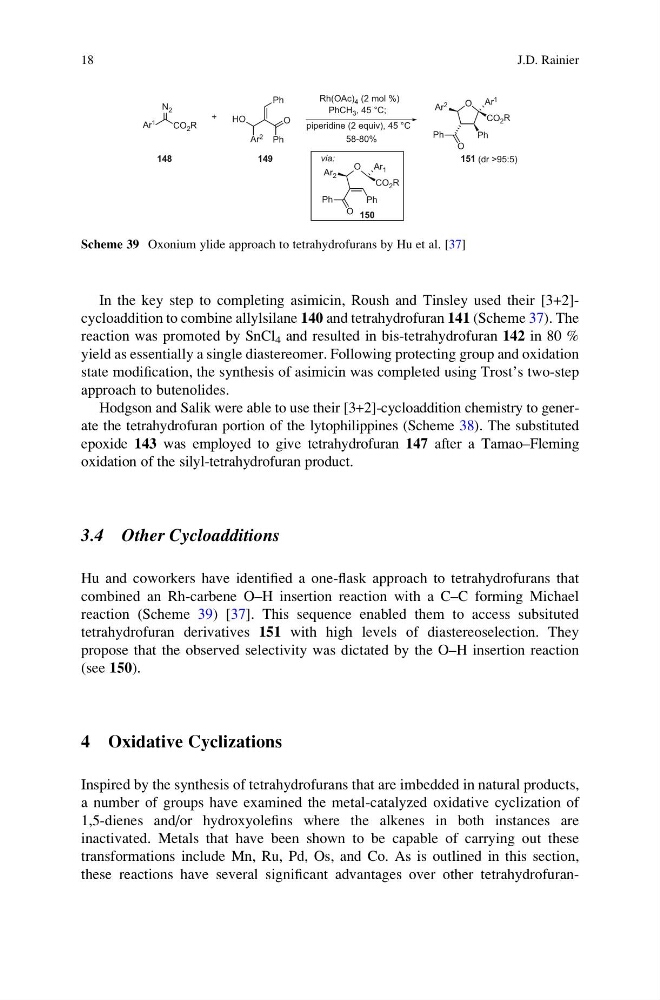
Hu and coworkers have identified a one-flask approach to tetrahydrofurans that
combined an Rh-carbene O–H insertion reaction with a C–C forming Michael
reaction (Scheme 39) [37]. This sequence enabled them to access subsituted
tetrahydrofuran derivatives 151 with high levels of diastereoselection. They
propose that the observed selectivity was dictated by the O–H insertion reaction
(see 150).
4 Oxidative Cyclizations
Inspired by the synthesis of tetrahydrofurans that are imbedded in natural products,
a number of groups have examined the metal-catalyzed oxidative cyclization of
1,5-dienes and/or hydroxyolefins where the alkenes in both instances are
inactivated. Metals that have been shown to be capable of carrying out these
transformations include Mn, Ru, Pd, Os, and Co. As is outlined in this section,
these reactions have several significant advantages over other tetrahydrofuranAr 1
CO 2 R
N 2
+
HO
Ar 2
Ph
Ph
O
Rh(OAc) 4 (2 mol %)
PhCH 3 , 45 °C;
piperidine (2 equiv), 45 °C
58-80%
O
Ar 2
CO 2 R
Ar 1
Ph
Ph
O
151 (dr >95:5)
148
149
O
Ar 2
CO 2 R
Ar 1
Ph
Ph
O 150
via:
Scheme 39 Oxonium ylide approach to tetrahydrofurans by Hu et al. [37]
18
J.D. Rainier
reaction was promoted by SnCl 4 and resulted in bis-tetrahydrofuran 142 in 80 %
yield as essentially a single diastereomer. Following protecting group and oxidation
state modification, the synthesis of asimicin was completed using Trost’s two-step
approach to butenolides.
Hodgson and Salik were able to use their [3+2]-cycloaddition chemistry to generate the tetrahydrofuran portion of the lytophilippines (Scheme 38). The substituted
epoxide 143 was employed to give tetrahydrofuran 147 after a Tamao–Fleming
oxidation of the silyl-tetrahydrofuran product.
3.4 Other Cycloadditions
Hu and coworkers have identified a one-flask approach to tetrahydrofurans that
combined an Rh-carbene O–H insertion reaction with a C–C forming Michael
reaction (Scheme 39) [37]. This sequence enabled them to access subsituted
tetrahydrofuran derivatives 151 with high levels of diastereoselection. They
propose that the observed selectivity was dictated by the O–H insertion reaction
(see 150).
4 Oxidative Cyclizations
Inspired by the synthesis of tetrahydrofurans that are imbedded in natural products,
a number of groups have examined the metal-catalyzed oxidative cyclization of
1,5-dienes and/or hydroxyolefins where the alkenes in both instances are
inactivated. Metals that have been shown to be capable of carrying out these
transformations include Mn, Ru, Pd, Os, and Co. As is outlined in this section,
these reactions have several significant advantages over other tetrahydrofuranAr 1
CO 2 R
N 2
+
HO
Ar 2
Ph
Ph
O
Rh(OAc) 4 (2 mol %)
PhCH 3 , 45 °C;
piperidine (2 equiv), 45 °C
58-80%
O
Ar 2
CO 2 R
Ar 1
Ph
Ph
O
151 (dr >95:5)
148
149
O
Ar 2
CO 2 R
Ar 1
Ph
Ph
O 150
via:
Scheme 39 Oxonium ylide approach to tetrahydrofurans by Hu et al. [37]
18
J.D. Rainier