

of CuI gave syn-hydroxysilane cyclization precursor 120 in 52 % yield for the two
steps. TBS protection was followed by [3+2]-cycloaddition with
α-benzyloxyacetaldehyde in the presence of BF 3 ∙Et 2 O to give tetrahydrofuran
122 in 70 % yield with complete diastereocontrol. The utility of the silyl group
was demonstrated through its conversion to alcohol 123 using Fleming’s oxidative
protocol.
Akiyama and coworkers have examined the use of chiral allylsilane 124 in
[3+2]-cycloadditions with α-ketoesters 125 (Scheme 33) [33]. When run in the
presence of SnCl 4 (1.1 equivalent), the cycloaddition of 124 gave tetrahydrofuran
126 with 85 % diastereomeric excess for the t-butyl ester.
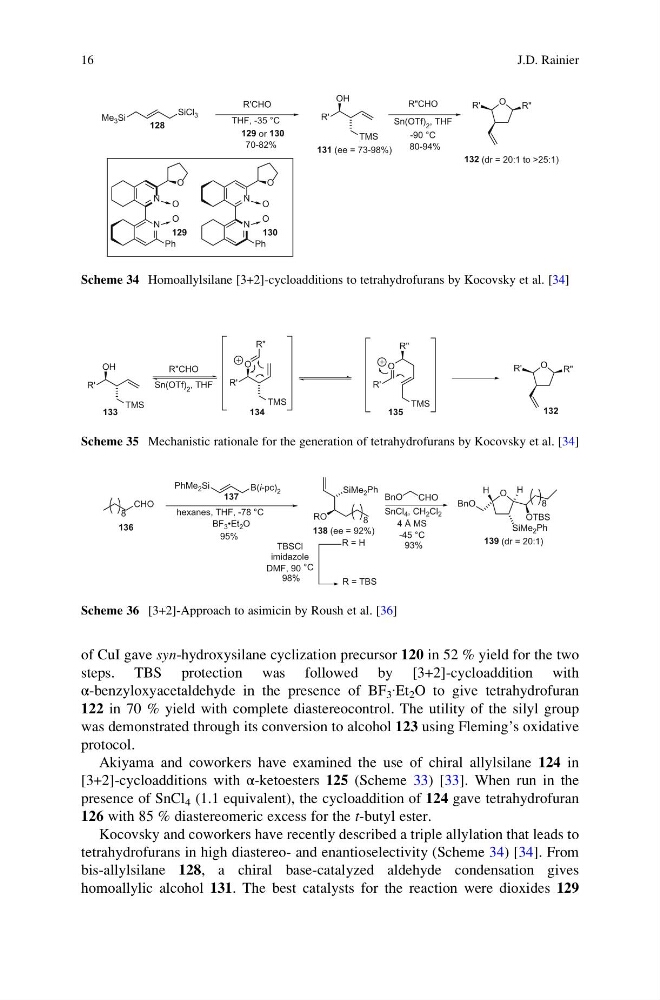
Kocovsky and coworkers have recently described a triple allylation that leads to
tetrahydrofurans in high diastereo- and enantioselectivity (Scheme 34) [34]. From
bis-allylsilane 128, a chiral base-catalyzed aldehyde condensation gives
homoallylic alcohol 131. The best catalysts for the reaction were dioxides 129
R'
TMS
OH
R"CHO
Sn(OTf) 2 , THF
R'
TMS
O
R"
R'
TMS
O
R"
O
R"
R'
133
134
135
132
Scheme 35 Mechanistic rationale for the generation of tetrahydrofurans by Kocovsky et al. [34]
Me 3 Si
SiCl 3
R'CHO
THF, -35 °C
R'
TMS
OH
129 or 130
N
N
O
Ph
O
O
N
N
O
Ph
O
O
129
130
70-82%
131 (ee = 73-98%)
R"CHO
Sn(OTf) 2 , THF
-90 °C
O
R"
R'
80-94%
132 (dr = 20:1 to >25:1)
128
Scheme 34 Homoallylsilane [3+2]-cycloadditions to tetrahydrofurans by Kocovsky et al. [34]
CHO
8
PhMe 2 Si
B(i-pc) 2
hexanes, THF, -78 °C
95%
8
RO
SiMe 2 Ph
TBSCl
imidazole
DMF, 90 °C
R = TBS
98%
BnO
CHO
SnCl 4 , CH 2 Cl 2
4 Å MS
-45 °C
O
H
BnO
H
8
OTBS
93%
139 (dr = 20:1)
SiMe 2 Ph
136
138 (ee = 92%)
137
R = H
BF 3 •Et 2 O
Scheme 36 [3+2]-Approach to asimicin by Roush et al. [36]
16
J.D. Rainier
steps. TBS protection was followed by [3+2]-cycloaddition with
α-benzyloxyacetaldehyde in the presence of BF 3 ∙Et 2 O to give tetrahydrofuran
122 in 70 % yield with complete diastereocontrol. The utility of the silyl group
was demonstrated through its conversion to alcohol 123 using Fleming’s oxidative
protocol.
Akiyama and coworkers have examined the use of chiral allylsilane 124 in
[3+2]-cycloadditions with α-ketoesters 125 (Scheme 33) [33]. When run in the
presence of SnCl 4 (1.1 equivalent), the cycloaddition of 124 gave tetrahydrofuran
126 with 85 % diastereomeric excess for the t-butyl ester.
Kocovsky and coworkers have recently described a triple allylation that leads to
tetrahydrofurans in high diastereo- and enantioselectivity (Scheme 34) [34]. From
bis-allylsilane 128, a chiral base-catalyzed aldehyde condensation gives
homoallylic alcohol 131. The best catalysts for the reaction were dioxides 129
R'
TMS
OH
R"CHO
Sn(OTf) 2 , THF
R'
TMS
O
R"
R'
TMS
O
R"
O
R"
R'
133
134
135
132
Scheme 35 Mechanistic rationale for the generation of tetrahydrofurans by Kocovsky et al. [34]
Me 3 Si
SiCl 3
R'CHO
THF, -35 °C
R'
TMS
OH
129 or 130
N
N
O
Ph
O
O
N
N
O
Ph
O
O
129
130
70-82%
131 (ee = 73-98%)
R"CHO
Sn(OTf) 2 , THF
-90 °C
O
R"
R'
80-94%
132 (dr = 20:1 to >25:1)
128
Scheme 34 Homoallylsilane [3+2]-cycloadditions to tetrahydrofurans by Kocovsky et al. [34]
CHO
8
PhMe 2 Si
B(i-pc) 2
hexanes, THF, -78 °C
95%
8
RO
SiMe 2 Ph
TBSCl
imidazole
DMF, 90 °C
R = TBS
98%
BnO
CHO
SnCl 4 , CH 2 Cl 2
4 Å MS
-45 °C
O
H
BnO
H
8
OTBS
93%
139 (dr = 20:1)
SiMe 2 Ph
136
138 (ee = 92%)
137
R = H
BF 3 •Et 2 O
Scheme 36 [3+2]-Approach to asimicin by Roush et al. [36]
16
J.D. Rainier