

3.3 Allylsilane–Aldehyde Cycloadditions
Allylsilane–aldehyde [3+2]-cycloadditions are a very powerful means of generating
tetrahydrofurans as they can be used to give either 2,5-cis- or 2,5-trans-isomers
depending upon the Lewis acid used to promote the reaction [30]. As an example
of the power of these reactions, Roush and Micalizio described the reaction of
allylsilane 108 (available from the condensation of allylborane 107 with aldehyde
106) with aldehyde 109 in the presence of BF 3 ∙Et 2 O to give cis-tetrahydrofuran 110 in
78 % yield and in >20:1 dr (Scheme 30) [31]. In a complementary fashion, the use of
SnCl 4 as the Lewis acid gave an 85 % yield (dr ¼ 20:1) of trans-tetrahydrofuran 111.
Roush and Micalizio proposed that the stereochemical outcome of the reactions
was governed by the synclinal transition states illustrated in Scheme 31. The use of
BF 3 ∙Et 2 O leads to transition state 112 having the Me 2 PhSi substituent synclinal to
the carbonyl oxygen atom. Transition state 115 is disfavored because of steric
interactions between BF 3 and the allylsilane substituent. SnCl 4 interacts in a
bidentate fashion and proceeds via synclinal transition state 117.
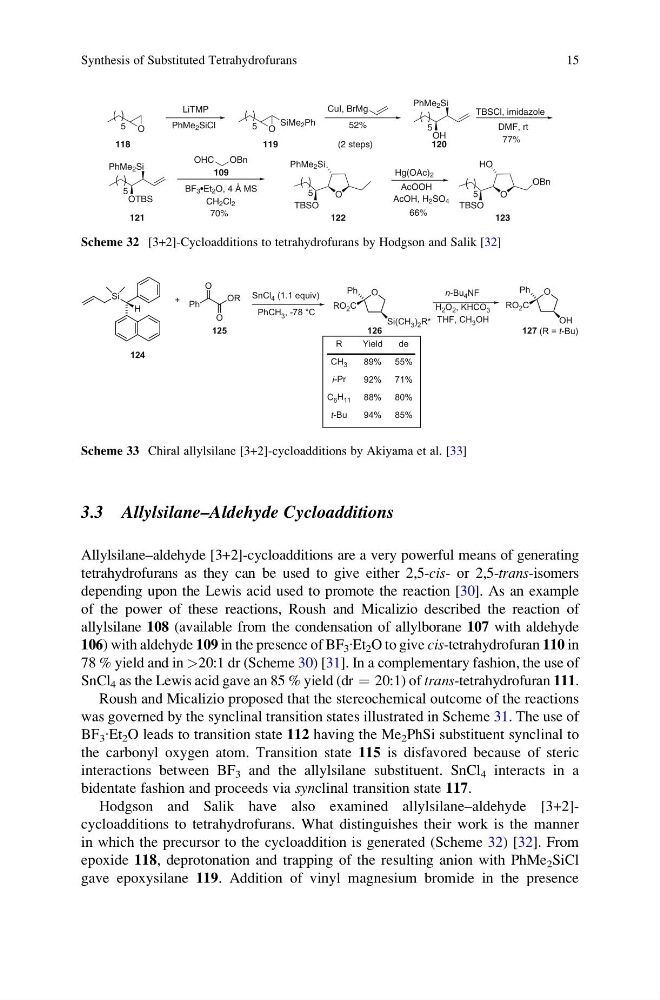
Hodgson and Salik have also examined allylsilane–aldehyde [3+2]cycloadditions to tetrahydrofurans. What distinguishes their work is the manner
in which the precursor to the cycloaddition is generated (Scheme 32) [32]. From
epoxide 118, deprotonation and trapping of the resulting anion with PhMe 2 SiCl
gave epoxysilane 119. Addition of vinyl magnesium bromide in the presence
O
LiTMP
CuI, BrMg
OH
O
SiMe 2 Ph
PhMe 2 Si
52%
TBSCl, imidazole
77%
OHC
OBn
BF 3 •Et 2 O, 4 Å MS
CH 2 Cl 2
70%
O
PhMe 2 Si
TBSO
O
HO
OBn
TBSO
5
Hg(OAc) 2
AcOOH
AcOH, H 2 SO 4
66%
5
5
5
5
118
119
120
109
122
123
OTBS
PhMe 2 Si
5
121
DMF, rt
PhMe 2 SiCl
(2 steps)
Scheme 32 [3+2]-Cycloadditions to tetrahydrofurans by Hodgson and Salik [32]
Si
H
+ Ph
O
O
OR SnCl 4 (1.1 equiv)
PhCH 3 , -78 °C
O
Si(CH 3 ) 2 R*
RO 2 C
Ph
R
CH 3
i-Pr
C 6 H 11
t-Bu
Yield
89%
92%
88%
94%
de
55%
71%
80%
85%
H 2 O 2 , KHCO 3
THF, CH 3 OH
O
OH
RO 2 C
Ph
124
125
126
127 (R = t-Bu)
n-Bu 4 NF
Scheme 33 Chiral allylsilane [3+2]-cycloadditions by Akiyama et al. [33]
Synthesis of Substituted Tetrahydrofurans
15
Allylsilane–aldehyde [3+2]-cycloadditions are a very powerful means of generating
tetrahydrofurans as they can be used to give either 2,5-cis- or 2,5-trans-isomers
depending upon the Lewis acid used to promote the reaction [30]. As an example
of the power of these reactions, Roush and Micalizio described the reaction of
allylsilane 108 (available from the condensation of allylborane 107 with aldehyde
106) with aldehyde 109 in the presence of BF 3 ∙Et 2 O to give cis-tetrahydrofuran 110 in
78 % yield and in >20:1 dr (Scheme 30) [31]. In a complementary fashion, the use of
SnCl 4 as the Lewis acid gave an 85 % yield (dr ¼ 20:1) of trans-tetrahydrofuran 111.
Roush and Micalizio proposed that the stereochemical outcome of the reactions
was governed by the synclinal transition states illustrated in Scheme 31. The use of
BF 3 ∙Et 2 O leads to transition state 112 having the Me 2 PhSi substituent synclinal to
the carbonyl oxygen atom. Transition state 115 is disfavored because of steric
interactions between BF 3 and the allylsilane substituent. SnCl 4 interacts in a
bidentate fashion and proceeds via synclinal transition state 117.
Hodgson and Salik have also examined allylsilane–aldehyde [3+2]cycloadditions to tetrahydrofurans. What distinguishes their work is the manner
in which the precursor to the cycloaddition is generated (Scheme 32) [32]. From
epoxide 118, deprotonation and trapping of the resulting anion with PhMe 2 SiCl
gave epoxysilane 119. Addition of vinyl magnesium bromide in the presence
O
LiTMP
CuI, BrMg
OH
O
SiMe 2 Ph
PhMe 2 Si
52%
TBSCl, imidazole
77%
OHC
OBn
BF 3 •Et 2 O, 4 Å MS
CH 2 Cl 2
70%
O
PhMe 2 Si
TBSO
O
HO
OBn
TBSO
5
Hg(OAc) 2
AcOOH
AcOH, H 2 SO 4
66%
5
5
5
5
118
119
120
109
122
123
OTBS
PhMe 2 Si
5
121
DMF, rt
PhMe 2 SiCl
(2 steps)
Scheme 32 [3+2]-Cycloadditions to tetrahydrofurans by Hodgson and Salik [32]
Si
H
+ Ph
O
O
OR SnCl 4 (1.1 equiv)
PhCH 3 , -78 °C
O
Si(CH 3 ) 2 R*
RO 2 C
Ph
R
CH 3
i-Pr
C 6 H 11
t-Bu
Yield
89%
92%
88%
94%
de
55%
71%
80%
85%
H 2 O 2 , KHCO 3
THF, CH 3 OH
O
OH
RO 2 C
Ph
124
125
126
127 (R = t-Bu)
n-Bu 4 NF
Scheme 33 Chiral allylsilane [3+2]-cycloadditions by Akiyama et al. [33]
Synthesis of Substituted Tetrahydrofurans
15