

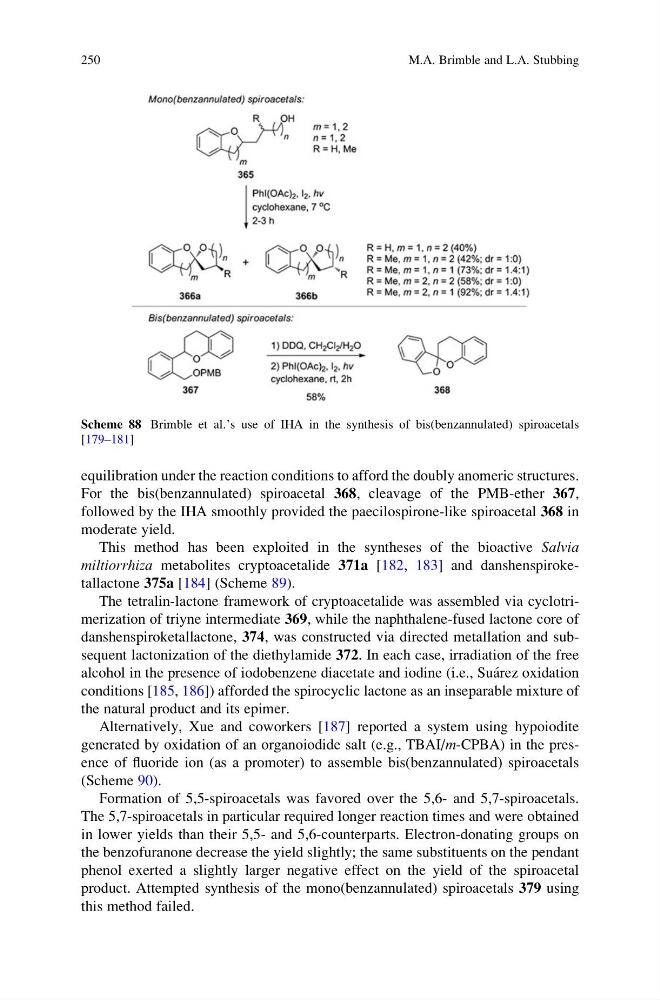
equilibration under the reaction conditions to afford the doubly anomeric structures.
For the bis(benzannulated) spiroacetal 368, cleavage of the PMB-ether 367,
followed by the IHA smoothly provided the paecilospirone-like spiroacetal 368 in
moderate yield.
This method has been exploited in the syntheses of the bioactive Salvia
miltiorrhiza metabolites cryptoacetalide 371a [182, 183] and danshenspiroketallactone 375a [184] (Scheme 89).
The tetralin-lactone framework of cryptoacetalide was assembled via cyclotrimerization of triyne intermediate 369, while the naphthalene-fused lactone core of
danshenspiroketallactone, 374, was constructed via directed metallation and subsequent lactonization of the diethylamide 372. In each case, irradiation of the free
alcohol in the presence of iodobenzene diacetate and iodine (i.e., Sua ´rez oxidation
conditions [185, 186]) afforded the spirocyclic lactone as an inseparable mixture of
the natural product and its epimer.
Alternatively, Xue and coworkers [187] reported a system using hypoiodite
generated by oxidation of an organoiodide salt (e.g., TBAI/m-CPBA) in the presence of fluoride ion (as a promoter) to assemble bis(benzannulated) spiroacetals
(Scheme 90).
Formation of 5,5-spiroacetals was favored over the 5,6- and 5,7-spiroacetals.
The 5,7-spiroacetals in particular required longer reaction times and were obtained
in lower yields than their 5,5- and 5,6-counterparts. Electron-donating groups on
the benzofuranone decrease the yield slightly; the same substituents on the pendant
phenol exerted a slightly larger negative effect on the yield of the spiroacetal
product. Attempted synthesis of the mono(benzannulated) spiroacetals 379 using
this method failed.
Scheme 88 Brimble et al.’s use of IHA in the synthesis of bis(benzannulated) spiroacetals
[179–181]
250
M.A. Brimble and L.A. Stubbing
For the bis(benzannulated) spiroacetal 368, cleavage of the PMB-ether 367,
followed by the IHA smoothly provided the paecilospirone-like spiroacetal 368 in
moderate yield.
This method has been exploited in the syntheses of the bioactive Salvia
miltiorrhiza metabolites cryptoacetalide 371a [182, 183] and danshenspiroketallactone 375a [184] (Scheme 89).
The tetralin-lactone framework of cryptoacetalide was assembled via cyclotrimerization of triyne intermediate 369, while the naphthalene-fused lactone core of
danshenspiroketallactone, 374, was constructed via directed metallation and subsequent lactonization of the diethylamide 372. In each case, irradiation of the free
alcohol in the presence of iodobenzene diacetate and iodine (i.e., Sua ´rez oxidation
conditions [185, 186]) afforded the spirocyclic lactone as an inseparable mixture of
the natural product and its epimer.
Alternatively, Xue and coworkers [187] reported a system using hypoiodite
generated by oxidation of an organoiodide salt (e.g., TBAI/m-CPBA) in the presence of fluoride ion (as a promoter) to assemble bis(benzannulated) spiroacetals
(Scheme 90).
Formation of 5,5-spiroacetals was favored over the 5,6- and 5,7-spiroacetals.
The 5,7-spiroacetals in particular required longer reaction times and were obtained
in lower yields than their 5,5- and 5,6-counterparts. Electron-donating groups on
the benzofuranone decrease the yield slightly; the same substituents on the pendant
phenol exerted a slightly larger negative effect on the yield of the spiroacetal
product. Attempted synthesis of the mono(benzannulated) spiroacetals 379 using
this method failed.
Scheme 88 Brimble et al.’s use of IHA in the synthesis of bis(benzannulated) spiroacetals
[179–181]
250
M.A. Brimble and L.A. Stubbing