

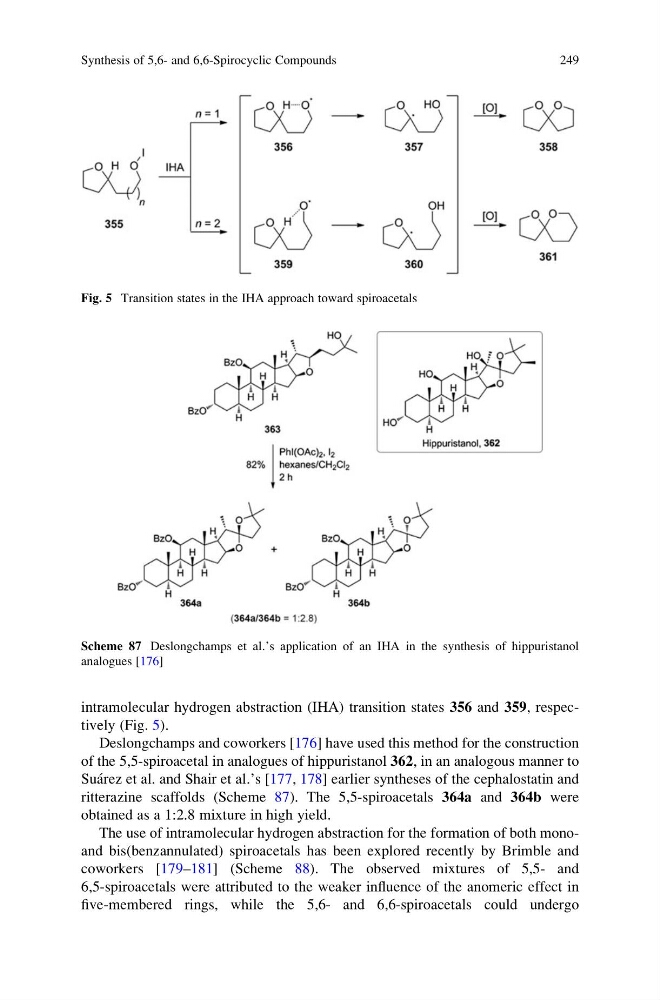
intramolecular hydrogen abstraction (IHA) transition states 356 and 359, respectively (Fig. 5).
Deslongchamps and coworkers [176] have used this method for the construction
of the 5,5-spiroacetal in analogues of hippuristanol 362, in an analogous manner to
Sua ´rez et al. and Shair et al.’s [177, 178] earlier syntheses of the cephalostatin and
ritterazine scaffolds (Scheme 87). The 5,5-spiroacetals 364a and 364b were
obtained as a 1:2.8 mixture in high yield.
The use of intramolecular hydrogen abstraction for the formation of both monoand bis(benzannulated) spiroacetals has been explored recently by Brimble and
coworkers [179–181] (Scheme 88). The observed mixtures of 5,5- and
6,5-spiroacetals were attributed to the weaker influence of the anomeric effect in
five-membered rings, while the 5,6- and 6,6-spiroacetals could undergo
Fig. 5 Transition states in the IHA approach toward spiroacetals
Scheme 87 Deslongchamps et al.’s application of an IHA in the synthesis of hippuristanol
analogues [176]
Synthesis of 5,6- and 6,6-Spirocyclic Compounds
249
Deslongchamps and coworkers [176] have used this method for the construction
of the 5,5-spiroacetal in analogues of hippuristanol 362, in an analogous manner to
Sua ´rez et al. and Shair et al.’s [177, 178] earlier syntheses of the cephalostatin and
ritterazine scaffolds (Scheme 87). The 5,5-spiroacetals 364a and 364b were
obtained as a 1:2.8 mixture in high yield.
The use of intramolecular hydrogen abstraction for the formation of both monoand bis(benzannulated) spiroacetals has been explored recently by Brimble and
coworkers [179–181] (Scheme 88). The observed mixtures of 5,5- and
6,5-spiroacetals were attributed to the weaker influence of the anomeric effect in
five-membered rings, while the 5,6- and 6,6-spiroacetals could undergo
Fig. 5 Transition states in the IHA approach toward spiroacetals
Scheme 87 Deslongchamps et al.’s application of an IHA in the synthesis of hippuristanol
analogues [176]
Synthesis of 5,6- and 6,6-Spirocyclic Compounds
249