

stereoelectronic properties of naphthalene and/or isocoumarin precursors
[58–60]. In their formal synthesis of γ-rubromycin 58, Brimble et al. [61] successfully balanced these factors to access the bis(benzannulated) core via dehydrative
spirocyclization of a dihydroxyketone 59 (Scheme 15).
Key to this strategy was removal of the isocoumarin F ring in the
spirocyclization precursor, thereby increasing the nucleophilicity of the E ring
phenol such that cyclization could occur under mildly acidic conditions. Thus,
treatment of precursor 59 with silica-supported sodium hydrogen sulfate afforded
the bis(benzannulated) spiroacetal 60 in high yield.
Additionally, in a recent report of their studies toward the related purpuromycin
64, Kozlowski and coworkers [62] found that the use of diketone 61 enabled
spirocyclization to take place under acidic conditions (Scheme 16).
Hydrogenolysis of the benzyl ethers, followed by treatment with PTSA afforded
the bis(benzannulated) spiroacetal 63 in moderate to good yield, with only trace
amounts of the benzopyran byproduct 62. Unfortunately, the authors were unable to
selectively reduce the “blocking” ketone functionality nor successfully oxidize the
naphthalene to the dihydroquinone and thus convert the spirocyclic core structure to
purpuromycin.
2.2 Metal-Catalyzed Addition/Elimination of Allylic Alcohols
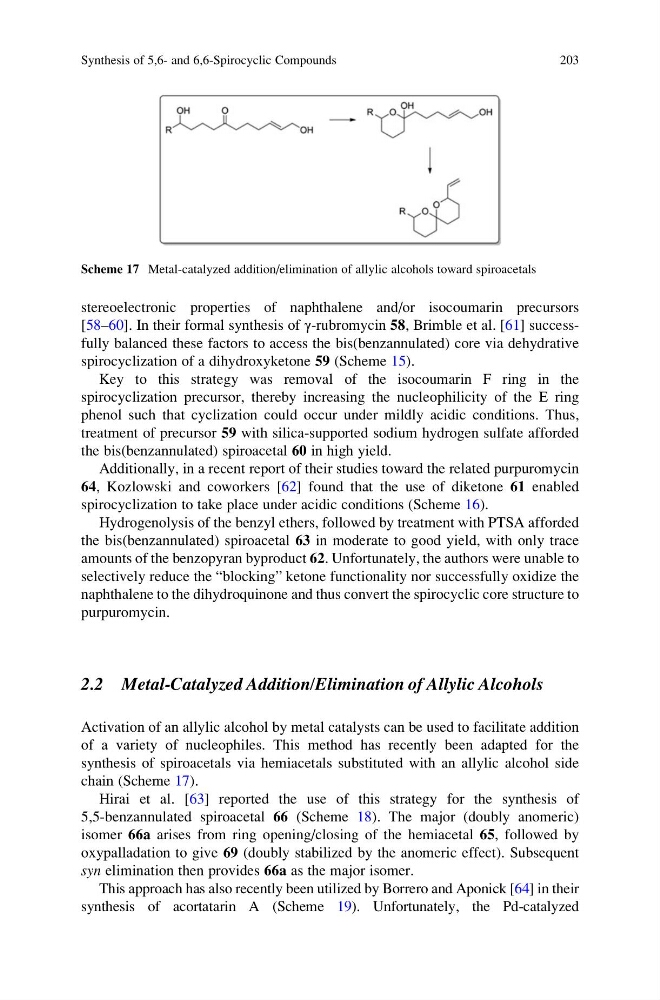
Activation of an allylic alcohol by metal catalysts can be used to facilitate addition
of a variety of nucleophiles. This method has recently been adapted for the
synthesis of spiroacetals via hemiacetals substituted with an allylic alcohol side
chain (Scheme 17).
Hirai et al. [63] reported the use of this strategy for the synthesis of
5,5-benzannulated spiroacetal 66 (Scheme 18). The major (doubly anomeric)
isomer 66a arises from ring opening/closing of the hemiacetal 65, followed by
oxypalladation to give 69 (doubly stabilized by the anomeric effect). Subsequent
syn elimination then provides 66a as the major isomer.
This approach has also recently been utilized by Borrero and Aponick [64] in their
synthesis of acortatarin A (Scheme 19). Unfortunately, the Pd-catalyzed
Scheme 17 Metal-catalyzed addition/elimination of allylic alcohols toward spiroacetals
Synthesis of 5,6- and 6,6-Spirocyclic Compounds
203
[58–60]. In their formal synthesis of γ-rubromycin 58, Brimble et al. [61] successfully balanced these factors to access the bis(benzannulated) core via dehydrative
spirocyclization of a dihydroxyketone 59 (Scheme 15).
Key to this strategy was removal of the isocoumarin F ring in the
spirocyclization precursor, thereby increasing the nucleophilicity of the E ring
phenol such that cyclization could occur under mildly acidic conditions. Thus,
treatment of precursor 59 with silica-supported sodium hydrogen sulfate afforded
the bis(benzannulated) spiroacetal 60 in high yield.
Additionally, in a recent report of their studies toward the related purpuromycin
64, Kozlowski and coworkers [62] found that the use of diketone 61 enabled
spirocyclization to take place under acidic conditions (Scheme 16).
Hydrogenolysis of the benzyl ethers, followed by treatment with PTSA afforded
the bis(benzannulated) spiroacetal 63 in moderate to good yield, with only trace
amounts of the benzopyran byproduct 62. Unfortunately, the authors were unable to
selectively reduce the “blocking” ketone functionality nor successfully oxidize the
naphthalene to the dihydroquinone and thus convert the spirocyclic core structure to
purpuromycin.
2.2 Metal-Catalyzed Addition/Elimination of Allylic Alcohols
Activation of an allylic alcohol by metal catalysts can be used to facilitate addition
of a variety of nucleophiles. This method has recently been adapted for the
synthesis of spiroacetals via hemiacetals substituted with an allylic alcohol side
chain (Scheme 17).
Hirai et al. [63] reported the use of this strategy for the synthesis of
5,5-benzannulated spiroacetal 66 (Scheme 18). The major (doubly anomeric)
isomer 66a arises from ring opening/closing of the hemiacetal 65, followed by
oxypalladation to give 69 (doubly stabilized by the anomeric effect). Subsequent
syn elimination then provides 66a as the major isomer.
This approach has also recently been utilized by Borrero and Aponick [64] in their
synthesis of acortatarin A (Scheme 19). Unfortunately, the Pd-catalyzed
Scheme 17 Metal-catalyzed addition/elimination of allylic alcohols toward spiroacetals
Synthesis of 5,6- and 6,6-Spirocyclic Compounds
203