

phenols 49 with Ir(I) catalyst 47 under hydrogen at a high pressure afforded the bis
(benzannulated) spiroacetals 50 in high yield and diastereoselectivity, in addition to
excellent enantioselectivity. This high level of selectivity may be attributed to the
restraining effect of the alkyl tether. On the other hand, hydrogenation of the acyclic
ketone 51 with 48 afforded the corresponding spiroacetal 52 as a racemic mixture.
Shi et al. have recently reported a TMSI-promoted approach toward
heteroannular acetals which has also been applied to spiroacetals [57]. Double
arylmethylation of a ketone at the α-position with an aromatic aldehyde affords a
dihydroxyketone that then undergoes dehydrative cyclization to give the desired
acetal. Spiroacetals were accessed using symmetric ketones, where both the α and
α
0 sites are available for alkylation (Scheme 14). Thus, coupling of salicylic
aldehydes 53 and ketones 54 with excess TMSI and NaI afforded the spiroacetals
55. Alternatively, coupling of a salicylic aldehyde 53a with an unsymmetrical
ketone 56 afforded the dihydroxyketone 57.
The synthesis of members of rubromycin family of bis(benzannulated)
spiroacetals under acid-catalyzed conditions have been hampered by the complex
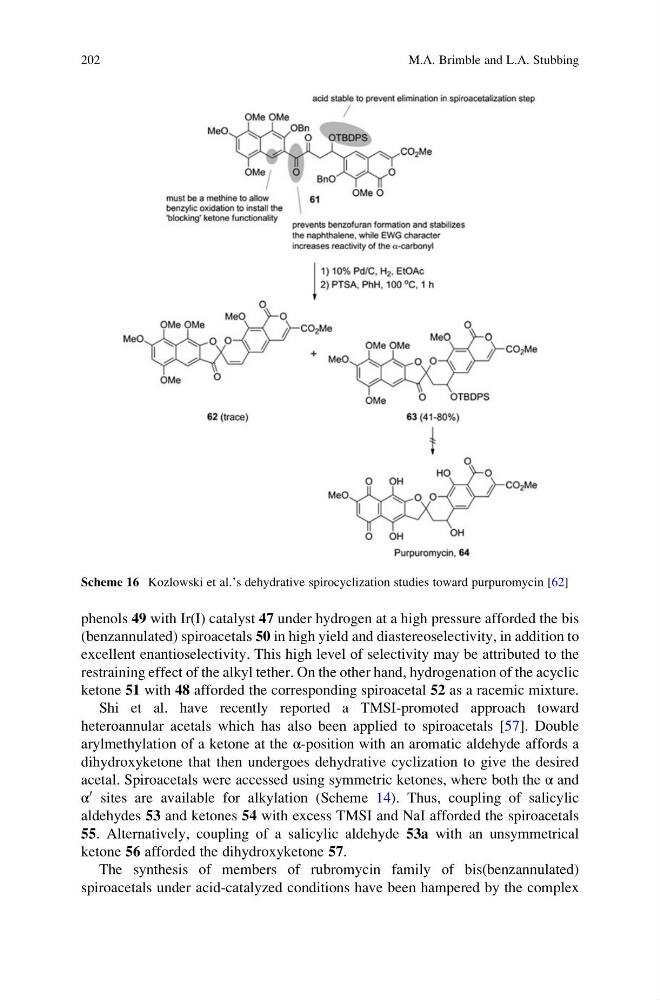
Scheme 16 Kozlowski et al.’s dehydrative spirocyclization studies toward purpuromycin [62]
202
M.A. Brimble and L.A. Stubbing
(benzannulated) spiroacetals 50 in high yield and diastereoselectivity, in addition to
excellent enantioselectivity. This high level of selectivity may be attributed to the
restraining effect of the alkyl tether. On the other hand, hydrogenation of the acyclic
ketone 51 with 48 afforded the corresponding spiroacetal 52 as a racemic mixture.
Shi et al. have recently reported a TMSI-promoted approach toward
heteroannular acetals which has also been applied to spiroacetals [57]. Double
arylmethylation of a ketone at the α-position with an aromatic aldehyde affords a
dihydroxyketone that then undergoes dehydrative cyclization to give the desired
acetal. Spiroacetals were accessed using symmetric ketones, where both the α and
α
0 sites are available for alkylation (Scheme 14). Thus, coupling of salicylic
aldehydes 53 and ketones 54 with excess TMSI and NaI afforded the spiroacetals
55. Alternatively, coupling of a salicylic aldehyde 53a with an unsymmetrical
ketone 56 afforded the dihydroxyketone 57.
The synthesis of members of rubromycin family of bis(benzannulated)
spiroacetals under acid-catalyzed conditions have been hampered by the complex
Scheme 16 Kozlowski et al.’s dehydrative spirocyclization studies toward purpuromycin [62]
202
M.A. Brimble and L.A. Stubbing