

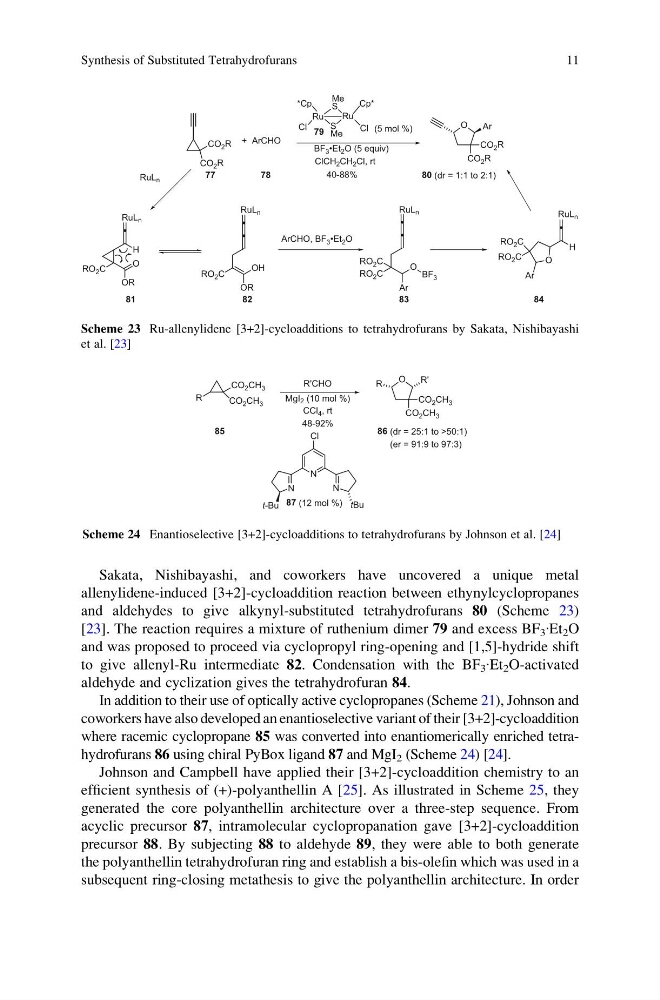
Sakata, Nishibayashi, and coworkers have uncovered a unique metal
allenylidene-induced [3+2]-cycloaddition reaction between ethynylcyclopropanes
and aldehydes to give alkynyl-substituted tetrahydrofurans 80 (Scheme 23)
[23]. The reaction requires a mixture of ruthenium dimer 79 and excess BF 3 ∙Et 2 O
and was proposed to proceed via cyclopropyl ring-opening and [1,5]-hydride shift
to give allenyl-Ru intermediate 82. Condensation with the BF 3 ∙Et 2 O-activated
aldehyde and cyclization gives the tetrahydrofuran 84.
In addition to their use of optically active cyclopropanes (Scheme 21), Johnson and
coworkers have also developed an enantioselective variant of their [3+2]-cycloaddition
where racemic cyclopropane 85 was converted into enantiomerically enriched tetrahydrofurans 86 using chiral PyBox ligand 87 and MgI 2 (Scheme 24) [24].
Johnson and Campbell have applied their [3+2]-cycloaddition chemistry to an
efficient synthesis of (+)-polyanthellin A [25]. As illustrated in Scheme 25, they
generated the core polyanthellin architecture over a three-step sequence. From
acyclic precursor 87, intramolecular cyclopropanation gave [3+2]-cycloaddition
precursor 88. By subjecting 88 to aldehyde 89, they were able to both generate
the polyanthellin tetrahydrofuran ring and establish a bis-olefin which was used in a
subsequent ring-closing metathesis to give the polyanthellin architecture. In order
CO 2 R
CO 2 R + ArCHO
Ru
Ru
S
Me
Me
S
Cp*
Cl
*Cp
Cl
(5 mol %)
BF 3 •Et 2 O (5 equiv)
ClCH 2 CH 2 Cl, rt
O
Ar
CO 2 R
CO 2 R
40-88%
80 (dr = 1:1 to 2:1)
O
OR
RO 2 C
RuL n
H
RuL n
OH
OR
RO 2 C
ArCHO, BF 3 •Et 2 O
RuL n
O
Ar
RO 2 C
RO 2 C
BF 3
RuL n
H
O
Ar
RO 2 C
RO 2 C
RuL n
77
78
79
81
82
83
84
Scheme 23 Ru-allenylidene [3+2]-cycloadditions to tetrahydrofurans by Sakata, Nishibayashi
et al. [23]
R
CO 2 CH 3
CO 2 CH 3
R'CHO
O
R
R'
CO 2 CH 3
CO 2 CH 3
MgI 2 (10 mol %)
CCl 4 , rt
48-92%
86 (dr = 25:1 to >50:1)
85
(er = 91:9 to 97:3)
N
Cl
N
N
tBu
t-Bu 87 (12 mol %)
Scheme 24 Enantioselective [3+2]-cycloadditions to tetrahydrofurans by Johnson et al. [24]
Synthesis of Substituted Tetrahydrofurans
11
allenylidene-induced [3+2]-cycloaddition reaction between ethynylcyclopropanes
and aldehydes to give alkynyl-substituted tetrahydrofurans 80 (Scheme 23)
[23]. The reaction requires a mixture of ruthenium dimer 79 and excess BF 3 ∙Et 2 O
and was proposed to proceed via cyclopropyl ring-opening and [1,5]-hydride shift
to give allenyl-Ru intermediate 82. Condensation with the BF 3 ∙Et 2 O-activated
aldehyde and cyclization gives the tetrahydrofuran 84.
In addition to their use of optically active cyclopropanes (Scheme 21), Johnson and
coworkers have also developed an enantioselective variant of their [3+2]-cycloaddition
where racemic cyclopropane 85 was converted into enantiomerically enriched tetrahydrofurans 86 using chiral PyBox ligand 87 and MgI 2 (Scheme 24) [24].
Johnson and Campbell have applied their [3+2]-cycloaddition chemistry to an
efficient synthesis of (+)-polyanthellin A [25]. As illustrated in Scheme 25, they
generated the core polyanthellin architecture over a three-step sequence. From
acyclic precursor 87, intramolecular cyclopropanation gave [3+2]-cycloaddition
precursor 88. By subjecting 88 to aldehyde 89, they were able to both generate
the polyanthellin tetrahydrofuran ring and establish a bis-olefin which was used in a
subsequent ring-closing metathesis to give the polyanthellin architecture. In order
CO 2 R
CO 2 R + ArCHO
Ru
Ru
S
Me
Me
S
Cp*
Cl
*Cp
Cl
(5 mol %)
BF 3 •Et 2 O (5 equiv)
ClCH 2 CH 2 Cl, rt
O
Ar
CO 2 R
CO 2 R
40-88%
80 (dr = 1:1 to 2:1)
O
OR
RO 2 C
RuL n
H
RuL n
OH
OR
RO 2 C
ArCHO, BF 3 •Et 2 O
RuL n
O
Ar
RO 2 C
RO 2 C
BF 3
RuL n
H
O
Ar
RO 2 C
RO 2 C
RuL n
77
78
79
81
82
83
84
Scheme 23 Ru-allenylidene [3+2]-cycloadditions to tetrahydrofurans by Sakata, Nishibayashi
et al. [23]
R
CO 2 CH 3
CO 2 CH 3
R'CHO
O
R
R'
CO 2 CH 3
CO 2 CH 3
MgI 2 (10 mol %)
CCl 4 , rt
48-92%
86 (dr = 25:1 to >50:1)
85
(er = 91:9 to 97:3)
N
Cl
N
N
tBu
t-Bu 87 (12 mol %)
Scheme 24 Enantioselective [3+2]-cycloadditions to tetrahydrofurans by Johnson et al. [24]
Synthesis of Substituted Tetrahydrofurans
11