

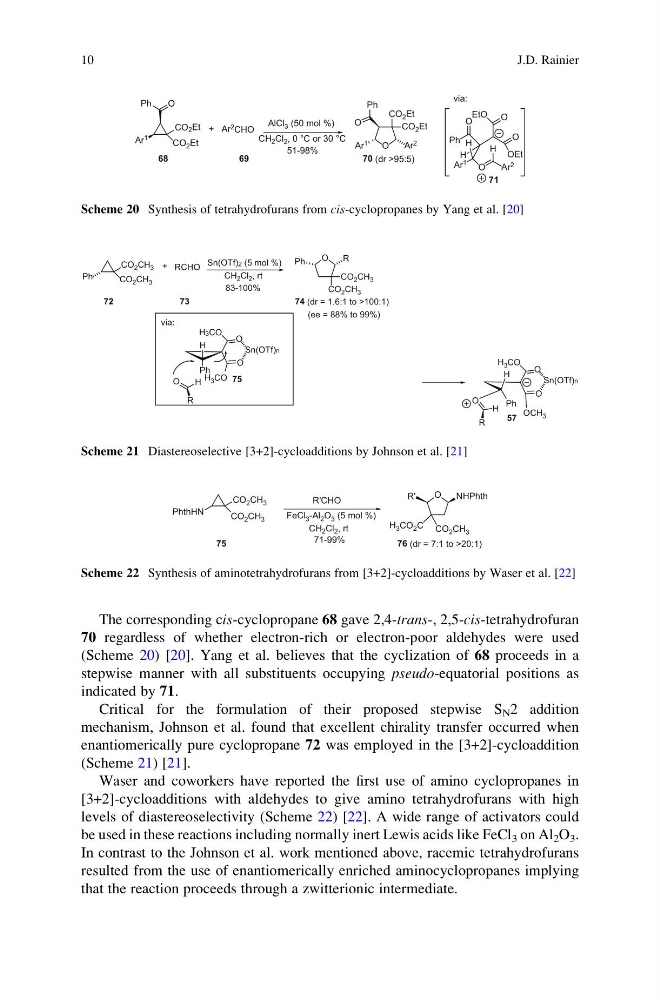
The corresponding cis-cyclopropane 68 gave 2,4-trans-, 2,5-cis-tetrahydrofuran
70 regardless of whether electron-rich or electron-poor aldehydes were used
(Scheme 20) [20]. Yang et al. believes that the cyclization of 68 proceeds in a
stepwise manner with all substituents occupying pseudo-equatorial positions as
indicated by 71.
Critical for the formulation of their proposed stepwise S N 2 addition
mechanism, Johnson et al. found that excellent chirality transfer occurred when
enantiomerically pure cyclopropane 72 was employed in the [3+2]-cycloaddition
(Scheme 21) [21].
Waser and coworkers have reported the first use of amino cyclopropanes in
[3+2]-cycloadditions with aldehydes to give amino tetrahydrofurans with high
levels of diastereoselectivity (Scheme 22) [22]. A wide range of activators could
be used in these reactions including normally inert Lewis acids like FeCl 3 on Al 2 O 3 .
In contrast to the Johnson et al. work mentioned above, racemic tetrahydrofurans
resulted from the use of enantiomerically enriched aminocyclopropanes implying
that the reaction proceeds through a zwitterionic intermediate.
Ar 1
CO 2 Et
CO 2 Et
+ Ar 2 CHO
O
Ar 1
Ar 2
CO 2 Et
CO 2 Et
AlCl 3 (50 mol %)
CH 2 Cl 2 , 0 °C or 30 °C
51-98%
70 (dr >95:5)
68
69
Ph
O
Ph
O
via:
O
Ar 2
H
O
Ph
Ar 1
O
O
EtO
OEt
H
H
71
Scheme 20 Synthesis of tetrahydrofurans from cis-cyclopropanes by Yang et al. [20]
Ph
CO 2 CH 3
CO 2 CH 3
+ RCHO
O
Ph
R
CO 2 CH 3
CO 2 CH 3
Sn(OTf)2 (5 mol %)
CH 2 Cl 2 , rt
83-100%
74 (dr = 1.6:1 to >100:1)
(ee = 88% to 99%)
Ph
H
O
H3CO
O
H 3 CO
Sn(OTf)n
O
R
H
Ph
H
O
H 3 CO
O
OCH 3
Sn(OTf)n
O
R
H
72
73
75
57
via:
Scheme 21 Diastereoselective [3+2]-cycloadditions by Johnson et al. [21]
PhthHN
CO 2 CH 3
CO 2 CH 3
O
R'
NHPhth
CH 2 Cl 2 , rt
71-99%
76 (dr = 7:1 to >20:1)
75
FeCl 3 -Al 2 O 3 (5 mol %)
CO 2 CH 3
H 3 CO 2 C
R'CHO
Scheme 22 Synthesis of aminotetrahydrofurans from [3+2]-cycloadditions by Waser et al. [22]
10
J.D. Rainier
70 regardless of whether electron-rich or electron-poor aldehydes were used
(Scheme 20) [20]. Yang et al. believes that the cyclization of 68 proceeds in a
stepwise manner with all substituents occupying pseudo-equatorial positions as
indicated by 71.
Critical for the formulation of their proposed stepwise S N 2 addition
mechanism, Johnson et al. found that excellent chirality transfer occurred when
enantiomerically pure cyclopropane 72 was employed in the [3+2]-cycloaddition
(Scheme 21) [21].
Waser and coworkers have reported the first use of amino cyclopropanes in
[3+2]-cycloadditions with aldehydes to give amino tetrahydrofurans with high
levels of diastereoselectivity (Scheme 22) [22]. A wide range of activators could
be used in these reactions including normally inert Lewis acids like FeCl 3 on Al 2 O 3 .
In contrast to the Johnson et al. work mentioned above, racemic tetrahydrofurans
resulted from the use of enantiomerically enriched aminocyclopropanes implying
that the reaction proceeds through a zwitterionic intermediate.
Ar 1
CO 2 Et
CO 2 Et
+ Ar 2 CHO
O
Ar 1
Ar 2
CO 2 Et
CO 2 Et
AlCl 3 (50 mol %)
CH 2 Cl 2 , 0 °C or 30 °C
51-98%
70 (dr >95:5)
68
69
Ph
O
Ph
O
via:
O
Ar 2
H
O
Ph
Ar 1
O
O
EtO
OEt
H
H
71
Scheme 20 Synthesis of tetrahydrofurans from cis-cyclopropanes by Yang et al. [20]
Ph
CO 2 CH 3
CO 2 CH 3
+ RCHO
O
Ph
R
CO 2 CH 3
CO 2 CH 3
Sn(OTf)2 (5 mol %)
CH 2 Cl 2 , rt
83-100%
74 (dr = 1.6:1 to >100:1)
(ee = 88% to 99%)
Ph
H
O
H3CO
O
H 3 CO
Sn(OTf)n
O
R
H
Ph
H
O
H 3 CO
O
OCH 3
Sn(OTf)n
O
R
H
72
73
75
57
via:
Scheme 21 Diastereoselective [3+2]-cycloadditions by Johnson et al. [21]
PhthHN
CO 2 CH 3
CO 2 CH 3
O
R'
NHPhth
CH 2 Cl 2 , rt
71-99%
76 (dr = 7:1 to >20:1)
75
FeCl 3 -Al 2 O 3 (5 mol %)
CO 2 CH 3
H 3 CO 2 C
R'CHO
Scheme 22 Synthesis of aminotetrahydrofurans from [3+2]-cycloadditions by Waser et al. [22]
10
J.D. Rainier