

De Clercq et al. [255] and Padwa et al. [155, 156] have used SmI 2 [256] to
induce the ethereal bridge opening of 7-oxanorbornanones. When Na/NH 3 is used
instead, 7-oxanorbornanols are the main products of reduction. Low-valent titanium
salts obtained by mixing TiCl 4 with zinc powder in THF lead mostly to products
of pinacolic coupling [257]. On their side, Cossy et al. [258] have found that
7-oxanorbornanones are reduced into the corresponding 3-hydroxycyclohexanones
by irradiation (low-pressure Hg lamp, quartz vessel) in MeCN in the presence of
Et 3 N. The triplet excited state of the ketone abstracts an electron from the tertiary
amine and forms the corresponding ketyl radical anion that is not tightly bound to
the counterion. Indeed, the triethylaminium radical cation is much larger than other
counterions such as Na
+
, TiCl 3
+ , or SmI 2
+ . This enhances the electron density at the
carbonyl group of the ketyl radical anion making it more prone to β-elimination of
the ethereal moiety of the 7-oxanorbornanone. The photoinduced electron transfer
cannot be done with compounds containing other chromophore than the ketone, but
it tolerates polyfunctionality as this will be illustrated below.
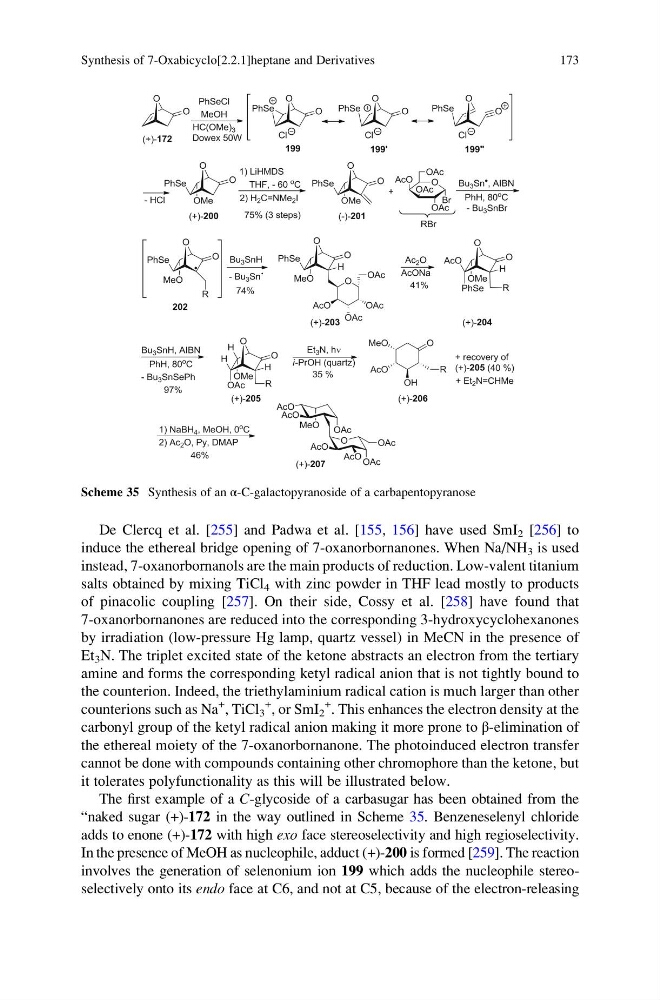
The first example of a C-glycoside of a carbasugar has been obtained from the
“naked sugar (+)-172 in the way outlined in Scheme 35. Benzeneselenyl chloride
adds to enone (+)-172 with high exo face stereoselectivity and high regioselectivity.
In the presence of MeOH as nucleophile, adduct (+)-200 is formed [259]. The reaction
involves the generation of selenonium ion 199 which adds the nucleophile stereoselectively onto its endo face at C6, and not at C5, because of the electron-releasing
Scheme 35 Synthesis of an α-C-galactopyranoside of a carbapentopyranose
Synthesis of 7-Oxabicyclo[2.2.1]heptane and Derivatives
173
induce the ethereal bridge opening of 7-oxanorbornanones. When Na/NH 3 is used
instead, 7-oxanorbornanols are the main products of reduction. Low-valent titanium
salts obtained by mixing TiCl 4 with zinc powder in THF lead mostly to products
of pinacolic coupling [257]. On their side, Cossy et al. [258] have found that
7-oxanorbornanones are reduced into the corresponding 3-hydroxycyclohexanones
by irradiation (low-pressure Hg lamp, quartz vessel) in MeCN in the presence of
Et 3 N. The triplet excited state of the ketone abstracts an electron from the tertiary
amine and forms the corresponding ketyl radical anion that is not tightly bound to
the counterion. Indeed, the triethylaminium radical cation is much larger than other
counterions such as Na
+
, TiCl 3
+ , or SmI 2
+ . This enhances the electron density at the
carbonyl group of the ketyl radical anion making it more prone to β-elimination of
the ethereal moiety of the 7-oxanorbornanone. The photoinduced electron transfer
cannot be done with compounds containing other chromophore than the ketone, but
it tolerates polyfunctionality as this will be illustrated below.
The first example of a C-glycoside of a carbasugar has been obtained from the
“naked sugar (+)-172 in the way outlined in Scheme 35. Benzeneselenyl chloride
adds to enone (+)-172 with high exo face stereoselectivity and high regioselectivity.
In the presence of MeOH as nucleophile, adduct (+)-200 is formed [259]. The reaction
involves the generation of selenonium ion 199 which adds the nucleophile stereoselectively onto its endo face at C6, and not at C5, because of the electron-releasing
Scheme 35 Synthesis of an α-C-galactopyranoside of a carbapentopyranose
Synthesis of 7-Oxabicyclo[2.2.1]heptane and Derivatives
173