

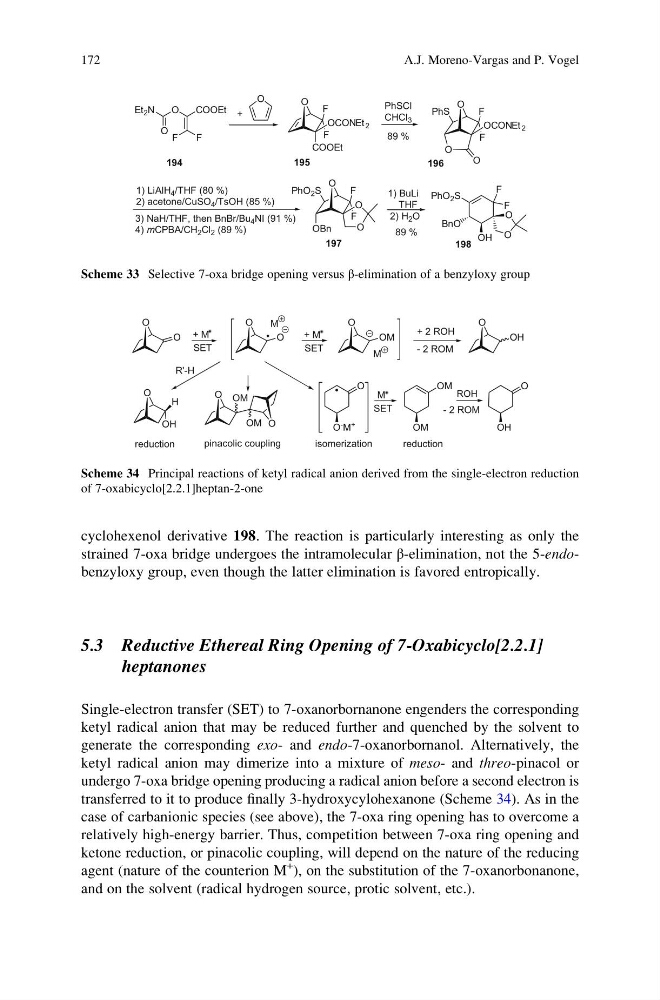
cyclohexenol derivative 198. The reaction is particularly interesting as only the
strained 7-oxa bridge undergoes the intramolecular β-elimination, not the 5-endobenzyloxy group, even though the latter elimination is favored entropically.
5.3 Reductive Ethereal Ring Opening of 7-Oxabicyclo[2.2.1]
heptanones
Single-electron transfer (SET) to 7-oxanorbornanone engenders the corresponding
ketyl radical anion that may be reduced further and quenched by the solvent to
generate the corresponding exo- and endo-7-oxanorbornanol. Alternatively, the
ketyl radical anion may dimerize into a mixture of meso- and threo-pinacol or
undergo 7-oxa bridge opening producing a radical anion before a second electron is
transferred to it to produce finally 3-hydroxycylohexanone (Scheme 34). As in the
case of carbanionic species (see above), the 7-oxa ring opening has to overcome a
relatively high-energy barrier. Thus, competition between 7-oxa ring opening and
ketone reduction, or pinacolic coupling, will depend on the nature of the reducing
agent (nature of the counterion M
+
), on the substitution of the 7-oxanorbonanone,
and on the solvent (radical hydrogen source, protic solvent, etc.).
O
O
O
O
O
OM
O
OH
+ M
SET
+ M
SET
pinacolic coupling
O
OH
H
R'-H
O
- M
+
O
OM
OM
OH
O
M
SET
isomerization
M
M
+ 2 ROH
ROH
- 2 ROM
O
O
OM
OM
- 2 ROM
reduction
reduction
Scheme 34 Principal reactions of ketyl radical anion derived from the single-electron reduction
of 7-oxabicyclo[2.2.1]heptan-2-one
O
F
F
OCONEt 2
COOEt
COOEt
O
Et 2 N
O
F
F
O
O
F
F
OCONEt 2
O
PhS
O
O
F
F
O
OBn
PhO 2 S
O
F
F
O
O
PhO 2 S
BnO
OH
+
194
195
PhSCl
CHCl 3
89 %
196
1) LiAlH 4 /THF (80 %)
2) acetone/CuSO 4 /TsOH (85 %)
3) NaH/THF, then BnBr/Bu 4 NI (91 %)
4) mCPBA/CH 2 Cl 2 (89 %)
197
1) BuLi
THF
2) H 2 O
89 %
198
Scheme 33 Selective 7-oxa bridge opening versus β-elimination of a benzyloxy group
172
A.J. Moreno-Vargas and P. Vogel
strained 7-oxa bridge undergoes the intramolecular β-elimination, not the 5-endobenzyloxy group, even though the latter elimination is favored entropically.
5.3 Reductive Ethereal Ring Opening of 7-Oxabicyclo[2.2.1]
heptanones
Single-electron transfer (SET) to 7-oxanorbornanone engenders the corresponding
ketyl radical anion that may be reduced further and quenched by the solvent to
generate the corresponding exo- and endo-7-oxanorbornanol. Alternatively, the
ketyl radical anion may dimerize into a mixture of meso- and threo-pinacol or
undergo 7-oxa bridge opening producing a radical anion before a second electron is
transferred to it to produce finally 3-hydroxycylohexanone (Scheme 34). As in the
case of carbanionic species (see above), the 7-oxa ring opening has to overcome a
relatively high-energy barrier. Thus, competition between 7-oxa ring opening and
ketone reduction, or pinacolic coupling, will depend on the nature of the reducing
agent (nature of the counterion M
+
), on the substitution of the 7-oxanorbonanone,
and on the solvent (radical hydrogen source, protic solvent, etc.).
O
O
O
O
O
OM
O
OH
+ M
SET
+ M
SET
pinacolic coupling
O
OH
H
R'-H
O
- M
+
O
OM
OM
OH
O
M
SET
isomerization
M
M
+ 2 ROH
ROH
- 2 ROM
O
O
OM
OM
- 2 ROM
reduction
reduction
Scheme 34 Principal reactions of ketyl radical anion derived from the single-electron reduction
of 7-oxabicyclo[2.2.1]heptan-2-one
O
F
F
OCONEt 2
COOEt
COOEt
O
Et 2 N
O
F
F
O
O
F
F
OCONEt 2
O
PhS
O
O
F
F
O
OBn
PhO 2 S
O
F
F
O
O
PhO 2 S
BnO
OH
+
194
195
PhSCl
CHCl 3
89 %
196
1) LiAlH 4 /THF (80 %)
2) acetone/CuSO 4 /TsOH (85 %)
3) NaH/THF, then BnBr/Bu 4 NI (91 %)
4) mCPBA/CH 2 Cl 2 (89 %)
197
1) BuLi
THF
2) H 2 O
89 %
198
Scheme 33 Selective 7-oxa bridge opening versus β-elimination of a benzyloxy group
172
A.J. Moreno-Vargas and P. Vogel