

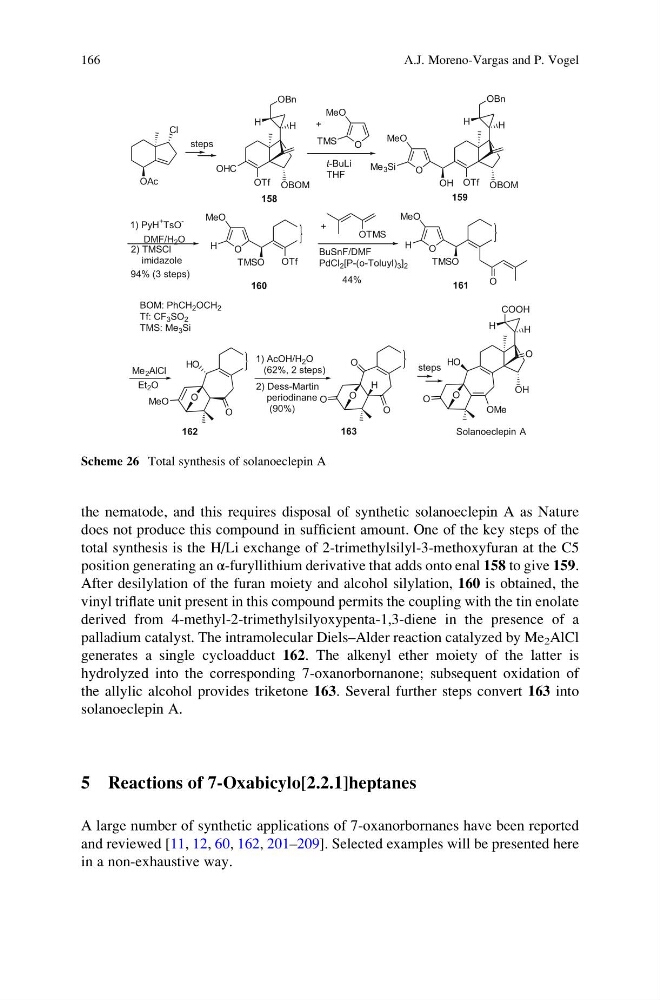
the nematode, and this requires disposal of synthetic solanoeclepin A as Nature
does not produce this compound in sufficient amount. One of the key steps of the
total synthesis is the H/Li exchange of 2-trimethylsilyl-3-methoxyfuran at the C5
position generating an α-furyllithium derivative that adds onto enal 158 to give 159.
After desilylation of the furan moiety and alcohol silylation, 160 is obtained, the
vinyl triflate unit present in this compound permits the coupling with the tin enolate
derived from 4-methyl-2-trimethylsilyoxypenta-1,3-diene in the presence of a
palladium catalyst. The intramolecular Diels–Alder reaction catalyzed by Me 2 AlCl
generates a single cycloadduct 162. The alkenyl ether moiety of the latter is
hydrolyzed into the corresponding 7-oxanorbornanone; subsequent oxidation of
the allylic alcohol provides triketone 163. Several further steps convert 163 into
solanoeclepin A.
5 Reactions of 7-Oxabicylo[2.2.1]heptanes
A large number of synthetic applications of 7-oxanorbornanes have been reported
and reviewed [11, 12, 60, 162, 201–209]. Selected examples will be presented here
in a non-exhaustive way.
OAc
Cl
OTf OBOM
OBn
H
H
OHC
O
MeO
TMS
OTf OBOM
OBn
H
H
O
MeO
Me 3 Si
OH
OTf
O
MeO
H
TMSO
O
MeO
H
TMSO
O
OTMS
O
O
MeO
HO
O
O
O
O
H
Me 2 AlCl
Et 2 O
OMe
O
O
HO
O
OH
COOH
H
H
steps
+
t-BuLi
THF
158
159
1) PyH
+
TsO
-
DMF/H 2 O
2) TMSCl
imidazole
94% (3 steps)
160
161
BuSnF/DMF
PdCl 2 [P-(o-Toluyl) 3 ] 2
+
44%
1) AcOH/H 2 O
(62%, 2 steps)
2) Dess-Martin
periodinane
(90%)
162
163
Solanoeclepin A
steps
BOM: PhCH 2 OCH 2
Tf: CF 3 SO 2
TMS: Me 3 Si
Scheme 26 Total synthesis of solanoeclepin A
166
A.J. Moreno-Vargas and P. Vogel
does not produce this compound in sufficient amount. One of the key steps of the
total synthesis is the H/Li exchange of 2-trimethylsilyl-3-methoxyfuran at the C5
position generating an α-furyllithium derivative that adds onto enal 158 to give 159.
After desilylation of the furan moiety and alcohol silylation, 160 is obtained, the
vinyl triflate unit present in this compound permits the coupling with the tin enolate
derived from 4-methyl-2-trimethylsilyoxypenta-1,3-diene in the presence of a
palladium catalyst. The intramolecular Diels–Alder reaction catalyzed by Me 2 AlCl
generates a single cycloadduct 162. The alkenyl ether moiety of the latter is
hydrolyzed into the corresponding 7-oxanorbornanone; subsequent oxidation of
the allylic alcohol provides triketone 163. Several further steps convert 163 into
solanoeclepin A.
5 Reactions of 7-Oxabicylo[2.2.1]heptanes
A large number of synthetic applications of 7-oxanorbornanes have been reported
and reviewed [11, 12, 60, 162, 201–209]. Selected examples will be presented here
in a non-exhaustive way.
OAc
Cl
OTf OBOM
OBn
H
H
OHC
O
MeO
TMS
OTf OBOM
OBn
H
H
O
MeO
Me 3 Si
OH
OTf
O
MeO
H
TMSO
O
MeO
H
TMSO
O
OTMS
O
O
MeO
HO
O
O
O
O
H
Me 2 AlCl
Et 2 O
OMe
O
O
HO
O
OH
COOH
H
H
steps
+
t-BuLi
THF
158
159
1) PyH
+
TsO
-
DMF/H 2 O
2) TMSCl
imidazole
94% (3 steps)
160
161
BuSnF/DMF
PdCl 2 [P-(o-Toluyl) 3 ] 2
+
44%
1) AcOH/H 2 O
(62%, 2 steps)
2) Dess-Martin
periodinane
(90%)
162
163
Solanoeclepin A
steps
BOM: PhCH 2 OCH 2
Tf: CF 3 SO 2
TMS: Me 3 Si
Scheme 26 Total synthesis of solanoeclepin A
166
A.J. Moreno-Vargas and P. Vogel