

provides 145 after acidic aqueous work-up. The reaction of 145 with BuMgCl
generates the corresponding magnesium alcoholate that is then heated under reflux
in toluene furnishing the cycloadduct 146 in 69 % yield [194]. Removal of the
chiral auxiliary implies first the formation of an enamine, realized by converting the
primary alcohol 146 into the corresponding chloride. The latter eliminates HCl on
treatment with DBU. The enamine so-obtained is hydrolyzed under acidic conditions and liberates lactam 147. The lactam is then converted into the corresponding
ethyl 4-hydroxybutyrate 148, which is etherified as a silyl ether 149. Regioselective
hydroboration of the alkene moiety of 7-oxanorbornene 149 uses a bulky
diakylborane such as disiamylborane. It is controlled by the bulk of the
silyloxymethyl substituent of the bridgehead center. After oxidative workup, alcohols 150 and 151 are isolated in 76 % and 7 % yield, respectively [195].
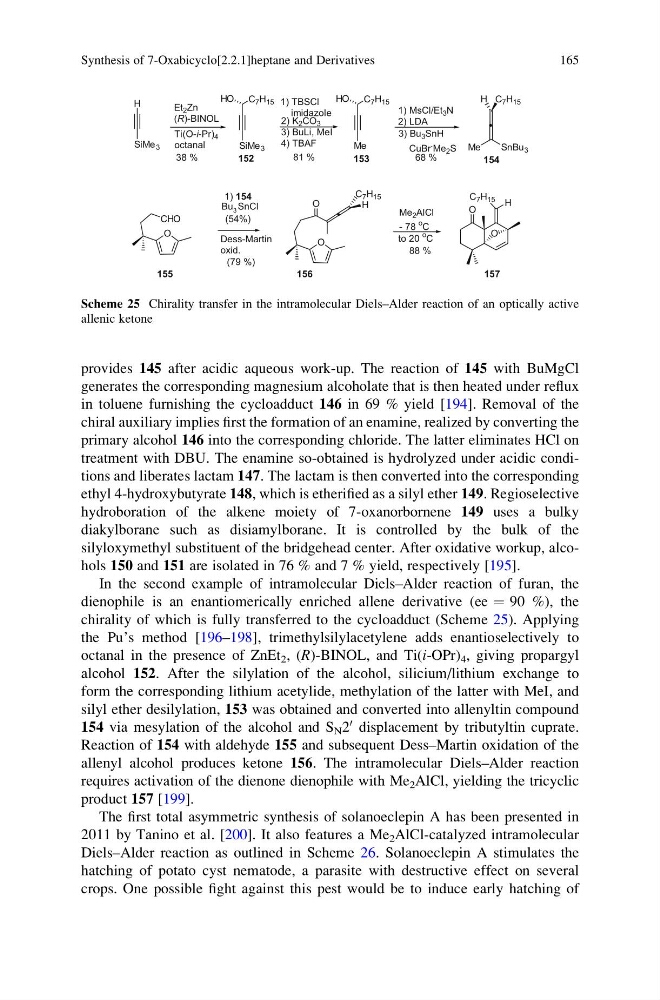
In the second example of intramolecular Diels–Alder reaction of furan, the
dienophile is an enantiomerically enriched allene derivative (ee ¼ 90 %), the
chirality of which is fully transferred to the cycloadduct (Scheme 25). Applying
the Pu’s method [196–198], trimethylsilylacetylene adds enantioselectively to
octanal in the presence of ZnEt 2 , (R)-BINOL, and Ti(i-OPr) 4 , giving propargyl
alcohol 152. After the silylation of the alcohol, silicium/lithium exchange to
form the corresponding lithium acetylide, methylation of the latter with MeI, and
silyl ether desilylation, 153 was obtained and converted into allenyltin compound
154 via mesylation of the alcohol and S N 2
0 displacement by tributyltin cuprate.
Reaction of 154 with aldehyde 155 and subsequent Dess–Martin oxidation of the
allenyl alcohol produces ketone 156. The intramolecular Diels–Alder reaction
requires activation of the dienone dienophile with Me 2 AlCl, yielding the tricyclic
product 157 [199].
The first total asymmetric synthesis of solanoeclepin A has been presented in
2011 by Tanino et al. [200]. It also features a Me 2 AlCl-catalyzed intramolecular
Diels–Alder reaction as outlined in Scheme 26. Solanoeclepin A stimulates the
hatching of potato cyst nematode, a parasite with destructive effect on several
crops. One possible fight against this pest would be to induce early hatching of
H
SiMe 3
SiMe 3
C 7 H 15
HO
Me
C 7 H 15
HO
H C 7 H 15
Me
SnBu 3
O
CHO
O
O
H
C 7 H 15
O
H
C 7 H 15
O
Et 2 Zn
(R)-BINOL
Ti(O-i-Pr) 4
octanal
38 %
1) TBSCl
imidazole
2) K 2 CO 3
3) BuLi, MeI
4) TBAF
1) MsCl/Et 3 N
2) LDA
3) Bu 3 SnH
CuBr
. Me 2 S
68 %
153
152
154
81 %
155
Dess-Martin
oxid.
(79 %)
156
Me 2 AlCl
- 78
o
C
to 20
o
C
88 %
157
1) 154
Bu 3 SnCl
(54%)
Scheme 25 Chirality transfer in the intramolecular Diels–Alder reaction of an optically active
allenic ketone
Synthesis of 7-Oxabicyclo[2.2.1]heptane and Derivatives
165
generates the corresponding magnesium alcoholate that is then heated under reflux
in toluene furnishing the cycloadduct 146 in 69 % yield [194]. Removal of the
chiral auxiliary implies first the formation of an enamine, realized by converting the
primary alcohol 146 into the corresponding chloride. The latter eliminates HCl on
treatment with DBU. The enamine so-obtained is hydrolyzed under acidic conditions and liberates lactam 147. The lactam is then converted into the corresponding
ethyl 4-hydroxybutyrate 148, which is etherified as a silyl ether 149. Regioselective
hydroboration of the alkene moiety of 7-oxanorbornene 149 uses a bulky
diakylborane such as disiamylborane. It is controlled by the bulk of the
silyloxymethyl substituent of the bridgehead center. After oxidative workup, alcohols 150 and 151 are isolated in 76 % and 7 % yield, respectively [195].
In the second example of intramolecular Diels–Alder reaction of furan, the
dienophile is an enantiomerically enriched allene derivative (ee ¼ 90 %), the
chirality of which is fully transferred to the cycloadduct (Scheme 25). Applying
the Pu’s method [196–198], trimethylsilylacetylene adds enantioselectively to
octanal in the presence of ZnEt 2 , (R)-BINOL, and Ti(i-OPr) 4 , giving propargyl
alcohol 152. After the silylation of the alcohol, silicium/lithium exchange to
form the corresponding lithium acetylide, methylation of the latter with MeI, and
silyl ether desilylation, 153 was obtained and converted into allenyltin compound
154 via mesylation of the alcohol and S N 2
0 displacement by tributyltin cuprate.
Reaction of 154 with aldehyde 155 and subsequent Dess–Martin oxidation of the
allenyl alcohol produces ketone 156. The intramolecular Diels–Alder reaction
requires activation of the dienone dienophile with Me 2 AlCl, yielding the tricyclic
product 157 [199].
The first total asymmetric synthesis of solanoeclepin A has been presented in
2011 by Tanino et al. [200]. It also features a Me 2 AlCl-catalyzed intramolecular
Diels–Alder reaction as outlined in Scheme 26. Solanoeclepin A stimulates the
hatching of potato cyst nematode, a parasite with destructive effect on several
crops. One possible fight against this pest would be to induce early hatching of
H
SiMe 3
SiMe 3
C 7 H 15
HO
Me
C 7 H 15
HO
H C 7 H 15
Me
SnBu 3
O
CHO
O
O
H
C 7 H 15
O
H
C 7 H 15
O
Et 2 Zn
(R)-BINOL
Ti(O-i-Pr) 4
octanal
38 %
1) TBSCl
imidazole
2) K 2 CO 3
3) BuLi, MeI
4) TBAF
1) MsCl/Et 3 N
2) LDA
3) Bu 3 SnH
CuBr
. Me 2 S
68 %
153
152
154
81 %
155
Dess-Martin
oxid.
(79 %)
156
Me 2 AlCl
- 78
o
C
to 20
o
C
88 %
157
1) 154
Bu 3 SnCl
(54%)
Scheme 25 Chirality transfer in the intramolecular Diels–Alder reaction of an optically active
allenic ketone
Synthesis of 7-Oxabicyclo[2.2.1]heptane and Derivatives
165