

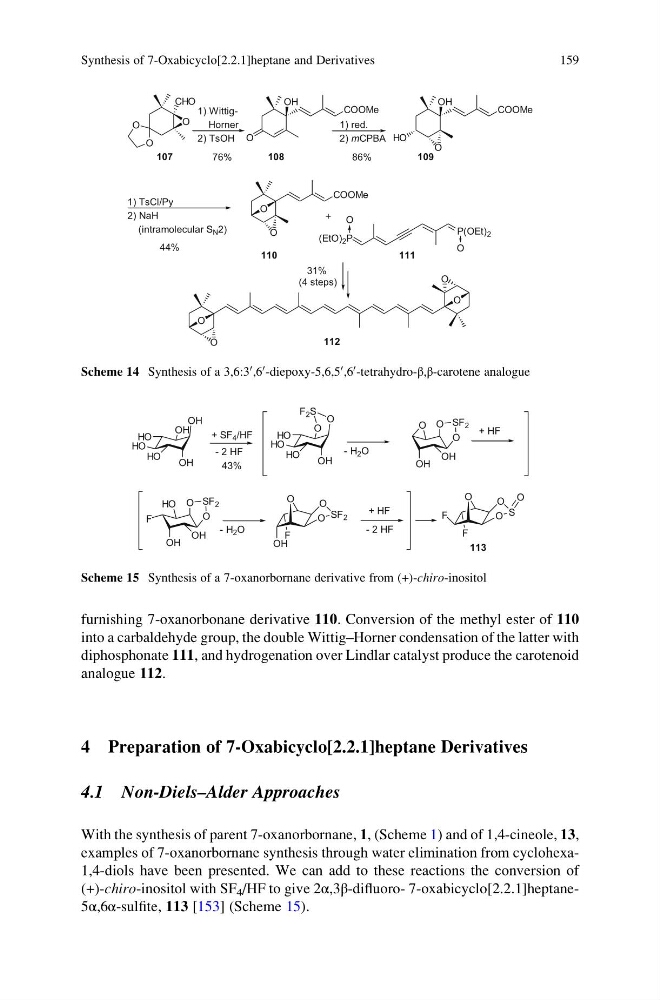
furnishing 7-oxanorbonane derivative 110. Conversion of the methyl ester of 110
into a carbaldehyde group, the double Wittig–Horner condensation of the latter with
diphosphonate 111, and hydrogenation over Lindlar catalyst produce the carotenoid
analogue 112.
4 Preparation of 7-Oxabicyclo[2.2.1]heptane Derivatives
4.1 Non-Diels–Alder Approaches
With the synthesis of parent 7-oxanorbornane, 1, (Scheme 1) and of 1,4-cineole, 13,
examples of 7-oxanorbornane synthesis through water elimination from cyclohexa1,4-diols have been presented. We can add to these reactions the conversion of
(+)-chiro-inositol with SF 4 /HF to give 2α,3β-difluoro- 7-oxabicyclo[2.2.1]heptane5α,6α-sulfite, 113 [153] (Scheme 15).
O
O
O
O
112
O
O
O
CHO
COOMe
O
OH
COOMe
HO
OH
O
COOMe
O
O
(EtO) 2 P
P(OEt) 2
O
O
1) WittigHorner
2) TsOH
1) red.
2) mCPBA
107
108
109
1) TsCl/Py
2) NaH
(intramolecular S N 2)
110
111
76%
86%
44%
31%
(4 steps)
+
Scheme 14 Synthesis of a 3,6:3
0 ,6
0 -diepoxy-5,6,5
0 ,6
0 -tetrahydro-β,β-carotene analogue
O
F
OH
O
O
SF 2
F
O
O
O
S
F
O
HO
HO
OH
OH
OH
HO
HO
HO
O
O
OH
HO
F 2 S
O O
O
SF 2
OH
OH
HO O
O
SF 2
OH
OH
F
- H 2 O
- H 2 O
+ SF 4 /HF
- 2 HF
+ HF
+ HF
113
- 2 HF
43%
Scheme 15 Synthesis of a 7-oxanorbornane derivative from (+)-chiro-inositol
Synthesis of 7-Oxabicyclo[2.2.1]heptane and Derivatives
159
into a carbaldehyde group, the double Wittig–Horner condensation of the latter with
diphosphonate 111, and hydrogenation over Lindlar catalyst produce the carotenoid
analogue 112.
4 Preparation of 7-Oxabicyclo[2.2.1]heptane Derivatives
4.1 Non-Diels–Alder Approaches
With the synthesis of parent 7-oxanorbornane, 1, (Scheme 1) and of 1,4-cineole, 13,
examples of 7-oxanorbornane synthesis through water elimination from cyclohexa1,4-diols have been presented. We can add to these reactions the conversion of
(+)-chiro-inositol with SF 4 /HF to give 2α,3β-difluoro- 7-oxabicyclo[2.2.1]heptane5α,6α-sulfite, 113 [153] (Scheme 15).
O
O
O
O
112
O
O
O
CHO
COOMe
O
OH
COOMe
HO
OH
O
COOMe
O
O
(EtO) 2 P
P(OEt) 2
O
O
1) WittigHorner
2) TsOH
1) red.
2) mCPBA
107
108
109
1) TsCl/Py
2) NaH
(intramolecular S N 2)
110
111
76%
86%
44%
31%
(4 steps)
+
Scheme 14 Synthesis of a 3,6:3
0 ,6
0 -diepoxy-5,6,5
0 ,6
0 -tetrahydro-β,β-carotene analogue
O
F
OH
O
O
SF 2
F
O
O
O
S
F
O
HO
HO
OH
OH
OH
HO
HO
HO
O
O
OH
HO
F 2 S
O O
O
SF 2
OH
OH
HO O
O
SF 2
OH
OH
F
- H 2 O
- H 2 O
+ SF 4 /HF
- 2 HF
+ HF
+ HF
113
- 2 HF
43%
Scheme 15 Synthesis of a 7-oxanorbornane derivative from (+)-chiro-inositol
Synthesis of 7-Oxabicyclo[2.2.1]heptane and Derivatives
159