

moiety of 100 is carbonylated in MeOH/DMF/Bu 3 N, what produces methyl ester
101. Chemoselective dihydroxylation of the acyclic terminal alkene unit of 101,
followed by Malaprade oxidation, provides aldehyde 102 that is then oxidized into
the corresponding carboxylic acid. Hydrolysis of the acetate and methyl ester
moieties finally liberates glycinoeclepin A.
3.6 Carotenoids with 7-Oxabicyclo[2.2.1]heptyl End Groups
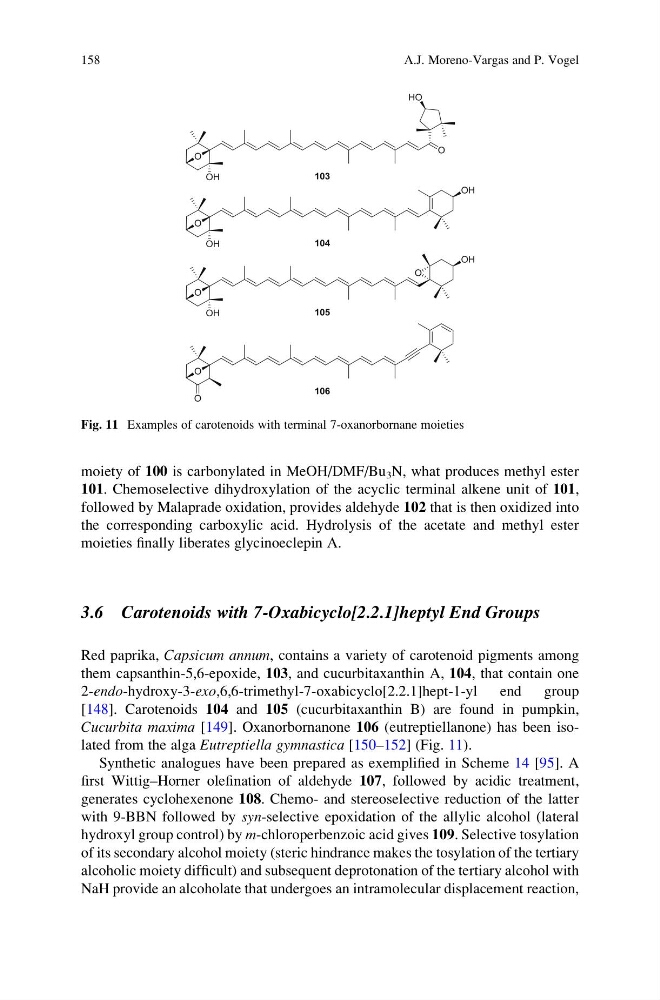
Red paprika, Capsicum annum, contains a variety of carotenoid pigments among
them capsanthin-5,6-epoxide, 103, and cucurbitaxanthin A, 104, that contain one
2-endo-hydroxy-3-exo,6,6-trimethyl-7-oxabicyclo[2.2.1]hept-1-yl
end
group
[148]. Carotenoids 104 and 105 (cucurbitaxanthin B) are found in pumpkin,
Cucurbita maxima [149]. Oxanorbornanone 106 (eutreptiellanone) has been isolated from the alga Eutreptiella gymnastica [150–152] (Fig. 11).
Synthetic analogues have been prepared as exemplified in Scheme 14 [95]. A
first Wittig–Horner olefination of aldehyde 107, followed by acidic treatment,
generates cyclohexenone 108. Chemo- and stereoselective reduction of the latter
with 9-BBN followed by syn-selective epoxidation of the allylic alcohol (lateral
hydroxyl group control) by m-chloroperbenzoic acid gives 109. Selective tosylation
of its secondary alcohol moiety (steric hindrance makes the tosylation of the tertiary
alcoholic moiety difficult) and subsequent deprotonation of the tertiary alcohol with
NaH provide an alcoholate that undergoes an intramolecular displacement reaction,
Fig. 11 Examples of carotenoids with terminal 7-oxanorbornane moieties
158
A.J. Moreno-Vargas and P. Vogel
101. Chemoselective dihydroxylation of the acyclic terminal alkene unit of 101,
followed by Malaprade oxidation, provides aldehyde 102 that is then oxidized into
the corresponding carboxylic acid. Hydrolysis of the acetate and methyl ester
moieties finally liberates glycinoeclepin A.
3.6 Carotenoids with 7-Oxabicyclo[2.2.1]heptyl End Groups
Red paprika, Capsicum annum, contains a variety of carotenoid pigments among
them capsanthin-5,6-epoxide, 103, and cucurbitaxanthin A, 104, that contain one
2-endo-hydroxy-3-exo,6,6-trimethyl-7-oxabicyclo[2.2.1]hept-1-yl
end
group
[148]. Carotenoids 104 and 105 (cucurbitaxanthin B) are found in pumpkin,
Cucurbita maxima [149]. Oxanorbornanone 106 (eutreptiellanone) has been isolated from the alga Eutreptiella gymnastica [150–152] (Fig. 11).
Synthetic analogues have been prepared as exemplified in Scheme 14 [95]. A
first Wittig–Horner olefination of aldehyde 107, followed by acidic treatment,
generates cyclohexenone 108. Chemo- and stereoselective reduction of the latter
with 9-BBN followed by syn-selective epoxidation of the allylic alcohol (lateral
hydroxyl group control) by m-chloroperbenzoic acid gives 109. Selective tosylation
of its secondary alcohol moiety (steric hindrance makes the tosylation of the tertiary
alcoholic moiety difficult) and subsequent deprotonation of the tertiary alcohol with
NaH provide an alcoholate that undergoes an intramolecular displacement reaction,
Fig. 11 Examples of carotenoids with terminal 7-oxanorbornane moieties
158
A.J. Moreno-Vargas and P. Vogel