

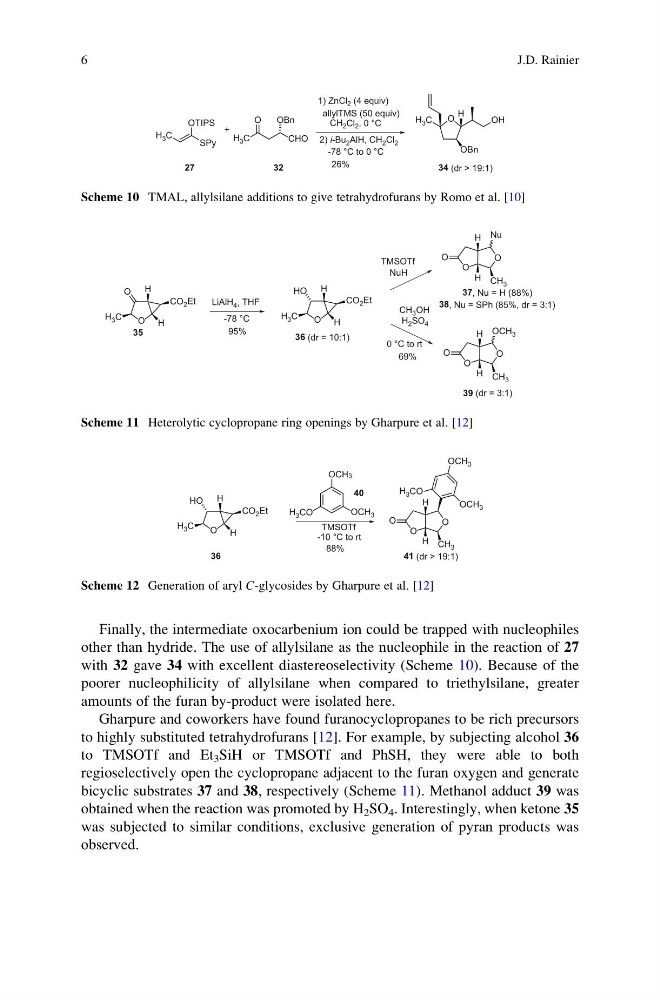
Finally, the intermediate oxocarbenium ion could be trapped with nucleophiles
other than hydride. The use of allylsilane as the nucleophile in the reaction of 27
with 32 gave 34 with excellent diastereoselectivity (Scheme 10). Because of the
poorer nucleophilicity of allylsilane when compared to triethylsilane, greater
amounts of the furan by-product were isolated here.
Gharpure and coworkers have found furanocyclopropanes to be rich precursors
to highly substituted tetrahydrofurans [12]. For example, by subjecting alcohol 36
to TMSOTf and Et 3 SiH or TMSOTf and PhSH, they were able to both
regioselectively open the cyclopropane adjacent to the furan oxygen and generate
bicyclic substrates 37 and 38, respectively (Scheme 11). Methanol adduct 39 was
obtained when the reaction was promoted by H 2 SO 4 . Interestingly, when ketone 35
was subjected to similar conditions, exclusive generation of pyran products was
observed.
O
HO
H 3 C
H
H
CO 2 Et
H 3 CO
OCH 3
OCH3
TMSOTf
88%
O
O
O
CH 3
H 3 CO
OCH 3
OCH 3
-10 °C to rt
36
41 (dr > 19:1)
H
H
40
Scheme 12 Generation of aryl C-glycosides by Gharpure et al. [12]
LiAlH 4 , THF
-78 °C
O
HO
H 3 C
H
H
CO 2 Et
36 (dr = 10:1)
TMSOTf
NuH
O
O
O
Nu
CH 3
37, Nu = H (88%)
38, Nu = SPh (85%, dr = 3:1)
O
O
H 3 C
H
H
CO 2 Et
CH 3 OH
H 2 SO 4
O
O
O
OCH 3
CH 3
39 (dr = 3:1)
69%
0 °C to rt
35
95%
H
H
H
H
Scheme 11 Heterolytic cyclopropane ring openings by Gharpure et al. [12]
SPy
OTIPS
+
H 3 C
O
CHO
OBn
1) ZnCl 2 (4 equiv)
allylTMS (50 equiv)
CH 2 Cl 2 , 0 °C
-78 °C to 0 °C
O
OBn
H
H 3 C
OH
26%
34 (dr > 19:1)
2) i-Bu 2 AlH, CH 2 Cl 2
H 3 C
27
32
Scheme 10 TMAL, allylsilane additions to give tetrahydrofurans by Romo et al. [10]
6
J.D. Rainier
other than hydride. The use of allylsilane as the nucleophile in the reaction of 27
with 32 gave 34 with excellent diastereoselectivity (Scheme 10). Because of the
poorer nucleophilicity of allylsilane when compared to triethylsilane, greater
amounts of the furan by-product were isolated here.
Gharpure and coworkers have found furanocyclopropanes to be rich precursors
to highly substituted tetrahydrofurans [12]. For example, by subjecting alcohol 36
to TMSOTf and Et 3 SiH or TMSOTf and PhSH, they were able to both
regioselectively open the cyclopropane adjacent to the furan oxygen and generate
bicyclic substrates 37 and 38, respectively (Scheme 11). Methanol adduct 39 was
obtained when the reaction was promoted by H 2 SO 4 . Interestingly, when ketone 35
was subjected to similar conditions, exclusive generation of pyran products was
observed.
O
HO
H 3 C
H
H
CO 2 Et
H 3 CO
OCH 3
OCH3
TMSOTf
88%
O
O
O
CH 3
H 3 CO
OCH 3
OCH 3
-10 °C to rt
36
41 (dr > 19:1)
H
H
40
Scheme 12 Generation of aryl C-glycosides by Gharpure et al. [12]
LiAlH 4 , THF
-78 °C
O
HO
H 3 C
H
H
CO 2 Et
36 (dr = 10:1)
TMSOTf
NuH
O
O
O
Nu
CH 3
37, Nu = H (88%)
38, Nu = SPh (85%, dr = 3:1)
O
O
H 3 C
H
H
CO 2 Et
CH 3 OH
H 2 SO 4
O
O
O
OCH 3
CH 3
39 (dr = 3:1)
69%
0 °C to rt
35
95%
H
H
H
H
Scheme 11 Heterolytic cyclopropane ring openings by Gharpure et al. [12]
SPy
OTIPS
+
H 3 C
O
CHO
OBn
1) ZnCl 2 (4 equiv)
allylTMS (50 equiv)
CH 2 Cl 2 , 0 °C
-78 °C to 0 °C
O
OBn
H
H 3 C
OH
26%
34 (dr > 19:1)
2) i-Bu 2 AlH, CH 2 Cl 2
H 3 C
27
32
Scheme 10 TMAL, allylsilane additions to give tetrahydrofurans by Romo et al. [10]
6
J.D. Rainier