

was formed as the major product. When the ether was moved so that it was adjacent
to the ketone, furan formation was no longer a problem (Scheme 6). For example,
tetrahydrofuran 20 was formed when trans-δ-silyloxy-keto-β-lactones 19 was
subjected to TiCl 4 , while 22 came from subjecting the corresponding cis-isomer
21 to the same conditions.
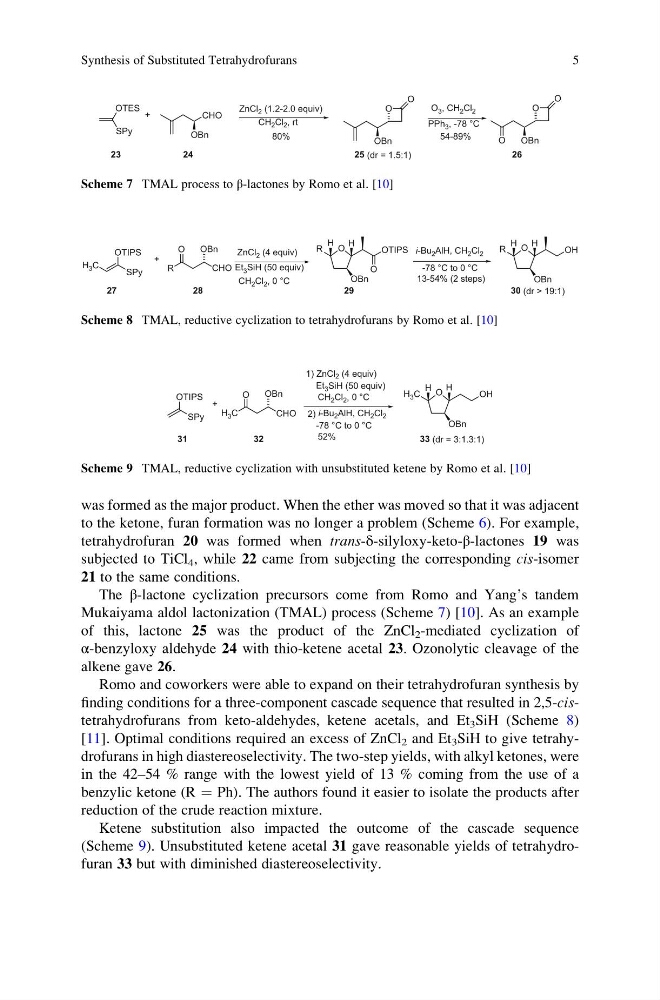
The β-lactone cyclization precursors come from Romo and Yang’s tandem
Mukaiyama aldol lactonization (TMAL) process (Scheme 7) [10]. As an example
of this, lactone 25 was the product of the ZnCl 2 -mediated cyclization of
α-benzyloxy aldehyde 24 with thio-ketene acetal 23. Ozonolytic cleavage of the
alkene gave 26.
Romo and coworkers were able to expand on their tetrahydrofuran synthesis by
finding conditions for a three-component cascade sequence that resulted in 2,5-cistetrahydrofurans from keto-aldehydes, ketene acetals, and Et 3 SiH (Scheme 8)
[11]. Optimal conditions required an excess of ZnCl 2 and Et 3 SiH to give tetrahydrofurans in high diastereoselectivity. The two-step yields, with alkyl ketones, were
in the 42–54 % range with the lowest yield of 13 % coming from the use of a
benzylic ketone (R ¼ Ph). The authors found it easier to isolate the products after
reduction of the crude reaction mixture.
Ketene substitution also impacted the outcome of the cascade sequence
(Scheme 9). Unsubstituted ketene acetal 31 gave reasonable yields of tetrahydrofuran 33 but with diminished diastereoselectivity.
SPy
OTES
+
CHO
OBn
ZnCl 2 (1.2-2.0 equiv)
CH 2 Cl 2 , rt
O
O
OBn
25 (dr = 1.5:1)
80%
O
O
O
OBn
O 3 , CH 2 Cl 2
PPh 3 , -78 °C
54-89%
23
24
26
Scheme 7 TMAL process to β-lactones by Romo et al. [10]
H 3 C
SPy
OTIPS
+
R
O
CHO
OBn
ZnCl 2 (4 equiv)
Et 3 SiH (50 equiv)
CH 2 Cl 2 , 0 °C
O
OBn
H
H
R
i-Bu 2 AlH, CH 2 Cl 2
-78 °C to 0 °C
O
OTIPS
O
OBn
H
H
R
OH
13-54% (2 steps)
27
28
29
30 (dr > 19:1)
Scheme 8 TMAL, reductive cyclization to tetrahydrofurans by Romo et al. [10]
SPy
OTIPS
+
H 3 C
O
CHO
OBn
1) ZnCl 2 (4 equiv)
Et 3 SiH (50 equiv)
CH 2 Cl 2 , 0 °C
-78 °C to 0 °C
O
OBn
H
H
H 3 C
OH
33 (dr = 3:1.3:1)
2) i-Bu 2 AlH, CH 2 Cl 2
31
32
52%
Scheme 9 TMAL, reductive cyclization with unsubstituted ketene by Romo et al. [10]
Synthesis of Substituted Tetrahydrofurans
5
to the ketone, furan formation was no longer a problem (Scheme 6). For example,
tetrahydrofuran 20 was formed when trans-δ-silyloxy-keto-β-lactones 19 was
subjected to TiCl 4 , while 22 came from subjecting the corresponding cis-isomer
21 to the same conditions.
The β-lactone cyclization precursors come from Romo and Yang’s tandem
Mukaiyama aldol lactonization (TMAL) process (Scheme 7) [10]. As an example
of this, lactone 25 was the product of the ZnCl 2 -mediated cyclization of
α-benzyloxy aldehyde 24 with thio-ketene acetal 23. Ozonolytic cleavage of the
alkene gave 26.
Romo and coworkers were able to expand on their tetrahydrofuran synthesis by
finding conditions for a three-component cascade sequence that resulted in 2,5-cistetrahydrofurans from keto-aldehydes, ketene acetals, and Et 3 SiH (Scheme 8)
[11]. Optimal conditions required an excess of ZnCl 2 and Et 3 SiH to give tetrahydrofurans in high diastereoselectivity. The two-step yields, with alkyl ketones, were
in the 42–54 % range with the lowest yield of 13 % coming from the use of a
benzylic ketone (R ¼ Ph). The authors found it easier to isolate the products after
reduction of the crude reaction mixture.
Ketene substitution also impacted the outcome of the cascade sequence
(Scheme 9). Unsubstituted ketene acetal 31 gave reasonable yields of tetrahydrofuran 33 but with diminished diastereoselectivity.
SPy
OTES
+
CHO
OBn
ZnCl 2 (1.2-2.0 equiv)
CH 2 Cl 2 , rt
O
O
OBn
25 (dr = 1.5:1)
80%
O
O
O
OBn
O 3 , CH 2 Cl 2
PPh 3 , -78 °C
54-89%
23
24
26
Scheme 7 TMAL process to β-lactones by Romo et al. [10]
H 3 C
SPy
OTIPS
+
R
O
CHO
OBn
ZnCl 2 (4 equiv)
Et 3 SiH (50 equiv)
CH 2 Cl 2 , 0 °C
O
OBn
H
H
R
i-Bu 2 AlH, CH 2 Cl 2
-78 °C to 0 °C
O
OTIPS
O
OBn
H
H
R
OH
13-54% (2 steps)
27
28
29
30 (dr > 19:1)
Scheme 8 TMAL, reductive cyclization to tetrahydrofurans by Romo et al. [10]
SPy
OTIPS
+
H 3 C
O
CHO
OBn
1) ZnCl 2 (4 equiv)
Et 3 SiH (50 equiv)
CH 2 Cl 2 , 0 °C
-78 °C to 0 °C
O
OBn
H
H
H 3 C
OH
33 (dr = 3:1.3:1)
2) i-Bu 2 AlH, CH 2 Cl 2
31
32
52%
Scheme 9 TMAL, reductive cyclization with unsubstituted ketene by Romo et al. [10]
Synthesis of Substituted Tetrahydrofurans
5