

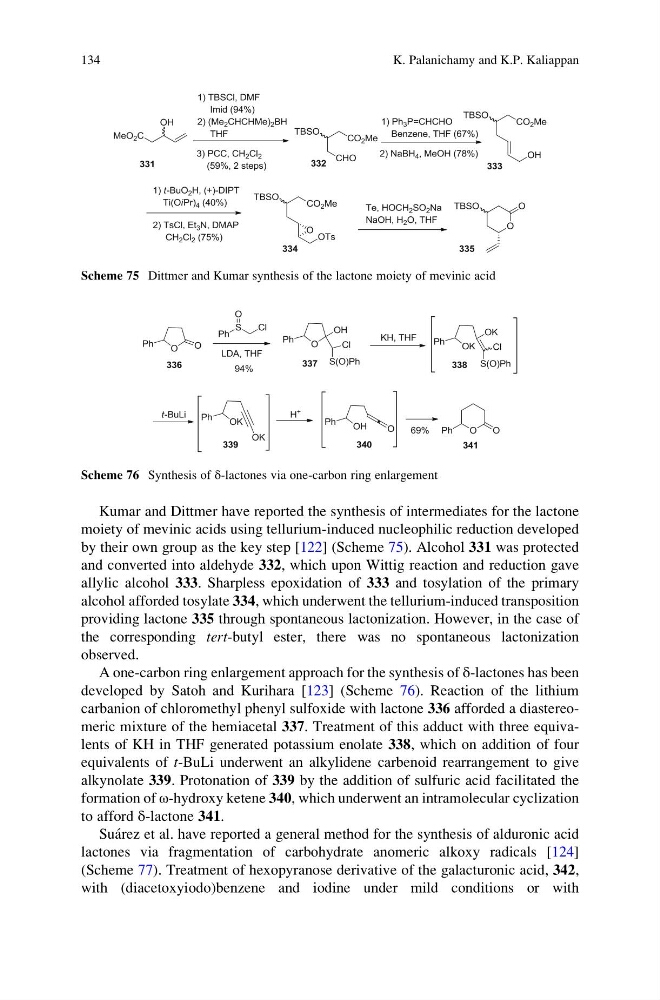
Kumar and Dittmer have reported the synthesis of intermediates for the lactone
moiety of mevinic acids using tellurium-induced nucleophilic reduction developed
by their own group as the key step [122] (Scheme 75). Alcohol 331 was protected
and converted into aldehyde 332, which upon Wittig reaction and reduction gave
allylic alcohol 333. Sharpless epoxidation of 333 and tosylation of the primary
alcohol afforded tosylate 334, which underwent the tellurium-induced transposition
providing lactone 335 through spontaneous lactonization. However, in the case of
the corresponding tert-butyl ester, there was no spontaneous lactonization
observed.
A one-carbon ring enlargement approach for the synthesis of δ-lactones has been
developed by Satoh and Kurihara [123] (Scheme 76). Reaction of the lithium
carbanion of chloromethyl phenyl sulfoxide with lactone 336 afforded a diastereomeric mixture of the hemiacetal 337. Treatment of this adduct with three equivalents of KH in THF generated potassium enolate 338, which on addition of four
equivalents of t-BuLi underwent an alkylidene carbenoid rearrangement to give
alkynolate 339. Protonation of 339 by the addition of sulfuric acid facilitated the
formation of ω-hydroxy ketene 340, which underwent an intramolecular cyclization
to afford δ-lactone 341.
Sua ´rez et al. have reported a general method for the synthesis of alduronic acid
lactones via fragmentation of carbohydrate anomeric alkoxy radicals [124]
(Scheme 77). Treatment of hexopyranose derivative of the galacturonic acid, 342,
with (diacetoxyiodo)benzene and iodine under mild conditions or with
Scheme 75 Dittmer and Kumar synthesis of the lactone moiety of mevinic acid
Scheme 76 Synthesis of δ-lactones via one-carbon ring enlargement
134
K. Palanichamy and K.P. Kaliappan
moiety of mevinic acids using tellurium-induced nucleophilic reduction developed
by their own group as the key step [122] (Scheme 75). Alcohol 331 was protected
and converted into aldehyde 332, which upon Wittig reaction and reduction gave
allylic alcohol 333. Sharpless epoxidation of 333 and tosylation of the primary
alcohol afforded tosylate 334, which underwent the tellurium-induced transposition
providing lactone 335 through spontaneous lactonization. However, in the case of
the corresponding tert-butyl ester, there was no spontaneous lactonization
observed.
A one-carbon ring enlargement approach for the synthesis of δ-lactones has been
developed by Satoh and Kurihara [123] (Scheme 76). Reaction of the lithium
carbanion of chloromethyl phenyl sulfoxide with lactone 336 afforded a diastereomeric mixture of the hemiacetal 337. Treatment of this adduct with three equivalents of KH in THF generated potassium enolate 338, which on addition of four
equivalents of t-BuLi underwent an alkylidene carbenoid rearrangement to give
alkynolate 339. Protonation of 339 by the addition of sulfuric acid facilitated the
formation of ω-hydroxy ketene 340, which underwent an intramolecular cyclization
to afford δ-lactone 341.
Sua ´rez et al. have reported a general method for the synthesis of alduronic acid
lactones via fragmentation of carbohydrate anomeric alkoxy radicals [124]
(Scheme 77). Treatment of hexopyranose derivative of the galacturonic acid, 342,
with (diacetoxyiodo)benzene and iodine under mild conditions or with
Scheme 75 Dittmer and Kumar synthesis of the lactone moiety of mevinic acid
Scheme 76 Synthesis of δ-lactones via one-carbon ring enlargement
134
K. Palanichamy and K.P. Kaliappan