

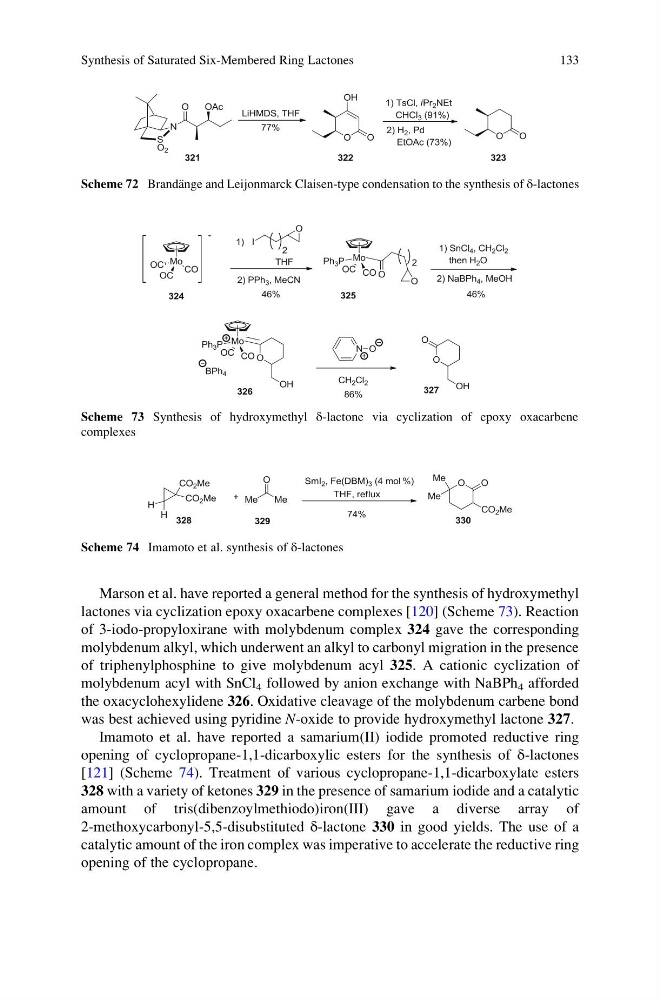
Marson et al. have reported a general method for the synthesis of hydroxymethyl
lactones via cyclization epoxy oxacarbene complexes [120] (Scheme 73). Reaction
of 3-iodo-propyloxirane with molybdenum complex 324 gave the corresponding
molybdenum alkyl, which underwent an alkyl to carbonyl migration in the presence
of triphenylphosphine to give molybdenum acyl 325. A cationic cyclization of
molybdenum acyl with SnCl 4 followed by anion exchange with NaBPh 4 afforded
the oxacyclohexylidene 326. Oxidative cleavage of the molybdenum carbene bond
was best achieved using pyridine N-oxide to provide hydroxymethyl lactone 327.
Imamoto et al. have reported a samarium(II) iodide promoted reductive ring
opening of cyclopropane-1,1-dicarboxylic esters for the synthesis of δ-lactones
[121] (Scheme 74). Treatment of various cyclopropane-1,1-dicarboxylate esters
328 with a variety of ketones 329 in the presence of samarium iodide and a catalytic
amount of tris(dibenzoylmethiodo)iron(III) gave a diverse array of
2-methoxycarbonyl-5,5-disubstituted δ-lactone 330 in good yields. The use of a
catalytic amount of the iron complex was imperative to accelerate the reductive ring
opening of the cyclopropane.
Scheme 72 Branda ¨nge and Leijonmarck Claisen-type condensation to the synthesis of δ-lactones
Scheme 73 Synthesis of hydroxymethyl δ-lactone via cyclization of epoxy oxacarbene
complexes
Scheme 74 Imamoto et al. synthesis of δ-lactones
Synthesis of Saturated Six-Membered Ring Lactones
133
lactones via cyclization epoxy oxacarbene complexes [120] (Scheme 73). Reaction
of 3-iodo-propyloxirane with molybdenum complex 324 gave the corresponding
molybdenum alkyl, which underwent an alkyl to carbonyl migration in the presence
of triphenylphosphine to give molybdenum acyl 325. A cationic cyclization of
molybdenum acyl with SnCl 4 followed by anion exchange with NaBPh 4 afforded
the oxacyclohexylidene 326. Oxidative cleavage of the molybdenum carbene bond
was best achieved using pyridine N-oxide to provide hydroxymethyl lactone 327.
Imamoto et al. have reported a samarium(II) iodide promoted reductive ring
opening of cyclopropane-1,1-dicarboxylic esters for the synthesis of δ-lactones
[121] (Scheme 74). Treatment of various cyclopropane-1,1-dicarboxylate esters
328 with a variety of ketones 329 in the presence of samarium iodide and a catalytic
amount of tris(dibenzoylmethiodo)iron(III) gave a diverse array of
2-methoxycarbonyl-5,5-disubstituted δ-lactone 330 in good yields. The use of a
catalytic amount of the iron complex was imperative to accelerate the reductive ring
opening of the cyclopropane.
Scheme 72 Branda ¨nge and Leijonmarck Claisen-type condensation to the synthesis of δ-lactones
Scheme 73 Synthesis of hydroxymethyl δ-lactone via cyclization of epoxy oxacarbene
complexes
Scheme 74 Imamoto et al. synthesis of δ-lactones
Synthesis of Saturated Six-Membered Ring Lactones
133