

2.4.1 Ring Expansion of Cyclopropanes
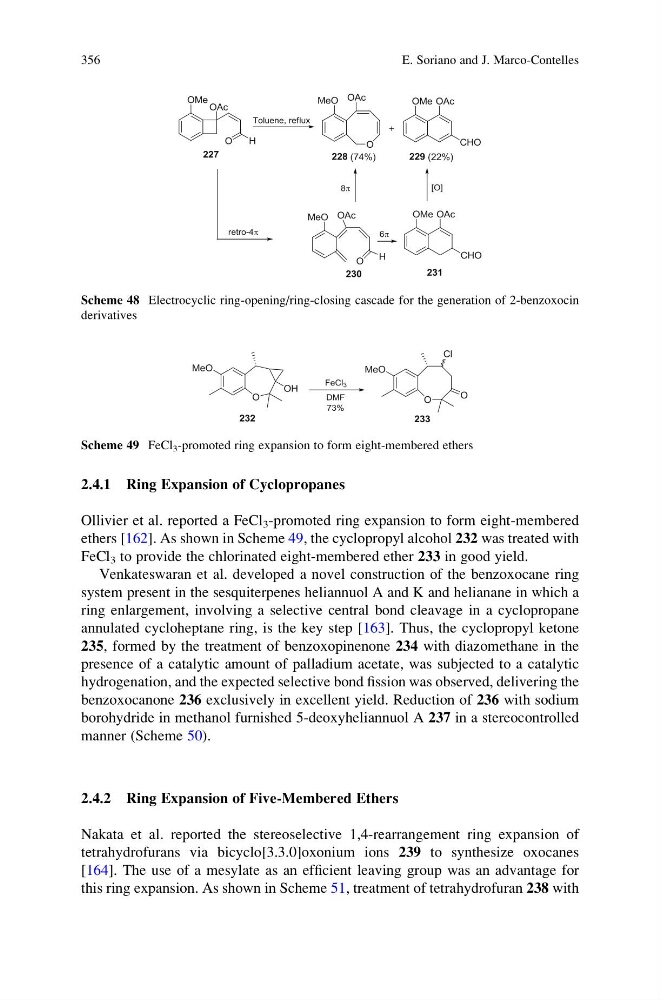
Ollivier et al. reported a FeCl 3 -promoted ring expansion to form eight-membered
ethers [162]. As shown in Scheme 49, the cyclopropyl alcohol 232 was treated with
FeCl 3 to provide the chlorinated eight-membered ether 233 in good yield.
Venkateswaran et al. developed a novel construction of the benzoxocane ring
system present in the sesquiterpenes heliannuol A and K and helianane in which a
ring enlargement, involving a selective central bond cleavage in a cyclopropane
annulated cycloheptane ring, is the key step [163]. Thus, the cyclopropyl ketone
235, formed by the treatment of benzoxopinenone 234 with diazomethane in the
presence of a catalytic amount of palladium acetate, was subjected to a catalytic
hydrogenation, and the expected selective bond fission was observed, delivering the
benzoxocanone 236 exclusively in excellent yield. Reduction of 236 with sodium
borohydride in methanol furnished 5-deoxyheliannuol A 237 in a stereocontrolled
manner (Scheme 50).
2.4.2 Ring Expansion of Five-Membered Ethers
Nakata et al. reported the stereoselective 1,4-rearrangement ring expansion of
tetrahydrofurans via bicyclo[3.3.0]oxonium ions 239 to synthesize oxocanes
[164]. The use of a mesylate as an efficient leaving group was an advantage for
this ring expansion. As shown in Scheme 51, treatment of tetrahydrofuran 238 with
Scheme 48 Electrocyclic ring-opening/ring-closing cascade for the generation of 2-benzoxocin
derivatives
Scheme 49 FeCl 3 -promoted ring expansion to form eight-membered ethers
356
E. Soriano and J. Marco-Contelles
Ollivier et al. reported a FeCl 3 -promoted ring expansion to form eight-membered
ethers [162]. As shown in Scheme 49, the cyclopropyl alcohol 232 was treated with
FeCl 3 to provide the chlorinated eight-membered ether 233 in good yield.
Venkateswaran et al. developed a novel construction of the benzoxocane ring
system present in the sesquiterpenes heliannuol A and K and helianane in which a
ring enlargement, involving a selective central bond cleavage in a cyclopropane
annulated cycloheptane ring, is the key step [163]. Thus, the cyclopropyl ketone
235, formed by the treatment of benzoxopinenone 234 with diazomethane in the
presence of a catalytic amount of palladium acetate, was subjected to a catalytic
hydrogenation, and the expected selective bond fission was observed, delivering the
benzoxocanone 236 exclusively in excellent yield. Reduction of 236 with sodium
borohydride in methanol furnished 5-deoxyheliannuol A 237 in a stereocontrolled
manner (Scheme 50).
2.4.2 Ring Expansion of Five-Membered Ethers
Nakata et al. reported the stereoselective 1,4-rearrangement ring expansion of
tetrahydrofurans via bicyclo[3.3.0]oxonium ions 239 to synthesize oxocanes
[164]. The use of a mesylate as an efficient leaving group was an advantage for
this ring expansion. As shown in Scheme 51, treatment of tetrahydrofuran 238 with
Scheme 48 Electrocyclic ring-opening/ring-closing cascade for the generation of 2-benzoxocin
derivatives
Scheme 49 FeCl 3 -promoted ring expansion to form eight-membered ethers
356
E. Soriano and J. Marco-Contelles