

2.3.5 Pericyclic Reaction
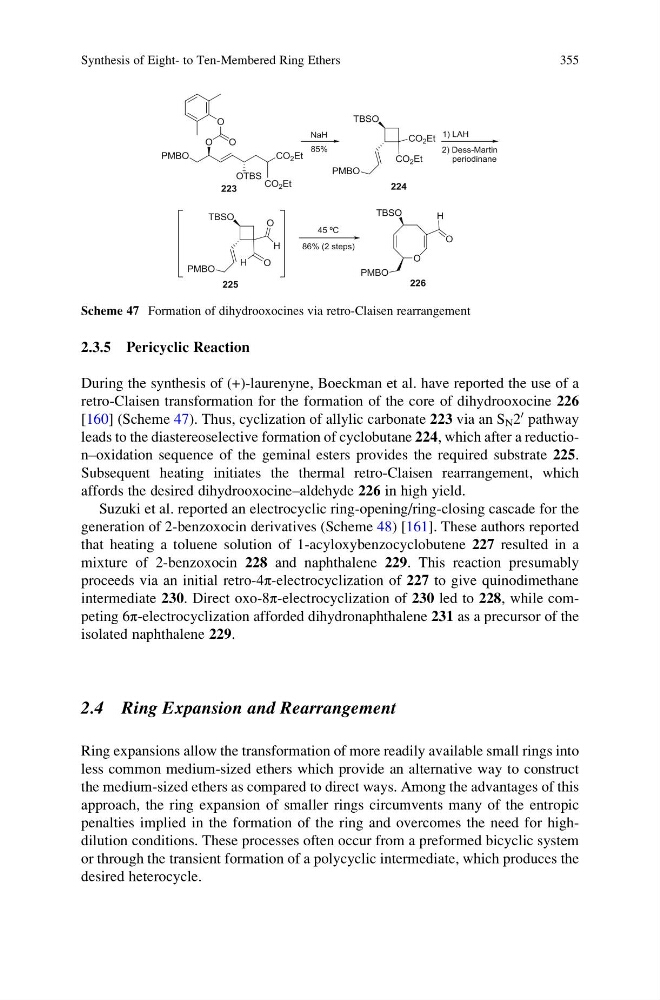
During the synthesis of (+)-laurenyne, Boeckman et al. have reported the use of a
retro-Claisen transformation for the formation of the core of dihydrooxocine 226
[160] (Scheme 47). Thus, cyclization of allylic carbonate 223 via an S N 2
0 pathway
leads to the diastereoselective formation of cyclobutane 224, which after a reduction–oxidation sequence of the geminal esters provides the required substrate 225.
Subsequent heating initiates the thermal retro-Claisen rearrangement, which
affords the desired dihydrooxocine–aldehyde 226 in high yield.
Suzuki et al. reported an electrocyclic ring-opening/ring-closing cascade for the
generation of 2-benzoxocin derivatives (Scheme 48) [161]. These authors reported
that heating a toluene solution of 1-acyloxybenzocyclobutene 227 resulted in a
mixture of 2-benzoxocin 228 and naphthalene 229. This reaction presumably
proceeds via an initial retro-4π-electrocyclization of 227 to give quinodimethane
intermediate 230. Direct oxo-8π-electrocyclization of 230 led to 228, while competing 6π-electrocyclization afforded dihydronaphthalene 231 as a precursor of the
isolated naphthalene 229.
2.4 Ring Expansion and Rearrangement
Ring expansions allow the transformation of more readily available small rings into
less common medium-sized ethers which provide an alternative way to construct
the medium-sized ethers as compared to direct ways. Among the advantages of this
approach, the ring expansion of smaller rings circumvents many of the entropic
penalties implied in the formation of the ring and overcomes the need for highdilution conditions. These processes often occur from a preformed bicyclic system
or through the transient formation of a polycyclic intermediate, which produces the
desired heterocycle.
Scheme 47 Formation of dihydrooxocines via retro-Claisen rearrangement
Synthesis of Eight- to Ten-Membered Ring Ethers
355
During the synthesis of (+)-laurenyne, Boeckman et al. have reported the use of a
retro-Claisen transformation for the formation of the core of dihydrooxocine 226
[160] (Scheme 47). Thus, cyclization of allylic carbonate 223 via an S N 2
0 pathway
leads to the diastereoselective formation of cyclobutane 224, which after a reduction–oxidation sequence of the geminal esters provides the required substrate 225.
Subsequent heating initiates the thermal retro-Claisen rearrangement, which
affords the desired dihydrooxocine–aldehyde 226 in high yield.
Suzuki et al. reported an electrocyclic ring-opening/ring-closing cascade for the
generation of 2-benzoxocin derivatives (Scheme 48) [161]. These authors reported
that heating a toluene solution of 1-acyloxybenzocyclobutene 227 resulted in a
mixture of 2-benzoxocin 228 and naphthalene 229. This reaction presumably
proceeds via an initial retro-4π-electrocyclization of 227 to give quinodimethane
intermediate 230. Direct oxo-8π-electrocyclization of 230 led to 228, while competing 6π-electrocyclization afforded dihydronaphthalene 231 as a precursor of the
isolated naphthalene 229.
2.4 Ring Expansion and Rearrangement
Ring expansions allow the transformation of more readily available small rings into
less common medium-sized ethers which provide an alternative way to construct
the medium-sized ethers as compared to direct ways. Among the advantages of this
approach, the ring expansion of smaller rings circumvents many of the entropic
penalties implied in the formation of the ring and overcomes the need for highdilution conditions. These processes often occur from a preformed bicyclic system
or through the transient formation of a polycyclic intermediate, which produces the
desired heterocycle.
Scheme 47 Formation of dihydrooxocines via retro-Claisen rearrangement
Synthesis of Eight- to Ten-Membered Ring Ethers
355