

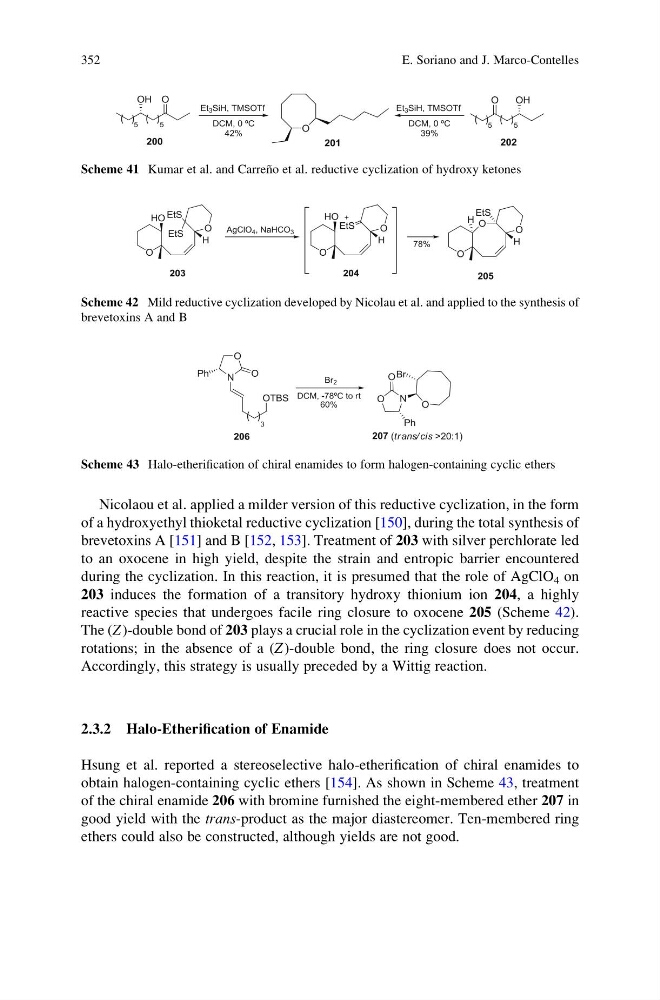
Nicolaou et al. applied a milder version of this reductive cyclization, in the form
of a hydroxyethyl thioketal reductive cyclization [150], during the total synthesis of
brevetoxins A [151] and B [152, 153]. Treatment of 203 with silver perchlorate led
to an oxocene in high yield, despite the strain and entropic barrier encountered
during the cyclization. In this reaction, it is presumed that the role of AgClO 4 on
203 induces the formation of a transitory hydroxy thionium ion 204, a highly
reactive species that undergoes facile ring closure to oxocene 205 (Scheme 42).
The (Z )-double bond of 203 plays a crucial role in the cyclization event by reducing
rotations; in the absence of a (Z)-double bond, the ring closure does not occur.
Accordingly, this strategy is usually preceded by a Wittig reaction.
2.3.2 Halo-Etherification of Enamide
Hsung et al. reported a stereoselective halo-etherification of chiral enamides to
obtain halogen-containing cyclic ethers [154]. As shown in Scheme 43, treatment
of the chiral enamide 206 with bromine furnished the eight-membered ether 207 in
good yield with the trans-product as the major diastereomer. Ten-membered ring
ethers could also be constructed, although yields are not good.
Scheme 41 Kumar et al. and Carren ˜o et al. reductive cyclization of hydroxy ketones
Scheme 42 Mild reductive cyclization developed by Nicolau et al. and applied to the synthesis of
brevetoxins A and B
Scheme 43 Halo-etherification of chiral enamides to form halogen-containing cyclic ethers
352
E. Soriano and J. Marco-Contelles
of a hydroxyethyl thioketal reductive cyclization [150], during the total synthesis of
brevetoxins A [151] and B [152, 153]. Treatment of 203 with silver perchlorate led
to an oxocene in high yield, despite the strain and entropic barrier encountered
during the cyclization. In this reaction, it is presumed that the role of AgClO 4 on
203 induces the formation of a transitory hydroxy thionium ion 204, a highly
reactive species that undergoes facile ring closure to oxocene 205 (Scheme 42).
The (Z )-double bond of 203 plays a crucial role in the cyclization event by reducing
rotations; in the absence of a (Z)-double bond, the ring closure does not occur.
Accordingly, this strategy is usually preceded by a Wittig reaction.
2.3.2 Halo-Etherification of Enamide
Hsung et al. reported a stereoselective halo-etherification of chiral enamides to
obtain halogen-containing cyclic ethers [154]. As shown in Scheme 43, treatment
of the chiral enamide 206 with bromine furnished the eight-membered ether 207 in
good yield with the trans-product as the major diastereomer. Ten-membered ring
ethers could also be constructed, although yields are not good.
Scheme 41 Kumar et al. and Carren ˜o et al. reductive cyclization of hydroxy ketones
Scheme 42 Mild reductive cyclization developed by Nicolau et al. and applied to the synthesis of
brevetoxins A and B
Scheme 43 Halo-etherification of chiral enamides to form halogen-containing cyclic ethers
352
E. Soriano and J. Marco-Contelles