

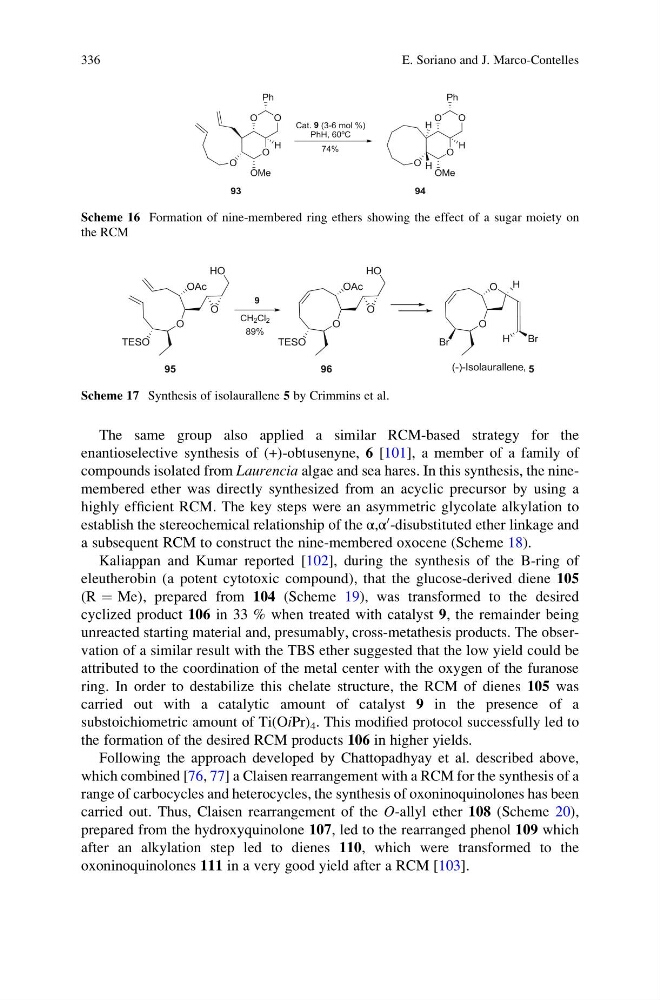
The same group also applied a similar RCM-based strategy for the
enantioselective synthesis of (+)-obtusenyne, 6 [101], a member of a family of
compounds isolated from Laurencia algae and sea hares. In this synthesis, the ninemembered ether was directly synthesized from an acyclic precursor by using a
highly efficient RCM. The key steps were an asymmetric glycolate alkylation to
establish the stereochemical relationship of the α,α
0 -disubstituted ether linkage and
a subsequent RCM to construct the nine-membered oxocene (Scheme 18).
Kaliappan and Kumar reported [102], during the synthesis of the B-ring of
eleutherobin (a potent cytotoxic compound), that the glucose-derived diene 105
(R ¼ Me), prepared from 104 (Scheme 19), was transformed to the desired
cyclized product 106 in 33 % when treated with catalyst 9, the remainder being
unreacted starting material and, presumably, cross-metathesis products. The observation of a similar result with the TBS ether suggested that the low yield could be
attributed to the coordination of the metal center with the oxygen of the furanose
ring. In order to destabilize this chelate structure, the RCM of dienes 105 was
carried out with a catalytic amount of catalyst 9 in the presence of a
substoichiometric amount of Ti(OiPr) 4 . This modified protocol successfully led to
the formation of the desired RCM products 106 in higher yields.
Following the approach developed by Chattopadhyay et al. described above,
which combined [76, 77] a Claisen rearrangement with a RCM for the synthesis of a
range of carbocycles and heterocycles, the synthesis of oxoninoquinolones has been
carried out. Thus, Claisen rearrangement of the O-allyl ether 108 (Scheme 20),
prepared from the hydroxyquinolone 107, led to the rearranged phenol 109 which
after an alkylation step led to dienes 110, which were transformed to the
oxoninoquinolones 111 in a very good yield after a RCM [103].
Scheme 16 Formation of nine-membered ring ethers showing the effect of a sugar moiety on
the RCM
,
Scheme 17 Synthesis of isolaurallene 5 by Crimmins et al.
336
E. Soriano and J. Marco-Contelles
enantioselective synthesis of (+)-obtusenyne, 6 [101], a member of a family of
compounds isolated from Laurencia algae and sea hares. In this synthesis, the ninemembered ether was directly synthesized from an acyclic precursor by using a
highly efficient RCM. The key steps were an asymmetric glycolate alkylation to
establish the stereochemical relationship of the α,α
0 -disubstituted ether linkage and
a subsequent RCM to construct the nine-membered oxocene (Scheme 18).
Kaliappan and Kumar reported [102], during the synthesis of the B-ring of
eleutherobin (a potent cytotoxic compound), that the glucose-derived diene 105
(R ¼ Me), prepared from 104 (Scheme 19), was transformed to the desired
cyclized product 106 in 33 % when treated with catalyst 9, the remainder being
unreacted starting material and, presumably, cross-metathesis products. The observation of a similar result with the TBS ether suggested that the low yield could be
attributed to the coordination of the metal center with the oxygen of the furanose
ring. In order to destabilize this chelate structure, the RCM of dienes 105 was
carried out with a catalytic amount of catalyst 9 in the presence of a
substoichiometric amount of Ti(OiPr) 4 . This modified protocol successfully led to
the formation of the desired RCM products 106 in higher yields.
Following the approach developed by Chattopadhyay et al. described above,
which combined [76, 77] a Claisen rearrangement with a RCM for the synthesis of a
range of carbocycles and heterocycles, the synthesis of oxoninoquinolones has been
carried out. Thus, Claisen rearrangement of the O-allyl ether 108 (Scheme 20),
prepared from the hydroxyquinolone 107, led to the rearranged phenol 109 which
after an alkylation step led to dienes 110, which were transformed to the
oxoninoquinolones 111 in a very good yield after a RCM [103].
Scheme 16 Formation of nine-membered ring ethers showing the effect of a sugar moiety on
the RCM
,
Scheme 17 Synthesis of isolaurallene 5 by Crimmins et al.
336
E. Soriano and J. Marco-Contelles