

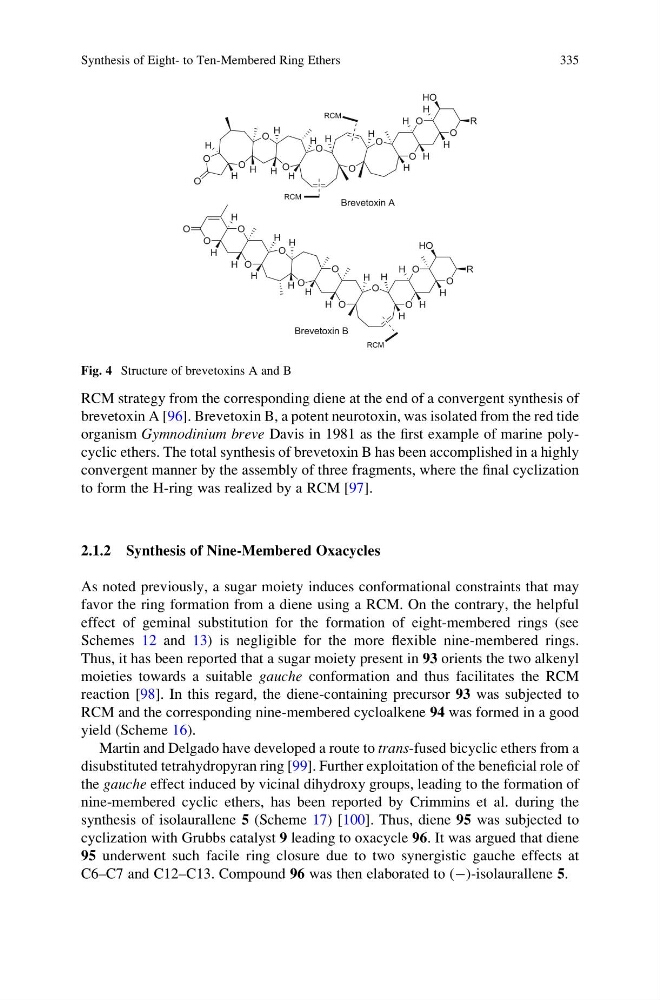
RCM strategy from the corresponding diene at the end of a convergent synthesis of
brevetoxin A [96]. Brevetoxin B, a potent neurotoxin, was isolated from the red tide
organism Gymnodinium breve Davis in 1981 as the first example of marine polycyclic ethers. The total synthesis of brevetoxin B has been accomplished in a highly
convergent manner by the assembly of three fragments, where the final cyclization
to form the H-ring was realized by a RCM [97].
2.1.2 Synthesis of Nine-Membered Oxacycles
As noted previously, a sugar moiety induces conformational constraints that may
favor the ring formation from a diene using a RCM. On the contrary, the helpful
effect of geminal substitution for the formation of eight-membered rings (see
Schemes 12 and 13) is negligible for the more flexible nine-membered rings.
Thus, it has been reported that a sugar moiety present in 93 orients the two alkenyl
moieties towards a suitable gauche conformation and thus facilitates the RCM
reaction [98]. In this regard, the diene-containing precursor 93 was subjected to
RCM and the corresponding nine-membered cycloalkene 94 was formed in a good
yield (Scheme 16).
Martin and Delgado have developed a route to trans-fused bicyclic ethers from a
disubstituted tetrahydropyran ring [99]. Further exploitation of the beneficial role of
the gauche effect induced by vicinal dihydroxy groups, leading to the formation of
nine-membered cyclic ethers, has been reported by Crimmins et al. during the
synthesis of isolaurallene 5 (Scheme 17) [100]. Thus, diene 95 was subjected to
cyclization with Grubbs catalyst 9 leading to oxacycle 96. It was argued that diene
95 underwent such facile ring closure due to two synergistic gauche effects at
C6–C7 and C12–C13. Compound 96 was then elaborated to (À)-isolaurallene 5.
Fig. 4 Structure of brevetoxins A and B
Synthesis of Eight- to Ten-Membered Ring Ethers
335
brevetoxin A [96]. Brevetoxin B, a potent neurotoxin, was isolated from the red tide
organism Gymnodinium breve Davis in 1981 as the first example of marine polycyclic ethers. The total synthesis of brevetoxin B has been accomplished in a highly
convergent manner by the assembly of three fragments, where the final cyclization
to form the H-ring was realized by a RCM [97].
2.1.2 Synthesis of Nine-Membered Oxacycles
As noted previously, a sugar moiety induces conformational constraints that may
favor the ring formation from a diene using a RCM. On the contrary, the helpful
effect of geminal substitution for the formation of eight-membered rings (see
Schemes 12 and 13) is negligible for the more flexible nine-membered rings.
Thus, it has been reported that a sugar moiety present in 93 orients the two alkenyl
moieties towards a suitable gauche conformation and thus facilitates the RCM
reaction [98]. In this regard, the diene-containing precursor 93 was subjected to
RCM and the corresponding nine-membered cycloalkene 94 was formed in a good
yield (Scheme 16).
Martin and Delgado have developed a route to trans-fused bicyclic ethers from a
disubstituted tetrahydropyran ring [99]. Further exploitation of the beneficial role of
the gauche effect induced by vicinal dihydroxy groups, leading to the formation of
nine-membered cyclic ethers, has been reported by Crimmins et al. during the
synthesis of isolaurallene 5 (Scheme 17) [100]. Thus, diene 95 was subjected to
cyclization with Grubbs catalyst 9 leading to oxacycle 96. It was argued that diene
95 underwent such facile ring closure due to two synergistic gauche effects at
C6–C7 and C12–C13. Compound 96 was then elaborated to (À)-isolaurallene 5.
Fig. 4 Structure of brevetoxins A and B
Synthesis of Eight- to Ten-Membered Ring Ethers
335