

compounds and has frequently been utilized to make medium-sized ethers [20,
21]. Several reviews have been published in this area in recent years [22–27].
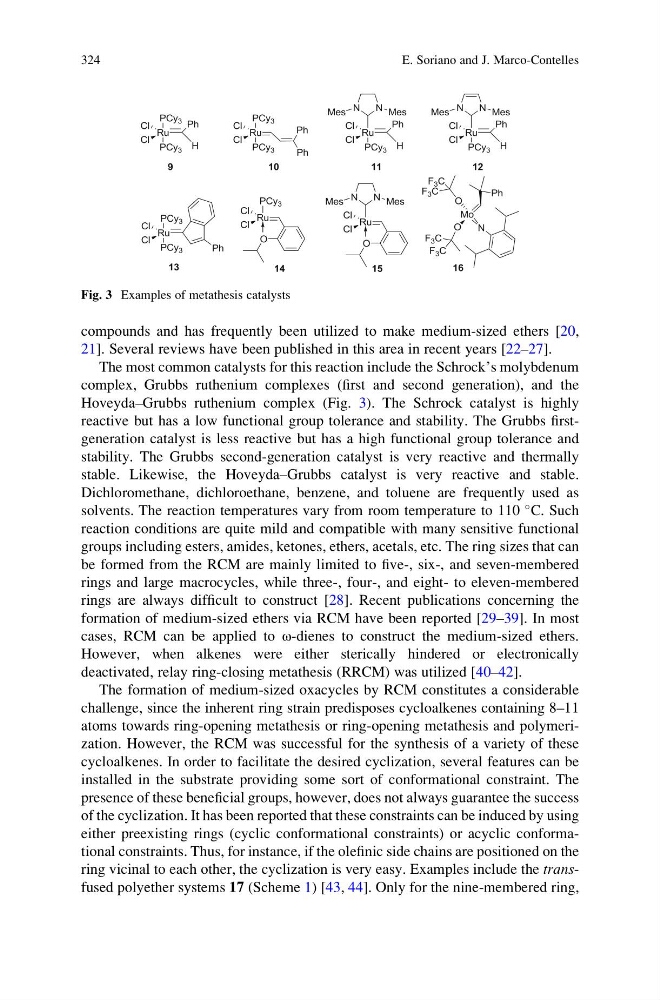
The most common catalysts for this reaction include the Schrock’s molybdenum
complex, Grubbs ruthenium complexes (first and second generation), and the
Hoveyda–Grubbs ruthenium complex (Fig. 3). The Schrock catalyst is highly
reactive but has a low functional group tolerance and stability. The Grubbs firstgeneration catalyst is less reactive but has a high functional group tolerance and
stability. The Grubbs second-generation catalyst is very reactive and thermally
stable. Likewise, the Hoveyda–Grubbs catalyst is very reactive and stable.
Dichloromethane, dichloroethane, benzene, and toluene are frequently used as
solvents. The reaction temperatures vary from room temperature to 110
C. Such
reaction conditions are quite mild and compatible with many sensitive functional
groups including esters, amides, ketones, ethers, acetals, etc. The ring sizes that can
be formed from the RCM are mainly limited to five-, six-, and seven-membered
rings and large macrocycles, while three-, four-, and eight- to eleven-membered
rings are always difficult to construct [28]. Recent publications concerning the
formation of medium-sized ethers via RCM have been reported [29–39]. In most
cases, RCM can be applied to ω-dienes to construct the medium-sized ethers.
However, when alkenes were either sterically hindered or electronically
deactivated, relay ring-closing metathesis (RRCM) was utilized [40–42].
The formation of medium-sized oxacycles by RCM constitutes a considerable
challenge, since the inherent ring strain predisposes cycloalkenes containing 8–11
atoms towards ring-opening metathesis or ring-opening metathesis and polymerization. However, the RCM was successful for the synthesis of a variety of these
cycloalkenes. In order to facilitate the desired cyclization, several features can be
installed in the substrate providing some sort of conformational constraint. The
presence of these beneficial groups, however, does not always guarantee the success
of the cyclization. It has been reported that these constraints can be induced by using
either preexisting rings (cyclic conformational constraints) or acyclic conformational constraints. Thus, for instance, if the olefinic side chains are positioned on the
ring vicinal to each other, the cyclization is very easy. Examples include the transfused polyether systems 17 (Scheme 1) [43, 44]. Only for the nine-membered ring,
Fig. 3 Examples of metathesis catalysts
324
E. Soriano and J. Marco-Contelles
21]. Several reviews have been published in this area in recent years [22–27].
The most common catalysts for this reaction include the Schrock’s molybdenum
complex, Grubbs ruthenium complexes (first and second generation), and the
Hoveyda–Grubbs ruthenium complex (Fig. 3). The Schrock catalyst is highly
reactive but has a low functional group tolerance and stability. The Grubbs firstgeneration catalyst is less reactive but has a high functional group tolerance and
stability. The Grubbs second-generation catalyst is very reactive and thermally
stable. Likewise, the Hoveyda–Grubbs catalyst is very reactive and stable.
Dichloromethane, dichloroethane, benzene, and toluene are frequently used as
solvents. The reaction temperatures vary from room temperature to 110
C. Such
reaction conditions are quite mild and compatible with many sensitive functional
groups including esters, amides, ketones, ethers, acetals, etc. The ring sizes that can
be formed from the RCM are mainly limited to five-, six-, and seven-membered
rings and large macrocycles, while three-, four-, and eight- to eleven-membered
rings are always difficult to construct [28]. Recent publications concerning the
formation of medium-sized ethers via RCM have been reported [29–39]. In most
cases, RCM can be applied to ω-dienes to construct the medium-sized ethers.
However, when alkenes were either sterically hindered or electronically
deactivated, relay ring-closing metathesis (RRCM) was utilized [40–42].
The formation of medium-sized oxacycles by RCM constitutes a considerable
challenge, since the inherent ring strain predisposes cycloalkenes containing 8–11
atoms towards ring-opening metathesis or ring-opening metathesis and polymerization. However, the RCM was successful for the synthesis of a variety of these
cycloalkenes. In order to facilitate the desired cyclization, several features can be
installed in the substrate providing some sort of conformational constraint. The
presence of these beneficial groups, however, does not always guarantee the success
of the cyclization. It has been reported that these constraints can be induced by using
either preexisting rings (cyclic conformational constraints) or acyclic conformational constraints. Thus, for instance, if the olefinic side chains are positioned on the
ring vicinal to each other, the cyclization is very easy. Examples include the transfused polyether systems 17 (Scheme 1) [43, 44]. Only for the nine-membered ring,
Fig. 3 Examples of metathesis catalysts
324
E. Soriano and J. Marco-Contelles