

the development of several strategies for their synthesis in recent years [4, 5].
Several excellent reviews about the medium-sized ether syntheses have been
published already [6–16]. In this chapter, the syntheses of 8-oxocine, 9-oxonene,
and 10-oxocine-membered rings will be reviewed.
2 Methods and Applications
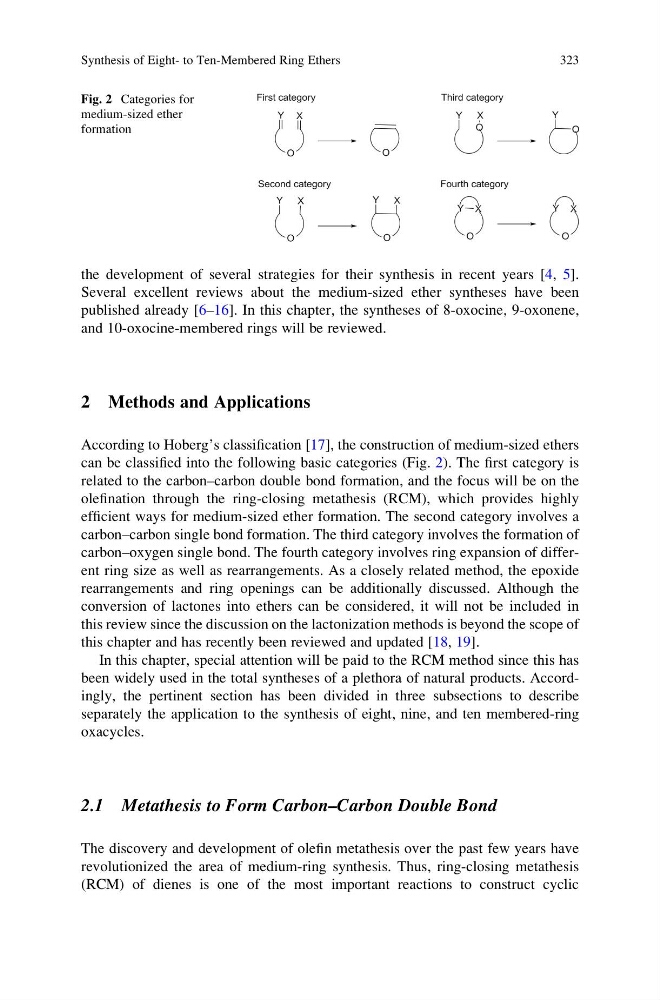
According to Hoberg’s classification [17], the construction of medium-sized ethers
can be classified into the following basic categories (Fig. 2). The first category is
related to the carbon–carbon double bond formation, and the focus will be on the
olefination through the ring-closing metathesis (RCM), which provides highly
efficient ways for medium-sized ether formation. The second category involves a
carbon–carbon single bond formation. The third category involves the formation of
carbon–oxygen single bond. The fourth category involves ring expansion of different ring size as well as rearrangements. As a closely related method, the epoxide
rearrangements and ring openings can be additionally discussed. Although the
conversion of lactones into ethers can be considered, it will not be included in
this review since the discussion on the lactonization methods is beyond the scope of
this chapter and has recently been reviewed and updated [18, 19].
In this chapter, special attention will be paid to the RCM method since this has
been widely used in the total syntheses of a plethora of natural products. Accordingly, the pertinent section has been divided in three subsections to describe
separately the application to the synthesis of eight, nine, and ten membered-ring
oxacycles.
2.1 Metathesis to Form Carbon–Carbon Double Bond
The discovery and development of olefin metathesis over the past few years have
revolutionized the area of medium-ring synthesis. Thus, ring-closing metathesis
(RCM) of dienes is one of the most important reactions to construct cyclic
Fig. 2 Categories for
medium-sized ether
formation
Synthesis of Eight- to Ten-Membered Ring Ethers
323
Several excellent reviews about the medium-sized ether syntheses have been
published already [6–16]. In this chapter, the syntheses of 8-oxocine, 9-oxonene,
and 10-oxocine-membered rings will be reviewed.
2 Methods and Applications
According to Hoberg’s classification [17], the construction of medium-sized ethers
can be classified into the following basic categories (Fig. 2). The first category is
related to the carbon–carbon double bond formation, and the focus will be on the
olefination through the ring-closing metathesis (RCM), which provides highly
efficient ways for medium-sized ether formation. The second category involves a
carbon–carbon single bond formation. The third category involves the formation of
carbon–oxygen single bond. The fourth category involves ring expansion of different ring size as well as rearrangements. As a closely related method, the epoxide
rearrangements and ring openings can be additionally discussed. Although the
conversion of lactones into ethers can be considered, it will not be included in
this review since the discussion on the lactonization methods is beyond the scope of
this chapter and has recently been reviewed and updated [18, 19].
In this chapter, special attention will be paid to the RCM method since this has
been widely used in the total syntheses of a plethora of natural products. Accordingly, the pertinent section has been divided in three subsections to describe
separately the application to the synthesis of eight, nine, and ten membered-ring
oxacycles.
2.1 Metathesis to Form Carbon–Carbon Double Bond
The discovery and development of olefin metathesis over the past few years have
revolutionized the area of medium-ring synthesis. Thus, ring-closing metathesis
(RCM) of dienes is one of the most important reactions to construct cyclic
Fig. 2 Categories for
medium-sized ether
formation
Synthesis of Eight- to Ten-Membered Ring Ethers
323