

6 From Lactones to Oxepins and Oxepenes
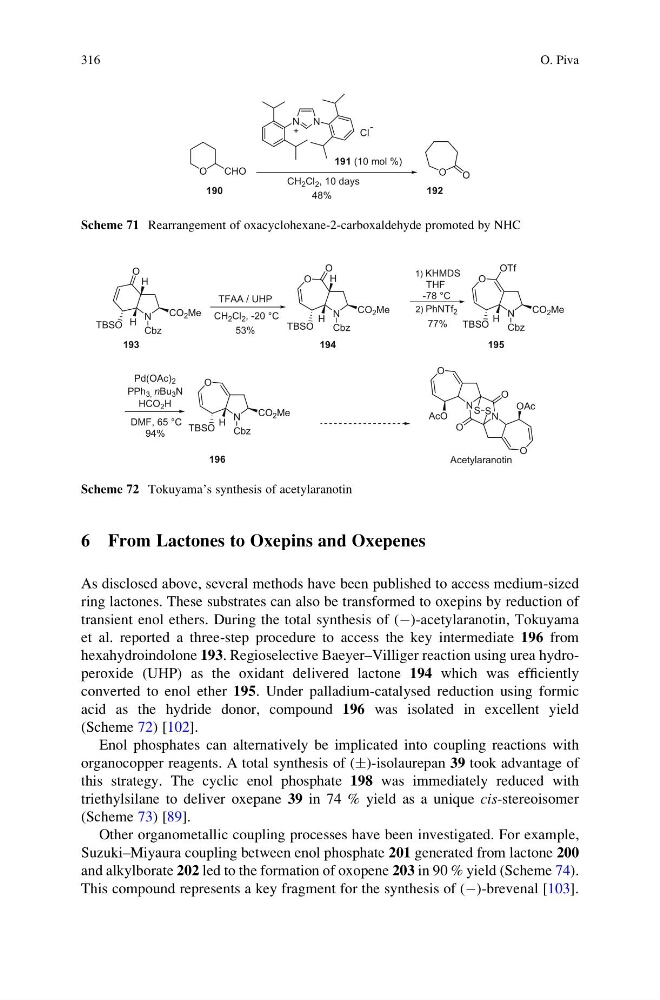
As disclosed above, several methods have been published to access medium-sized
ring lactones. These substrates can also be transformed to oxepins by reduction of
transient enol ethers. During the total synthesis of (À)-acetylaranotin, Tokuyama
et al. reported a three-step procedure to access the key intermediate 196 from
hexahydroindolone 193. Regioselective Baeyer–Villiger reaction using urea hydroperoxide (UHP) as the oxidant delivered lactone 194 which was efficiently
converted to enol ether 195. Under palladium-catalysed reduction using formic
acid as the hydride donor, compound 196 was isolated in excellent yield
(Scheme 72) [102].
Enol phosphates can alternatively be implicated into coupling reactions with
organocopper reagents. A total synthesis of (Æ)-isolaurepan 39 took advantage of
this strategy. The cyclic enol phosphate 198 was immediately reduced with
triethylsilane to deliver oxepane 39 in 74 % yield as a unique cis-stereoisomer
(Scheme 73) [89].
Other organometallic coupling processes have been investigated. For example,
Suzuki–Miyaura coupling between enol phosphate 201 generated from lactone 200
and alkylborate 202 led to the formation of oxopene 203 in 90 % yield (Scheme 74).
This compound represents a key fragment for the synthesis of (À)-brevenal [103].
O
CHO
O
O
192
N N
Cl
191 (10 mol %)
CH 2 Cl 2 , 10 days
+
-
190
48%
Scheme 71 Rearrangement of oxacyclohexane-2-carboxaldehyde promoted by NHC
N
O
TBSO
CO 2 Me
H
H
Cbz
TFAA / UHP
CH 2 Cl 2 , -20 °C
N
CO 2 Me
Cbz
O
O
TBSO
H
H
194
193
53%
N
CO 2 Me
Cbz
O
OTf
TBSO
H
195
1) KHMDS
THF
-78 °C
2) PhNTf 2
77%
N
CO 2 Me
Cbz
O
TBSO
H
196
Pd(OAc) 2
PPh 3, nBu 3 N
HCO 2 H
DMF, 65 °C
94%
N
O
AcO
N
O
O
O
OAc
S S
Acetylaranotin
Scheme 72 Tokuyama’s synthesis of acetylaranotin
316
O. Piva
As disclosed above, several methods have been published to access medium-sized
ring lactones. These substrates can also be transformed to oxepins by reduction of
transient enol ethers. During the total synthesis of (À)-acetylaranotin, Tokuyama
et al. reported a three-step procedure to access the key intermediate 196 from
hexahydroindolone 193. Regioselective Baeyer–Villiger reaction using urea hydroperoxide (UHP) as the oxidant delivered lactone 194 which was efficiently
converted to enol ether 195. Under palladium-catalysed reduction using formic
acid as the hydride donor, compound 196 was isolated in excellent yield
(Scheme 72) [102].
Enol phosphates can alternatively be implicated into coupling reactions with
organocopper reagents. A total synthesis of (Æ)-isolaurepan 39 took advantage of
this strategy. The cyclic enol phosphate 198 was immediately reduced with
triethylsilane to deliver oxepane 39 in 74 % yield as a unique cis-stereoisomer
(Scheme 73) [89].
Other organometallic coupling processes have been investigated. For example,
Suzuki–Miyaura coupling between enol phosphate 201 generated from lactone 200
and alkylborate 202 led to the formation of oxopene 203 in 90 % yield (Scheme 74).
This compound represents a key fragment for the synthesis of (À)-brevenal [103].
O
CHO
O
O
192
N N
Cl
191 (10 mol %)
CH 2 Cl 2 , 10 days
+
-
190
48%
Scheme 71 Rearrangement of oxacyclohexane-2-carboxaldehyde promoted by NHC
N
O
TBSO
CO 2 Me
H
H
Cbz
TFAA / UHP
CH 2 Cl 2 , -20 °C
N
CO 2 Me
Cbz
O
O
TBSO
H
H
194
193
53%
N
CO 2 Me
Cbz
O
OTf
TBSO
H
195
1) KHMDS
THF
-78 °C
2) PhNTf 2
77%
N
CO 2 Me
Cbz
O
TBSO
H
196
Pd(OAc) 2
PPh 3, nBu 3 N
HCO 2 H
DMF, 65 °C
94%
N
O
AcO
N
O
O
O
OAc
S S
Acetylaranotin
Scheme 72 Tokuyama’s synthesis of acetylaranotin
316
O. Piva